
‘Salami slicing’: How China is trying to increase control in the Pacific
‘Salami Slicing’: How China is Expanding Control in the Pacific
Salami slicing – China’s maritime operations have taken a significant leap in recent weeks, with its ships pushing further into contested waters than ever before. These actions, described as “law enforcement” and “research” missions, have involved mapping sensitive seabeds and asserting presence in areas over 500 miles from its shores. Analysts argue that these steps are part of a broader strategy to consolidate territorial claims in the Pacific without triggering full-scale conflict. The approach, termed “salami-slicing,” relies on incremental moves to shape international perceptions and strengthen China’s de facto control over regions where its sovereignty claims are disputed.
The Strategy of Incremental Domination
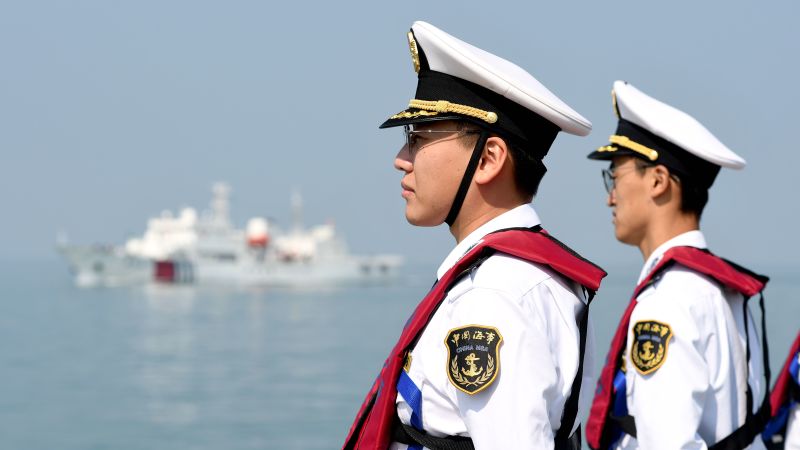
For years, China has been accused of using a slow, calculated strategy to assert dominance in the Pacific. This method involves small, non-confrontational actions that accumulate over time, creating a sense of inevitability for its territorial ambitions. By operating below the threshold of open warfare, Beijing aims to solidify its influence in key regions while avoiding immediate backlash from neighboring countries or global powers. The latest maneuvers, particularly those involving the China Maritime Safety Agency (MSA), are seen as a continuation of this approach.
A Shifting Legal and Political Landscape
The expansion of China’s maritime presence has drawn attention to its legal claims in the South China Sea. The 9-Dash Line, a contentious boundary that encompasses vast areas of the region, has been a focal point of disputes. In 2023, Beijing extended this line to include an additional “dash,” reaching east of Taiwan for the first time. This move was followed by recent actions where MSA vessels ventured beyond the so-called “First Island Chain,” a strategic corridor linking southern Japan to the Philippines and the southern South China Sea. Such activities are not just about territorial control; they are also about political signaling to reinforce China’s authority.
US-China Relations and the Taiwan Factor
The timing of these maneuvers coincides with a pivotal moment in US-China relations. During a recent visit to Beijing by US President Donald Trump, the two leaders exchanged warm greetings, but the visit also underscored the importance of Taiwan in the broader geopolitical context. Chinese leader Xi Jinping made it clear that Taiwan remains a critical issue, with the potential to disrupt bilateral ties. Analysts suggest that the recent MSA operations are designed to pressure Taiwan while maintaining the appearance of peaceful expansion.
The Bashi Channel Breakout
One of the most notable recent actions involved three MSA vessels navigating the Bashi Channel, a narrow waterway between the Philippines and Taiwan. This marked the first time MSA ships had been observed operating east of the First Island Chain, a move analysts describe as the “Bashi Breakout.” According to Ray Powell, director of the SeaLight project at Stanford University’s Gordian Knot Center for National Security Innovation, the maneuver was a clear assertion of Beijing’s claim to jurisdiction over waters traditionally considered beyond its reach. “This is a major step in defining China’s maritime boundaries,” Powell told CNN, highlighting the strategic implications.
“Beijing is essentially saying we have jurisdiction over this area on the other side of the First Island Chain. That’s pretty significant,” Powell added.
Powell also pointed out that the MSA’s activities represent a shift in China’s tactics. While the People’s Liberation Army Navy has historically conducted exercises in the region, the MSA’s focus on policing and governance may pose a more persistent threat. Their operations seem less provocative, making it easier to justify their presence as routine rather than aggressive.
Legal Significance and Political Messaging
The MSA’s movements have been framed by China’s state-run Global Times as a “sovereignty declaration” with both legal and political weight. The article emphasized that the actions were intended to counter foreign skepticism about China’s ability to enforce its claims. By mapping the seabed east of Taiwan, the agency aimed to demonstrate its authority over these waters. “The waters east of Taiwan Island will constitute our ‘nearshore waters’ — the very waters where we maintain a presence and exercise jurisdiction and governance,” the Global Times stated in a social media post.
Taiwan’s Response and Concerns
Taiwan’s leaders have not remained silent on the issue. President Lai Ching-te asserted that Beijing’s objectives are transparent: to “expand” its influence over the island. A Taiwanese security official noted that the MSA’s operations are part of a coordinated effort to project an image of stability while advancing territorial ambitions. “They are creating a false impression that they have de facto jurisdiction over Taiwan,” the official said, underscoring the concern that these moves could erode Taiwan’s sense of autonomy.
“China’s threats towards Taiwan know no limits,” Lai said during a recent press briefing.
Analysts also highlight the broader implications for the Indo-Pacific region. While China’s expansion is primarily focused on the South China Sea, the move to assert control over waters east of Taiwan signals a growing ambition to dominate the entire western Pacific. This could threaten the balance of power in the region, particularly for smaller nations that lack the resources to challenge China’s growing influence.
Historical Context of the 9-Dash Line
The 9-Dash Line, originally a set of nine dashes outlining China’s claims in the South China Sea, has been a source of international contention. In 2016, the Permanent Court of Arbitration in The Hague ruled that China’s claims had no legal basis under international law. Despite this, Beijing has continued to refine and expand its maritime boundaries. The addition of a 10th dash in 2023, which now includes waters east of Taiwan, represents a strategic redefinition of its territorial reach.
The Role of Soft Power and Information Campaigns
China’s approach extends beyond military actions, incorporating soft power tactics to shape global perceptions. The semi-official Yuyuan Tantian social media account, operated by the national broadcaster, has been used to disseminate information about the MSA’s activities. This serves as a way to gauge international reactions and build support for China’s claims. By emphasizing the “new facts on the water,” Beijing aims to legitimize its presence in the region, even as legal disputes persist.
Implications for Regional Stability
As China continues to assert its dominance through these incremental steps, the implications for regional stability are profound. While the MSA’s actions may appear less threatening than naval exercises, their cumulative effect could redefine the geopolitical landscape. Countries in the Indo-Pacific, including Taiwan, face increasing pressure to align with Beijing’s vision of maritime order. Analysts warn that this strategy could eventually lead to more aggressive moves, forcing a reevaluation of existing alliances and commitments.
