
Is Trump celebrating the country, or himself, on America’s 250th?
A Self-Portrait of National Pride: Trump’s 250th Anniversary Speech Sparks Debate
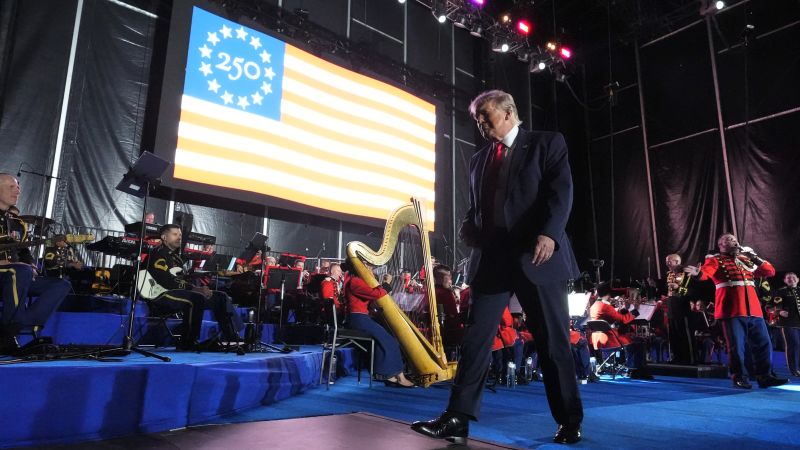
Is Trump celebrating the country or himself – On Wednesday night, as the nation’s 250-year journey appeared momentarily suspended, President Donald Trump launched a spectacle to commemorate America’s semi-quincentennial. The event, held on the National Mall, was marked by a dramatic display of military jets and a patriotic performance by the ‘President’s own’ Marine Band. Trump’s address, framed as a tribute to the country’s enduring strength at this historic juncture, was largely attributed to his leadership, according to the president himself. Yet, the message was far from universal, raising questions about whether the celebration was more about personal legacy than collective progress.
The Spectacle and the Message
As military jets streaked across the National Mall, the stage was set for a theatrical rendition of American history. Trump’s speech, delivered under the glow of a meticulously arranged backdrop, began with a nod to the Declaration of Independence. But instead of reflecting on the ideals of 1776, the president quickly pivoted to the present, declaring, “America is back” and asserting that his administration had revived a nation on the brink of collapse. The tone was unmistakably self-centered, with a litany of achievements — real or exaggerated — contrasted against the “total disaster” of the Biden era.
“We have taken power back from the far-off political class,” Trump said, echoing the language of revolution. “We have reclaimed our strength.”
While many Americans would concede that Trump’s policies, such as the southern border security measures and the new tax-cutting legislation, have garnered significant support among his base, the broader implications of the event were less clear. The president’s emphasis on individual triumph over collective effort seemed to overshadow the nation’s long arc of growth and resilience. Critics argued that the celebration was less about honoring the country’s founding principles and more about positioning Trump as the central figure in its modern narrative.
A Nation in Transition: Approval Ratings and Public Sentiment
Despite the grandeur of the event, Trump’s approval rating stood at a disheartening 36% in the latest CNN Poll of Polls. This figure, which indicates that a majority of citizens oppose him, came at a time when the United States was celebrating its 250th birthday. The irony was not lost on observers, who noted that the president’s focus on his own legacy seemed particularly jarring amid a climate of public discontent.
“As Americans come together to celebrate the 250th anniversary of the nation’s founding, Donald Trump is doing what he does best: blowing money on flashy, Trump-themed events while forcing Americans to foot the bill,” said Ken Martin, the Democratic National Committee chair.
Martin’s critique highlighted a recurring theme in the debate over the event’s purpose. While the nation’s founding was a unifying moment, Trump’s approach to the occasion appeared to prioritize personal recognition over shared history. His speech, though delivered with the flair of a showman, left many wondering whether the celebration of America’s past was a means to an end — or if it was an end in itself.
From Founding to Present: A Fast-Forward Narrative
Trump’s address began with a reverent acknowledgment of the Declaration of Independence, a document that symbolizes the birth of American democracy. However, the president’s narrative quickly shifted from historical reflection to a modern-day triumph. He described the nation as “dead” just two years prior, claiming that his leadership had resurrected it. This framing of history as a linear path from decline to revival underscored his belief in a singular, transformative role.
During the speech, Trump enumerated a series of accomplishments, many of which were met with applause from his loyal supporters. Yet, the manner in which these achievements were presented raised eyebrows. For instance, he highlighted the nation’s military strength, a point that resonated with many, but also drew criticism for downplaying the complexities of contemporary conflicts. His remarks on the war in Iran, while popular with some, were seen by others as an example of his tendency to simplify complex issues into bold, decisive actions.
Divides and Dominance: A Test of Unity
The event’s ability to bridge political divides was put to the test. While Trump’s supporters celebrated the speech as a victory, the broader public’s reaction was mixed. Millions of Americans, who are not MAGA voters, were left questioning whether the celebration of the country’s 250th anniversary was a platform for national unity or a stage for personal acclaim.
Trump’s speech also drew sharp criticism for its tone. By comparing himself to the revolutionary founders, the president invoked a sense of historical destiny. However, his insistence on monarchical authority, with references to “power grabs” and “tyranny,” contrasted sharply with the democratic ideals of the nation’s founders. This duality — between the president’s portrayal of himself as a savior and his critics’ view of him as a disruptor — underscored the deepening political rifts.
Legacy and Leadership: A Double-Edged Celebration
While the event was a showcase of Trump’s influence, it also revealed the polarizing nature of his leadership. The president’s decision to host the Great American State Fair, despite backlash from artists who felt the event had become politicized, highlighted his strategy of turning every moment into a platform for his message. The rally that followed, with its emphasis on his policies and personal achievements, further cemented his focus on self-promotion.
Trump’s remarks about the southern border and the tax-cutting law were met with enthusiasm by his base, but these policies also sparked debate among those who questioned their long-term impact. Similarly, his campaign against diversity, equity, and inclusion programs was seen by some as a bold statement of cultural values, while others viewed it as an attack on progressive ideals. Even the physical changes to the National Mall, such as the proposed triumphal arch and the renovation of the Reflecting Pool, were emblematic of his approach to shaping the nation’s narrative through spectacle.
Yet, the speech was not without its moments of national pride. Trump’s praise for the military, a theme that resonated across ideological lines, reminded audiences of the country’s global standing. This bipartisan appeal was further emphasized by the presence of some Washington, DC residents, who, despite the city’s liberal leanings, appreciated his efforts to enhance public safety and streamline urban development.
What’s Next? A President’s Ambitions
Trump’s celebration was not the final word on America’s 250th anniversary. He hinted at a continued effort to redefine the nation’s story, stating that his “favorite president” would speak on the Mall on July Fourth. This suggestion raised questions about whether the event was a single moment of reflection or part of a broader campaign to shape historical memory in his favor.
For now, the event’s success was measured by the warmth of the crowd. Trump’s supporters, many of whom felt marginalized by the political system, found validation in his words. But the true test of the celebration’s impact would be how it resonated with those who do not share his vision. As the nation’s history unfolded, the debate over whether Trump was honoring his country or his own legacy remained unresolved.
“Just like those patriots of 1776 over the past 17 months, we have taken power back from the far-off political class,” Trump said, weaving a narrative that equated his presidency with the revolutionary spirit. This rhetoric, while powerful, also exposed the tension between his vision of America and the diverse perspectives that define the country’s ongoing evolution. As the festivities concluded, the question lingered: Would this celebration mark a turning point in the nation’s story, or merely a chapter in the president’s own saga?
