
How smartphones and the New York Knicks created Brooklyn’s biggest block party
How Smartphones and the New York Knicks Crafted Brooklyn’s Most Vibrant Block Party
The Metaphysical Watch Parties
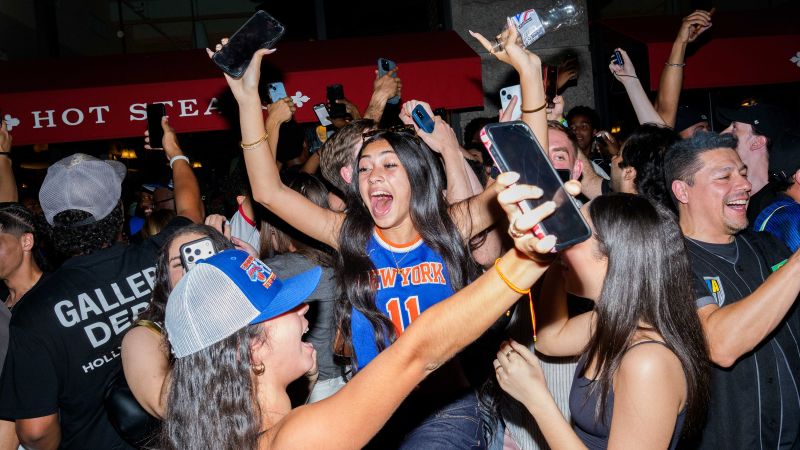
How smartphones and the New York – As the Eastern Conference Finals unfolded early in the season, the New York Knicks’ improbable resurgence began to reshape the way fans experienced the game. What started as a series of comebacks and dominant performances turned into a cultural phenomenon, with the city’s sports scene transformed by the omnipresence of smartphones. Official watch parties outside Madison Square Garden, once simple gatherings of supporters, became living examples of how technology blurs the line between observation and participation. Crowds, now equipped with their own screens, turned the act of watching into a performative spectacle, creating a feedback loop that amplified the game’s intensity.
At the heart of this transformation were semi-professional streamers, whose setups—complete with gimbals and camera rigs—elevated mundane moments into curated content. These individuals encouraged exaggerated gestures and choreographed interactions, drawing in bystanders who eagerly pulled out their phones to join the fray. The result was a strange, self-reinforcing cycle: every fan’s action was filmed, every filmed moment sought viral traction, and every viral clip became a catalyst for more anticipation. It felt as if the city itself had become a stage, with smartphones acting as both cameras and mirrors, reflecting the collective joy and confusion of the moment.
“It was like a snake eating its own tail—every fan’s contribution to the narrative was both a cause and a consequence of the next wave of attention,”
the author mused, capturing the surreal quality of the scene. The stakes were high, as the Knicks’ success could unlock lucrative partnerships with prediction markets, turning casual observers into potential influencers. Yet, the spectacle wasn’t just about profit; it was about connection. The city, long starved for triumph, found itself momentarily united in the glow of screens, each device a portal to the same shared experience.
A Century of Longing
The Knicks’ journey to the Eastern Conference Finals was more than a sports story—it was a generational reckoning. For over a century, the team had been a symbol of hope and heartbreak, with fans growing up in the shadow of its struggles. The last time the city celebrated a Knicks championship was in 1973, a moment etched into the memories of those who had followed the team as children. Now, as the same fans aged into parents and grandparents, they watched a new generation take up the mantle, their excitement a bridge across decades of waiting.
Each win brought fresh layers of visual proof that the Knicks had become more than a franchise; they were a collective identity. The videos capturing these victories felt like fragments of a larger narrative, blending the raw energy of the crowd with the precision of smartphone lenses. Yet, this new era of observation carried a quiet irony. The very act of watching—mediated by screens and social media—altered the experience, creating a kind of temporal dissonance. Time, once fluid in sports, now seemed fragmented, as if the city’s collective memory was being replayed in real time, pixel by pixel.
Despite the digital layer, the human element remained central. Fans gathered in neighborhoods once deemed unlikely hotspots, their presence a testament to the Knicks’ growing influence. In Fort Greene, a major intersection became a temporary shrine, with people bringing picnic blankets, beach chairs, and drinks to sip while they waited. The street vendors, too, adapted, offering ice cream from trucks and pizza from nearby slice shops, turning the ordinary into the celebratory. Yet, the city’s hunger for unity extended beyond food and comfort—it craved proximity, even in the form of shared screens.
The Cuban restaurant in Fort Greene, with its large outdoor dining space, became an unexpected venue for collective viewing. A projector cast the game onto its brick wall, turning the space into a makeshift arena. But the crowd’s size soon outgrew the setup, leading to a temporary disruption when police intervened to manage the flow of traffic. Though the game was briefly turned off, the fans’ resolve was unshaken. They remained, switching to their phones to keep the celebration alive, their screens a patchwork of faces and cheers.
Across the city, the same dynamic played out. Bars, bodegas, and even public parks became impromptu arenas, their patrons united by the Knicks’ progress. The Brooklyn Academy of Music, a cultural landmark, hosted a 16-foot screen that transformed its steps into a makeshift seating area. Still, the setup couldn’t fully satisfy the crowd’s need for immersion. Many viewers, even those in the front rows, found themselves looking up at the screen, their attention divided between the action and the sea of faces around them.
Amid the chaos, Jalen Brunson emerged as a symbol of the Knicks’ grit. His ability to carry the team through adversity, as seen in the climactic Game 5, underscored the blend of physical and digital spectacle. The game’s conclusion wasn’t just a victory for the team—it was a moment of catharsis for a city that had waited lifetimes to see its basketball team thrive again. The smartphones, once a tool for detachment, became a conduit for reconnection, their glow a reminder of how technology shapes not just how we watch, but how we feel.
Yet, there was a melancholy to it all. The author noted the strange disconnection between the live experience and the curated highlights, questioning whether the city’s joy felt genuine or merely amplified. Still, the collective energy was undeniable. In a time when sports have often become a backdrop for personal narratives, the Knicks’ run had momentarily restored the magic of shared triumph. The smartphones, with their tiny screens and endless feeds, had turned the city into a network of interconnected hearts, each one beating in sync with the next.
As the final buzzer echoed through the streets, the Knicks’ victory was not just a win on the scoreboard—it was a moment that redefined the way fans interacted with their passion. The block party, once a physical gathering, now existed in the digital and the real, a testament to how the modern era has reshaped the very essence of fandom. For a city that had waited so long, this was a celebration not just of basketball, but of a shared dream made visible through the lens of a phone.
