
Angst at the Supreme Court before a rush of decisions
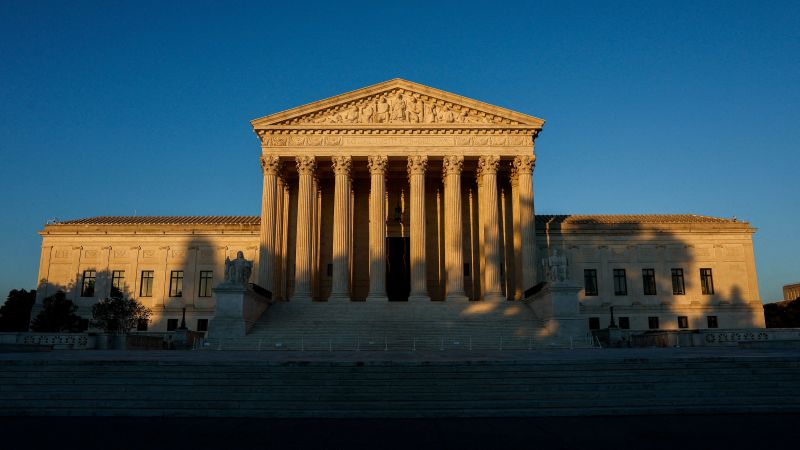
Supreme Court’s Political Shift Amid Key Rulings
Angst at the Supreme Court before – The late spring season signals a pivotal moment as the Supreme Court gears up to release a series of landmark rulings. This term has already reshaped the legal landscape, with decisions that have far-reaching implications for American governance. Among the most notable outcomes, the Court invalidated significant portions of President Donald Trump’s tariff policy while simultaneously weakening the Voting Rights Act and tipping the scales in favor of Republican strategies in the redistricting battle he initiated. These developments have sparked intense debate about the Court’s role in American democracy, with critics arguing it is becoming increasingly politicized.
The Trump Era and the Court’s Docket
As the Court prepares to deliver more decisions, the focus remains on the former president’s legacy. CNN Supreme Court reporter John Fritze highlighted that the coming months will see a flurry of major rulings, many of which trace back to Trump’s first year in office. The first few months of his administration saw a range of contentious issues, from birthright citizenship to the removal of independent officials, which have now reached the Court’s merits docket. These cases, including the immigration disputes and election-related challenges, underscore the Court’s growing involvement in politically charged matters.
“This is the best time of year to be a Supreme Court reporter, when all the big cases come down,” Fritze remarked. He noted that Trump’s influence looms large over the docket, partly due to his distinctive response to the tariffs case. “He almost immediately called the justices who ruled against him a disgrace to their families,” Fritze explained, emphasizing how the president’s public criticism has heightened the Court’s visibility as a political entity.
Political Perceptions and the Voting Rights Act
Despite the Court’s claim of impartiality, its rulings have drawn scrutiny for their political implications. Two key decisions, which did not directly name Trump but still aligned with his interests, highlighted this trend. The Court’s rejection of the Voting Rights Act’s core provisions, which had been a cornerstone of civil rights legislation, was seen as a victory for the president. Conversely, its support for Trump’s tariff policies marked a significant setback for his economic agenda.
Fritze acknowledged that the timing of the redistricting decision, which allowed Republicans to gain an edge in the ongoing battle over voting boundaries, has fueled criticism. The case, which was postponed from the previous term, was described as a “very important case” that the public often struggles to grasp. Its release during a politically sensitive period has led to accusations that the Court is prioritizing partisan outcomes over constitutional principles.
“The timing of the decision opened the Court to a lot of criticism,” Fritze said. “It was viewed as looking through a political lens, even if the justices insist they are not.” This sentiment was echoed by Justice Ketanji Brown Jackson, the youngest and most liberal member of the bench, who expressed concerns about the perception of political bias. While she hasn’t explicitly labeled the Court as partisan, her public remarks suggest unease about how decisions are framed and received.
Partisan Dynamics and the Court’s Response
The Court has faced mounting pressure to defend its decisions against accusations of partisanship. Fritze noted that justices like Samuel Alito and Chief Justice John Roberts have publicly refuted claims of political favoritism, arguing that the tariff case exemplifies their nonpartisan approach. “They’re not choosing sides but applying the law,” Fritze said, though the president’s sharp criticism has complicated this narrative.
Recent interventions in state-level cases further illustrate the Court’s political impact. In Alabama, its decision to allow certain redistricting practices gave Republicans an advantage, while in Virginia, it chose not to step in, effectively shielding Democratic efforts. These contrasting actions have created a cumulative effect, with the Court’s rulings increasingly favoring Republican interests. “It’s a pattern that’s been emerging over several months,” Fritze observed, noting the broader implications for the 2024 election cycle.
“The argument that it’s not political is that the cases are different,” Fritze clarified. “The Virginia case lacked strong legal foundation, and even liberal commentators admit that. However, California’s recent success shows the Court can also support Democratic causes.” This dichotomy has deepened the perception that the justices are not merely interpreting the law but shaping the political terrain, particularly in states where redistricting and voting rules are critical.
Mail-in Ballots and the Election Outlook
As the Court continues to navigate its political role, another major area of focus is the counting of mail-in ballots. Fritze pointed out that upcoming decisions could determine the fate of this process, which has become a flashpoint in the 2024 election. The timing of these rulings, coinciding with the campaign season, has added urgency to the debate over how the Court might influence voter access and election integrity.
The Court’s interventions have also been interpreted as strategic moves to bolster Republican chances. In Alabama, its decision to uphold specific redistricting measures has been seen as a direct advantage for the party. Meanwhile, its reluctance to intervene in Virginia’s voting procedures has allowed Democratic candidates to retain some footing. These decisions, combined with the broader trend of supporting Trump’s policies, have led to accusations of the Court being “a political organ rather than the last word of American justice,” as Fritze put it.
“The Court is increasingly perceived as a tool for partisan agendas,” Fritze said. “Even among the justices, there’s a good deal of angst about this question of politics. It always comes up in election cases, and it’s clear that the public is watching closely.” This tension between judicial independence and political influence is a defining feature of the current era, with the Court’s rulings often serving as a battleground for ideological clashes.
The Road Ahead and Implications for Democracy
With a backlog of significant cases, the Court’s upcoming decisions will test its ability to maintain its reputation as an impartial arbiter. Fritze emphasized that the justices are aware of the scrutiny they face, particularly in cases where the stakes are high. “The Court knows that its rulings are being closely analyzed for political bias,” he said, noting that the pressure to appear neutral is mounting as the 2024 election approaches.
While the Court has defended its actions, the cumulative effect of its decisions has left many questioning its role in shaping the political landscape. The erosion of the Voting Rights Act, the support for redistricting strategies, and the potential influence on mail-in ballot rules all point to a judiciary that is deeply entangled in the nation’s political affairs. As Fritze put it, the Court’s ability to balance its duties as a legal institution with its role in the political process will be crucial in the months to come.
This shift raises important questions about the future of judicial independence. Will the Court remain a check on executive power, or will it increasingly serve as an extension of the political branches? The answers to these questions will depend on how the justices handle upcoming cases and how they address the growing perception of partisanship. For now, the spotlight remains on the Court as it prepares to deliver decisions that could redefine the course of American democracy.
