
New image of the Crystal Ball Nebula captures the ‘spectacular’ throes of a dying star
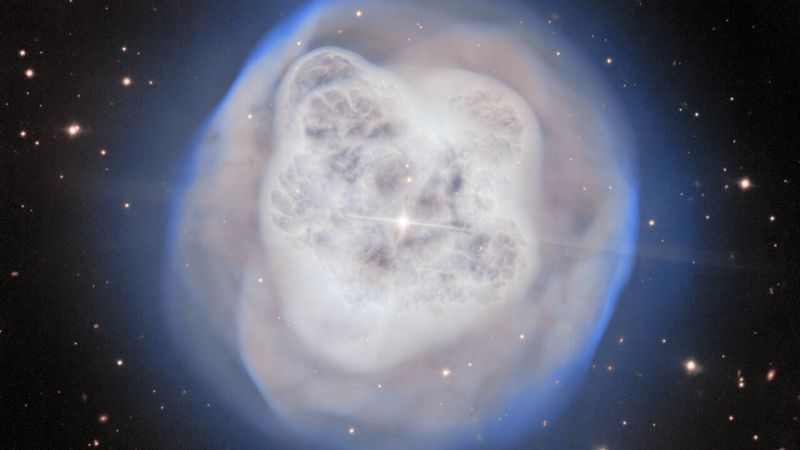
New Crystal Ball Nebula Image Reveals Stellar Death’s Beauty
New image of the Crystal Ball – Astronomers have shared a mesmerizing new image of the Crystal Ball Nebula, showcasing the dramatic final moments of a star’s life. This stunning visualization, captured by the Gemini Multi-Object Spectrograph on the Gemini North telescope in Hawaii, offers a fresh perspective on the nebula’s intricate structure. The image highlights the complex interplay between two stars in a binary system as they interact with the expanding shell of gas and dust, a process that shapes the nebula’s unique, cloudlike form. The focus keyword—new image of the Crystal—serves as a gateway to understanding the universe’s artistic side through cosmic phenomena.
The Science of Stellar Transformation
The Crystal Ball Nebula, a planetary nebula, is a glowing remnant of a star in its final phase. As the star exhausts its nuclear fuel, it sheds its outer layers, creating a shell of gas that interacts with the dense core, a white dwarf. This interaction produces the vibrant colors and intricate patterns observed in such nebulas. The new image of the Crystal Ball Nebula reveals how the gravitational dance between its two stars—orbital periods of nine years—carves delicate shapes into the surrounding material. Travis Rector, a physicist at the University of Alaska Anchorage, described the process as resembling the creation of cotton candy, emphasizing the symmetry and artistry of the nebula’s structure.
“Although we didn’t aim to study this object specifically, the new image of the Crystal Ball Nebula was so captivating that it became a highlight of our observations,” Rector explained. “It’s a reminder of how the universe can create art in the form of science.”
Historical Context and Cosmic Perspective
First cataloged by William Herschel in 1790, the Crystal Ball Nebula was initially mistaken for a planet due to its appearance through early telescopes. However, modern technology has unveiled its true nature as a stellar remnant. The new image of the Crystal Ball Nebula, taken 1,500 light-years from Earth, provides insight into how light from nearly 1,500 years ago still illuminates our view. This timescale underscores the slow, deliberate processes that shape celestial objects, offering a window into the star’s final years.
Planetary nebulae are fleeting cosmic phenomena, lasting only about 10,000 years before their gas disperses into space. The new image of the Crystal Ball Nebula captures a rare opportunity to observe the brief yet intense phase of stellar evolution. Rector noted that studying such nebulas across different wavelengths reveals new details, making them invaluable for understanding the life cycle of stars. The Crystal Ball Nebula, part of a binary star system, exemplifies how multiple stars can influence the shape of a nebula’s ejected material.
“The new image of the Crystal Ball Nebula is not just a scientific achievement but a visual masterpiece that highlights the universe’s creative processes,” said Jan Cami, an astronomer at Western University. “Each nebula has its own story, and this one is a testament to the dynamic interactions of stars in their final stages.”
Deciphering the Nebula’s Colors and Composition
The vivid hues in the new image of the Crystal Ball Nebula are the result of specific gases interacting with starlight. Red tones come from ionized hydrogen, while blue hues stem from oxygen. These elements provide clues about the chemical makeup of the dying star. The Gemini spectrograph isolates these wavelengths, enabling scientists to decode the nebula’s history and evolution. This method has become essential for analyzing the transition of stars from their main-sequence phase to white dwarfs, as seen in the new image of the Crystal Ball Neb
