
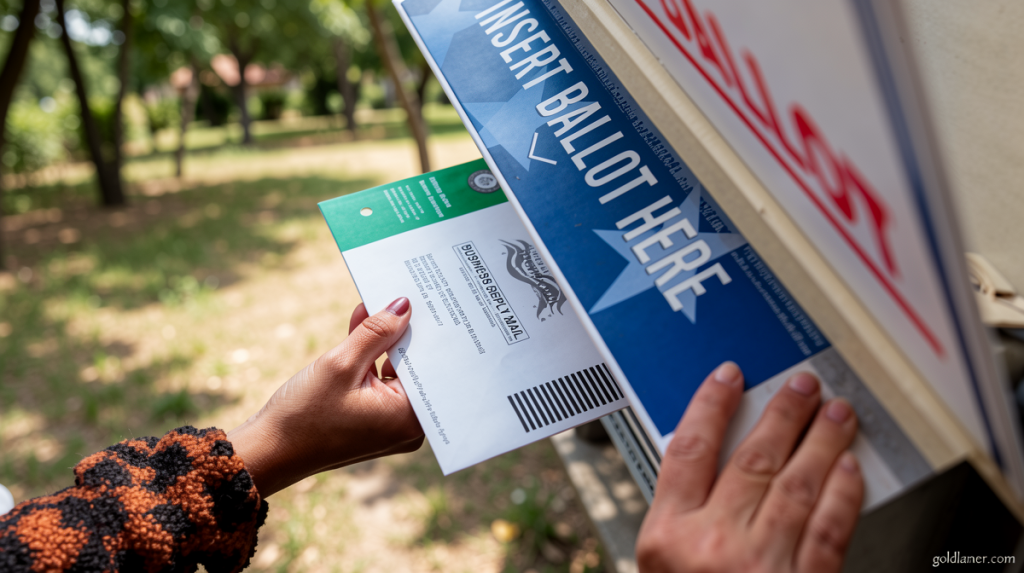
Judge Pauses US Postal Service Mail Voting Plan
Goldlaner.com – A federal judge in Boston issued a two-week temporary restraining order late Thursday night, effectively freezing the U.S. Postal Service’s newly finalized rules that would impose sweeping new conditions on how states deliver mail ballots to voters. The order, handed down by Judge Indira Talwani, gives Democratic-leaning states and voter-protection groups a short window to continue using existing ballot-envelope procedures ahead of the November 3, 2026 midterm elections. In practical terms, the judge pauses US Postal Service enforcement of the Final Rule until the court completes its review.
The intervention lands at a compressed moment. With roughly six weeks between the ruling and Election Day, state election administrators face tight timelines for designing, printing, and deploying any ballot materials. Talwani, an Obama appointee, found that the challengers were likely to succeed on their core constitutional and statutory arguments, meaning the agency’s Final Rule could not stand while litigation proceeds.
“Through the Final Rule, the USPS is refusing to send mail ballots to eligible voters unless States or local election officials submit their mail ballot envelopes and return envelopes and receive advance approval from the USPS without regard to impending deadlines for the November 3, 2026 election.”
What the Final Rule Would Have Required
Under the regulation released Friday night, states wishing to use the postal carrier for their mail ballots would have been obligated to transmit complete lists of registered mail voters directly to the agency. Beyond that data-sharing requirement, the rule would have accepted only ballots sealed in envelopes bearing individualized bar codes tied to each voter — a mechanism designed to enable automated tracking of every ballot through the delivery pipeline.
The administration framed these conditions as tools to aid law-enforcement investigations into potential ballot irregularities. State election officials pushed back sharply in court filings, arguing the mandate would force them to redesign and reprint millions of ballot envelopes from scratch. Vendors supplying those envelopes reportedly indicated the production turnaround could not be completed before the midterms. Officials also questioned whether the proposed system for uploading voter lists to an agency portal was technically feasible on the compressed schedule.
“Plaintiff States have neither time nor funds to design new mail ballots, seek approval of the new designs, order production of mail ballots, update their own election management systems, train election officials to use the USPS portal, and upload citizen data to the portal, all before the midterms.”
The Supreme Court Backdrop and What Comes Next
The Thursday ruling arrives amid a rapidly evolving legal confrontation between the states and the Trump administration over a March executive order that directed federal agencies to tighten controls around mail voting. On Monday, the Supreme Court vacated an earlier Talwani order that had blocked agencies from implementing portions of that executive order across roughly two dozen plaintiff states. Writing for the majority, the justices held that the lower-court injunction had been premature because, at the time the states first filed suit, the agencies had not yet published their final implementing regulations. Three liberal justices dissented.
That high-court decision did not address the postal regulation itself, because the agency had not released the rule until Friday night — after the Supreme Court appeal record was already closed. The latest litigation therefore proceeds from revised complaints that opponents filed specifically in response to the Final Rule, giving Talwani a fresh procedural basis to evaluate the rule on its own merits. The judge pauses US Postal Service implementation only temporarily; a hearing is scheduled for next Thursday to determine whether the two-week order converts into a longer-duration preliminary injunction pending full trial.
The administration’s response to the Thursday ruling remains unclear. The Department of Justice did not immediately answer questions about whether it will appeal the restraining order directly or wait for a preliminary-injunction decision — the latter being the more conventional appellate pathway. The White House had not responded to requests for comment as of publication. In its own court filings, the Justice Department characterized the regulatory change as “modest” and maintained that the postal agency possessed the statutory authority to impose the new envelope and data requirements.
FAQ
What does the restraining order mean for voters heading into the 2026 midterms? For the next two weeks, states may continue using their existing mail-ballot procedures without complying with the new envelope-approval and bar-code requirements. Voters should check with their local election office for ballot deadlines, which remain unchanged during the pause.
When will the court decide whether to extend the block? Judge Talwani has set a hearing for the Thursday following the restraining order’s issuance. At that hearing she will weigh whether to issue a preliminary injunction, which would keep the Final Rule frozen for a substantially longer period while the case moves toward trial.
Could the administration appeal before the preliminary-injunction ruling? It is procedurally possible but uncommon. The Justice Department has not confirmed its strategy. Most practitioners expect the government to wait for the preliminary-injunction decision before seeking appellate review, since that ruling carries a fuller record and a more developed factual basis.