
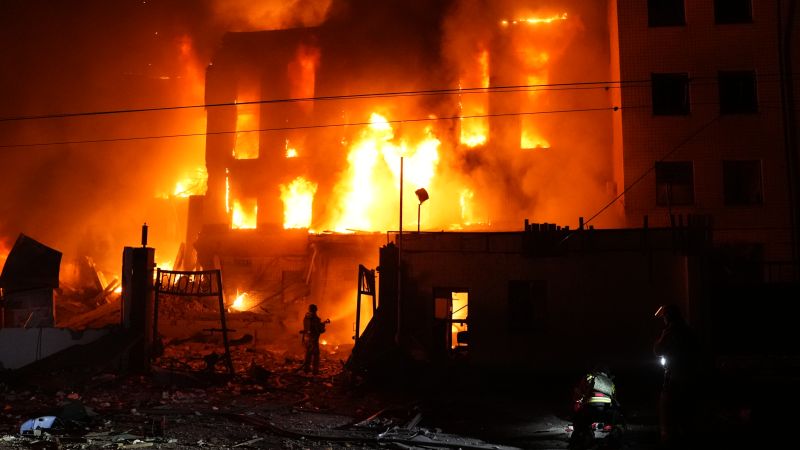
Kyiv Hit by Massive Missile Barrage Hours After Diplomatic Truce Collapses
Goldlaner.com – The fragile window of calm that had briefly shielded Ukraine’s capital from Russian strikes ended abruptly on Tuesday morning, when a dense salvo of ballistic and cruise missiles, supplemented by drone swarms, struck multiple districts of Kyiv. The assault landed just one day after American special envoys departed the city, underscoring how quickly the diplomatic pause dissolved once the 72-hour ceasefire window closed.
Explosions tore through the urban landscape in the early hours of Tuesday local time. Ukrainian authorities confirmed that the combined barrage caused injuries to six civilians and set fire to residential structures across the city. Mayor Vitali Klitschko reported that residents were trapped inside at least one apartment building as flames spread, and that blazes also broke out at an educational facility. The scale of the bombardment was sufficient to prompt neighboring Poland to scramble military aircraft into the air to safeguard its own airspace, a precaution that signals how close the debris field and missile trajectories came to the Polish border.
The Diplomatic Window That Closed
The strikes arrived at the precise moment the agreed-upon pause on capital-city attacks expired. Over the preceding weekend, Washington had dispatched Steve Witkoff and Jared Kushner — the latter being President Donald Trump’s son-in-law — on a rapid two-city shuttle between Moscow and Kyiv. On Sunday, the pair held intensive sessions with Russian President Vladimir Putin in the Kremlin. The very next day, they sat down with Ukrainian counterparts in Kyiv, attempting to reignite a peace process that had been stalled for months.
Witkoff offered a cautiously optimistic readout of those conversations on the social platform X:
“Substantive progress was made, including movement on scheduling additional trilateral talks.”
Yet no concrete breakthrough was announced, and the language of “scheduling” rather than “holding” left the substance of any agreement ambiguous. The weekend’s diplomacy had been predicated on a mutual understanding: neither side would target the other’s capital while the envoys were in town. That arrangement, a rare gesture of restraint in a war that has now stretched across multiple years, evaporated the moment the clock ran out on Tuesday.
A Pattern of Escalation in Kyiv
The Tuesday barrage did not emerge from a vacuum. In the weeks preceding the diplomatic interlude, Russian forces had intensified their campaign against Kyiv’s infrastructure and command nodes. Most notably, on Friday a daytime missile strike struck the headquarters of Ukraine’s Security Service (SBU) — the first time that building had been hit since the full-scale invasion began. Analysts and Ukrainian officials alike read that strike as a sharp escalation, a signal that Moscow was willing to risk diplomatic fallout to degrade Kyiv’s intelligence and counterintelligence capacity.
Underlying that escalation is a structural problem on the Ukrainian side: a critical shortage of interceptor missiles. As Russia rotates through ballistic, cruise, and drone platforms in layered salvos, Kyiv’s air-defense network — already stretched thin across a vast front — struggles to intercept every incoming threat. The cumulative effect is that key assets in the capital, once considered relatively safe, are now exposed to regular targeting.
Ukraine’s Deep-Range Response
The war has not remained one-directional. Over recent months, Ukrainian forces have expanded the reach of their own aerial strikes, pushing drones and missiles deeper into Russian territory to hit fuel depots, airfields, and logistics hubs. On the same Tuesday morning that Kyiv was under fire, the governor of Saratov — a city well inside Russia’s southern interior — posted on Telegram that a Ukrainian drone had struck civilian infrastructure in the city and wounded several people. The parallel timing of attacks on both capitals, even as the formal truce lapsed, illustrates how tightly coupled the two sides’ operations have become.
What Comes Next
The collapse of the weekend ceasefire leaves the trilateral negotiation track in uncertain shape. Witkoff’s reference to “additional trilateral talks” suggests that Washington still envisions a format involving the United States, Russia, and Ukraine sitting at the same table, but the absence of a confirmed date or agenda means the next round remains speculative. For Kyiv, the immediate priority is damage assessment, rescue operations at burning buildings, and reinforcing air-defense coverage before the next salvo arrives. For Moscow, the Tuesday barrage can be read as a reminder that the capital remains a legitimate target the moment diplomatic cover lifts.
The broader implication is stark: a war that has consumed years of Ukrainian lives and infrastructure continues to operate on a rhythm of brief pauses punctuated by renewed bombardment. Until interceptor-missile production catches up with the volume of Russian strikes, and until a negotiated framework gains enough momentum to constrain both sides’ targeting choices, the cycle of truce-then-barrage is likely to repeat. The story is developing, and further details on casualties, infrastructure damage, and diplomatic follow-up are expected in the coming hours.
Related Reading
Frequently Asked Questions
What is Russia pounds Kyiv one day after?
Russia pounds Kyiv one day after is the main topic of this guide. The article explains the context, practical details, and next steps readers should understand.
Why does Russia pounds Kyiv one day after matter?
Russia pounds Kyiv one day after matters because readers are looking for a useful answer, not just a short summary. Good content should match search intent and help them decide what to do next.