
Paris Landmark Shuts Down as Workers Walk Out Over Alleged Gender-Based Exclusion During Religious Visit
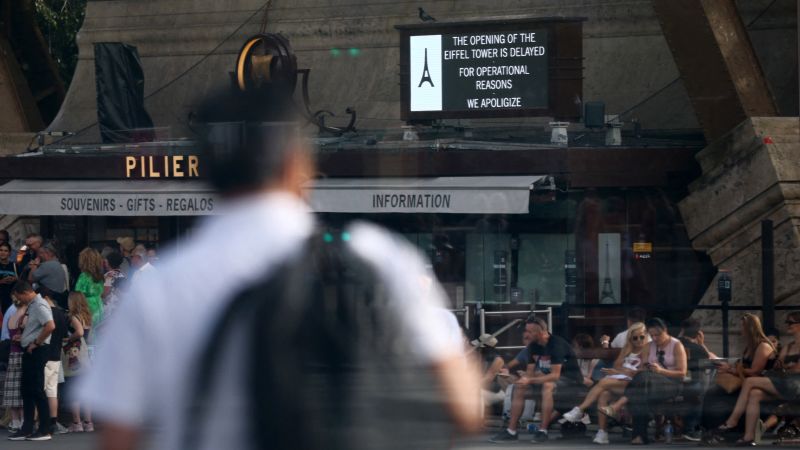
Goldlaner.com – The iconic iron lattice of the Eiffel Tower stood empty of visitors on Monday when its workforce staged a walkout, demanding answers over what union leaders describe as a humiliating episode in which female employees were ordered off their posts during a delegation visit by a Hindu spiritual organization. The closure, which sent shockwaves through French politics and across the Indian diaspora, has reignited fierce debate about gender equality, religious accommodation, and the limits of institutional deference in one of the world’s most visited monuments.
The Visit That Triggered the Walkout
Roughly 100 members of the Bochasanwasi Akshar Purushottam Swaminarayan Sanstha, commonly known as BAPS, toured the tower on Saturday. The organization, headquartered in Ahmedabad, India, characterizes itself as a “spiritual, volunteer-driven fellowship” committed to societal uplift through personal development and the promotion of Hindu ideals including faith, service, and global harmony. The delegation’s Paris itinerary extended beyond the tower: on Sunday, the group inaugurated a newly constructed Hindu temple in the French capital, capping a week of high-profile religious activity that drew thousands of devotees to processions and ceremonies across the city.
Union Leaders Describe a Humiliating Order
Diane Davoine, who represents the Eiffel Tower workforce through the local union, laid out the employees’ grievance to reporters outside the monument. Her account was blunt and emotional:
“Women were asked to leave their places of work in order to place men there.”
She added that the episode left female staff feeling publicly degraded and singled out.
“So that absolutely does not go down well with the employees, with women obviously, who are all humiliated by what happened, by the way some were treated.”
Management Admits Conditions Were Accepted
The Eiffel Tower Operating Company, known by its acronym SETE, confirmed that the visiting delegation had asked for a tour format that restricted “interactions with women.” In remarks carried by BFMTV, a French broadcaster, SETE conceded that accepting such a condition was a mistake.
“These conditions should not have been accepted.”
The company did not elaborate further on the circumstances surrounding the Saturday visit.
BAPS Issues a Cautious Apology
In a posted statement on the social platform X, BAPS stopped short of naming the female staff directly. The organization said it treated the raised concerns “very seriously” and explained that the Saturday tour had been arranged “in coordination with the Eiffel Tower team at the start of normal opening hours” so as to minimize disruption to the general public.
“To the best of our knowledge, at no point was anyone prevented access to the Eiffel Tower.”
The statement closed with a broader expression of regret:
“Nevertheless, we sincerely apologise for any pain or inconvenience caused.”
French Politicians Demand Accountability
Paris Mayor Emmanuel Grégoire announced that a formal inquiry into the allegations had been opened. Writing on X, he framed the episode as a failure of basic institutional values.
“It is not acceptable that such conditions can be tolerated. These are neither my values, nor those that the Eiffel Tower should uphold, where everyone should be able to move about and act freely, without distinction between women and men.”
Aurore Bergé, France’s Minister for Gender Equality and the Fight Against Discrimination, weighed in with sharper language, calling the alleged incident “unacceptable” and invoking the constitutional bedrock of French secularism.
“In France, gender equality is neither negotiable nor subject to varying standards. It is a principle, and there are no exceptions to it.”
A Nation’s Long Fight for Equality Collides With Religious Custom
The controversy lands in a country whose modern identity is inseparable from a century of feminist organizing. French women won suffrage in 1944, fought for decades over reproductive autonomy, and in 2024 became the first nation anywhere to enshrine the right to abortion directly in its constitution. The ideological lineage of that secular commitment traces back to the French Revolution itself. Against that backdrop, the suggestion that a state-adjacent landmark could quietly accommodate a request to sideline women struck many observers as a profound institutional lapse.
India Watches Closely
By Tuesday, the closure had become front-page news across Indian media. Social-media commentary split along familiar lines: some users questioned why the tower’s management would comply with what they saw as a discriminatory ask, while others argued the episode tarnished both India’s international standing and the public image of Hinduism. The debate touched a nerve in a country where questions of women’s access to temples and participation in ritual remain politically charged.
BAPS’s Global Temple Network and the Wider Hindu Context
BAPS operates an extensive network of ornately designed temples worldwide. Its most prominent Western building is the BAPS Swaminarayan Akshardham in Robbinsville, New Jersey, recognized as the largest Hindu temple in the United States. The organization also constructed the largest Hindu temple in the United Arab Emirates, a project inaugurated by Indian Prime Minister Narendra Modi in 2024. In recent days, thousands of BAPS-associated devotees participated in processions and ceremonies across France, including a march through the eastern Paris suburb of Bussy-Saint-Georges described by the organization as “led by women and girls of all ages,” and a river procession on the Seine attended by more than 5,500 devotees from around the globe.
Hinduism, widely regarded as the world’s oldest continuously practiced religion and its third-largest faith behind Christianity and Islam with over one billion adherents, has long venerated the feminine divine through goddesses such as Saraswati, the embodiment of wisdom; Kali, the destroyer of evil and ego; and Lakshmi, the bestower of wealth and prosperity. Yet within the tradition, debates over women’s full participation in temple worship and certain rituals have persisted for generations. A landmark 2018 ruling in India opened several temples to women of all ages, a decision that remains contested in parts of the country and that gives added weight to questions about how religious institutions negotiate gender norms in public spaces abroad.
As the investigation ordered by Mayor Grégoire proceeds, the episode is likely to shape how French public institutions handle future requests from religious delegations seeking modified access protocols. For the Eiffel Tower’s workforce, the walkout was less about one Saturday visit than about a principle: that no employee, regardless of gender, should be treated as disposable in order to accommodate an outside party’s preferences.
Related Reading
Frequently Asked Questions
What is Eiffel Tower closed due to strike?
Eiffel Tower closed due to strike is the main topic of this guide. The article explains the context, practical details, and next steps readers should understand.
Why does Eiffel Tower closed due to strike matter?
Eiffel Tower closed due to strike matters because readers are looking for a useful answer, not just a short summary. Good content should match search intent and help them decide what to do next.