
Venezuelans scour collapsed buildings by hand while government machinery stands unused
Earthquake Crisis in Venezuela: Manual Efforts Amid Government Inaction
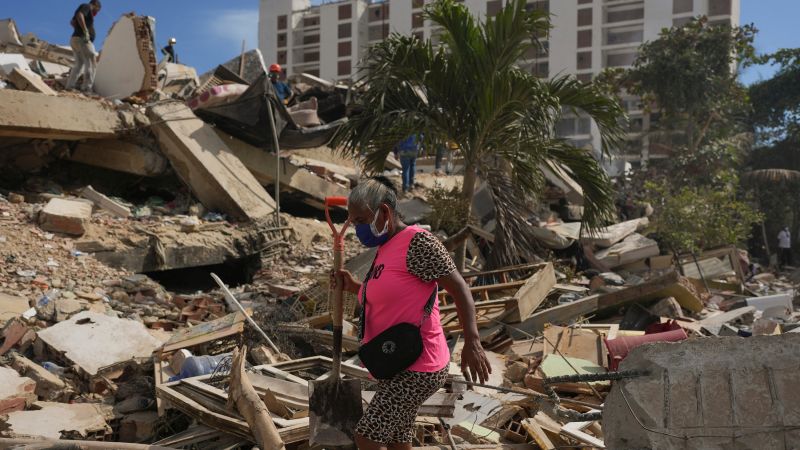
Venezuelans scour collapsed buildings by hand – Residents of La Guaira, a coastal city in Venezuela, are still sifting through the wreckage of buildings reduced to rubble by two catastrophic earthquakes that struck nearly a week ago. Despite the scale of destruction, the government’s heavy machinery remains idle, highlighting a critical shortfall in emergency response. A government excavator sat motionless beside a mound of concrete and twisted rebar, its engine silent and its purpose unfulfilled. This delay has forced citizens to rely on rudimentary tools like pickaxes, shovels, and even their bare hands to uncover survivors trapped in the remnants of collapsed structures.
State Machinery Falters Amid Fuel Shortages
Heavy machinery plays a crucial role in disaster recovery, yet its absence in La Guaira has raised alarms. When CNN inquired about the excavator’s inactivity, the operator cited a lack of fuel as the primary obstacle. This issue underscores broader challenges in the country’s infrastructure, where Venezuela, home to the world’s largest oil reserves, struggles to allocate resources effectively during crises. Citizens, now desperate and exhausted, have taken matters into their own hands, searching for loved ones in the aftermath of one of the nation’s worst earthquakes in over a century.
“People are outraged,” stated political analyst Carmen Beatriz Fernández, head of DataStrategia, a consulting firm. “What we are witnessing is this disaster as a reflection of another deeper tragedy—dedicating the state’s resources solely to repression and propaganda. You’ve dismantled the state’s ability to meet basic needs.”
Corruption and Mismanagement Under Scrutiny
Adding to the frustration, four officials were arrested for allegedly seizing valuables from the rubble. The Scientific, Penal and Criminal Investigations Corps (CICPC) announced Tuesday that these men had been removed from their posts and their cases forwarded to the judiciary. The statement emphasized the institution’s commitment to addressing “police misconduct, acts of corruption, or conduct that undermines institutional integrity.”
Meanwhile, opposition leader María Corina Machado, who has been in exile in the U.S., expressed renewed determination to return to Venezuela. Speaking to Fox News, she said, “We need to be together. This crisis has motivated me to come back and stand with my people.” Her comments reflect growing sentiment that the government’s inefficiency is exacerbating the disaster’s human toll.
Rescue Challenges and Resource Gaps
La Guaira, one of the hardest-hit regions, is grappling with the aftermath of the quakes. The air is thick with the scent of decay, and hospitals are overwhelmed, struggling to keep pace with the influx of injured. In the absence of advanced equipment, volunteers and civilians have become the primary force in rescue operations. Hassel Mendoza, an engineer who flew in from Tampa to search for her family in the ruins of a nine-story apartment building, described the ordeal as “exceedingly difficult without the right tools.”
Mendoza, who has been sleeping on the ground for two nights, shared the struggles of the community. “We lost a lot of time trying to figure out new tools for a specific activity, like cutting steel,” she explained. The lack of resources extends beyond fuel; even a civil defense team from the neighboring state of Aragua arrived without essential equipment, leaving the search and rescue efforts to improvisation. While donations of water provided some relief, they were not enough to ease the suffering of those displaced.
Slow Progress and Rising Casualties
The official death toll continues to climb, albeit slowly. On Wednesday, National Assembly President Jorge Rodríguez, the acting president’s brother, reported at least 2,295 fatalities, a 350-person increase from the previous day. However, many believe the true number is far higher. The US Geological Survey estimates that tens of thousands may have perished, with the Venezuelan government and the United Nations preparing 10,000 body bags to accommodate the expected toll.
At a makeshift morgue near La Guaira’s port, CNN observed rows of caskets stacked along the docks. The sight of these bodies, combined with the lingering smell of death, serves as a grim reminder of the disaster’s scale. For families like Mendoza’s, hope remains fragile. “We have a little hope that my family is alive,” she said, her voice steady but filled with anxiety. The uncertainty of whether loved ones are buried beneath the rubble or have been rescued has kept many awake, their lives suspended in the limbo of disaster.
Government’s Defense of Response
Despite the criticism, the government has defended its actions, framing the situation as one of “initial chaos.” Top lawmakers, including Interior Minister Diosdado Cabello, have urged citizens to trust in their ability to organize. “We ask our people that, in the midst of this situation, we be able to organize ourselves in the communes,” Cabello stated last Thursday. “We have to know who is missing, where they were, and so that we can do the rescue work more precisely.”
While the government’s emphasis on local organization is notable, it has not addressed the systemic failures that have left heavy machinery idle. The initiative to deploy volunteers according to “established priorities” is a step toward coordination, but it does little to mitigate the immediate impact of the fuel shortages and equipment gaps. As the search continues, the question remains: how long will Venezuelans be forced to rely on their own strength in a crisis that demands swift and efficient action?
Residents of La Guaira, now sleeping in the open and working without adequate tools, have become the backbone of the recovery effort. Their determination, though commendable, underscores the deepening crisis. With the country’s resources stretched thin and public trust eroding, the path to rebuilding will be long and arduous. The earthquakes have not only devastated infrastructure but also exposed the vulnerabilities of a state ill-prepared to respond to emergencies. As the official death toll rises, the people of Venezuela face the daunting task of navigating both the physical wreckage and the political fallout of their nation’s delayed response.
