
Iran’s Economy Under Siege: Washington Prepares Its Harshest Sanctions Package Yet
Goldlaner.com – After six months of war, years of international isolation, and a devastating military campaign carried out jointly by the United States and Israel, the Islamic Republic of Iran now confronts yet another front in its struggle for survival. President Donald Trump is preparing a new round of economic measures designed to squeeze Tehran’s remaining revenue channels, with Treasury Secretary Scott Bessent vowing to unveil “the toughest sanctions in history” at a Monday news conference. The announcement comes at a moment of deepening deadlock in negotiations aimed at ending the conflict, while Iran continues to inflict widespread economic disruption by choking shipping traffic through the Strait of Hormuz — the narrow waterway through which roughly one-fifth of the world’s traded oil passes.
A Population Feeling the Squeeze
The human cost of compounding economic pressure is already visible across Iranian cities. State media carried remarks from President Masoud Pezeshkian acknowledging the severity of the situation:
“We are apologetic that these problems exist, as we find ourselves in a full-scale economic, military, and security war. As the government, we are seeking with all our being to steer inflation, public problems, people’s livelihoods, people’s jobs, people’s future, and people’s lives towards dignity and pride.”
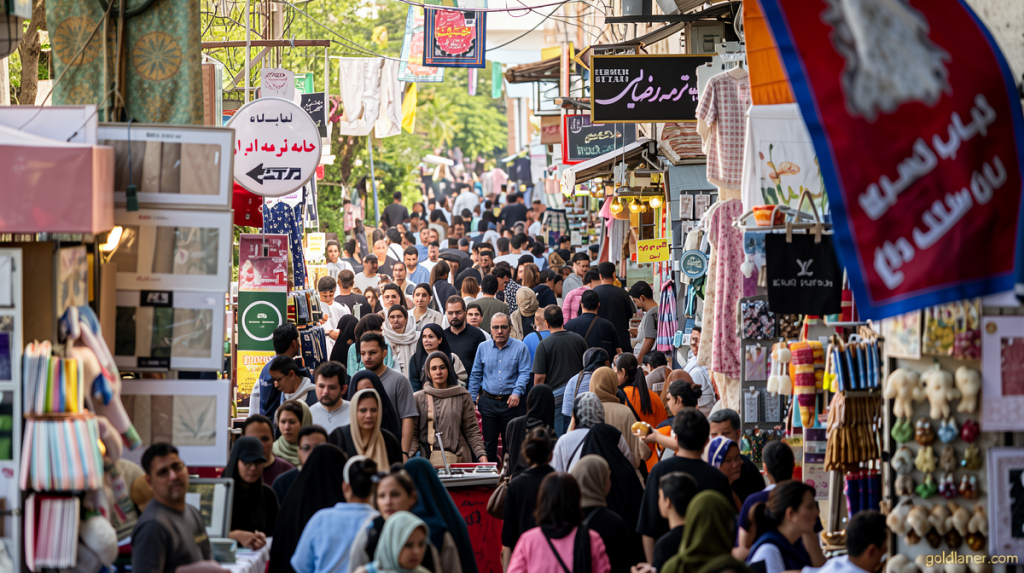
Footage circulating on social media last week captured eerily empty produce stalls in Tehran and Karaj, where vendors lamented that their fresh vegetables and fruits were going unsold. A 36-year-old Tehran resident named Nima described conditions as “untenable,” noting that beyond the sheer cost of daily necessities, certain essential medications had simply disappeared from shelves. A small-shop owner, who spoke on condition of anonymity to discuss the economy freely, explained that foreign-branded toiletries — shampoo, conditioner, toothpaste — were vanishing from inventory, and that even domestically produced goods required price increases to remain viable.
Decades of Sanctions Evasion
Yet analysts caution that without fundamentally new enforcement mechanisms, Washington risks confronting the same resilient, adaptive apparatus that has allowed the Islamic Republic to weather decades of Western financial isolation. Over successive sanction regimes, Iran built a sprawling, decentralized architecture of front companies, currency-exchange brokers, intermediaries, and a shadow tanker fleet that relies on ship-to-ship transfers, manipulated AIS tracking signals, and fabricated documentation to move crude oil to market.
The scale of that shadow system remains substantial. According to the US Financial Crimes Enforcement Network (FinCEN), roughly $9 billion in Iranian shadow-banking activity flowed through American correspondent accounts in 2024, based on filings from US financial institutions. The Treasury Department has identified shell entities operating in oil, shipping, and investment sectors that channel billions of dollars through networks anchored in the United Arab Emirates, Hong Kong, and Singapore. Transactions are frequently settled in Chinese yuan, executed via barter arrangements, or routed entirely outside the dollar-based interbank system, according to Umud Shokri, an energy strategist and senior visiting fellow at George Mason University.
The New Playbook — and Its Limits
Bessent framed the upcoming measures in stark terms, telling CNBC that they would “squash” the economy of what he called “this murderous regime,” curtail Tehran’s capacity to “project power through their proxies,” and constrain its ability to fund the Iranian military apparatus. The rhetoric signals an administration intent on escalating economic coercion beyond the thresholds already in place.
Experts, however, warn that the distributional impact will fall disproportionately on ordinary citizens rather than on the entrenched networks that have historically absorbed sanction shocks. Shokri explained that further restrictions would weaken the rial, accelerate inflation, raise the cost of imported consumer goods and industrial inputs, and erode household purchasing power. Wage earners, pensioners, small businesses, and lower-income families would be particularly exposed, while politically connected institutions and intermediaries would remain partially “insulated” by continued profits from smuggling, currency manipulation, and control over scarce import allocations.
The China Question
For the new package to bite where Washington intends, it must reach the entities that actually absorb Iranian oil exports: major Chinese state and independent refineries, the banks that process the resulting revenue, and the logistics firms that move cargoes across the Indian Ocean. Targeting those nodes, however, carries the risk of provoking retaliation from Beijing — a partner whose own energy security depends on steady Iranian supply and whose strategic alignment with Tehran has deepened considerably over the past decade. Any escalation that threatens Chinese commercial interests could prompt countermeasures in trade, currency, or multilateral forums, complicating the broader geopolitical calculus the administration is already managing across the Middle East and Asia-Pacific.
Whether the Trump administration will sustain the pressure campaign through the inevitable political and economic friction that follows remains an open question. The regime in Tehran has survived every prior round of sanctions by adapting, rerouting, and absorbing shocks. The coming measures represent the most aggressive attempt yet to close those adaptive channels — but history suggests that the question is not whether sanctions will be imposed, but whether they can be enforced with enough consistency and reach to prevent the old workarounds from reasserting themselves within months.
Related Reading
Frequently Asked Questions
What is Trump is trying to tighten the screws?
Trump is trying to tighten the screws is the main topic of this guide. The article explains the context, practical details, and next steps readers should understand.
Why does Trump is trying to tighten the screws matter?
Trump is trying to tighten the screws matters because readers are looking for a useful answer, not just a short summary. Good content should match search intent and help them decide what to do next.