
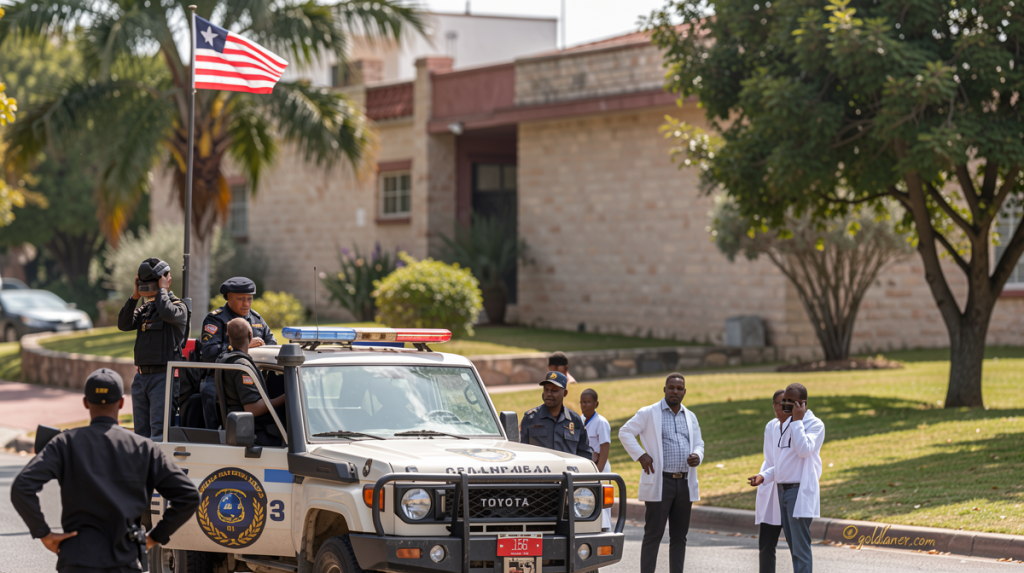
Liberia Once Offered Black Americans a New Home
Goldlaner.com – Liberia once offered Black Americans a new home in the early nineteenth century, and now the West African nation is receiving deportees that Washington wants shipped abroad. The first flight under a bilateral deportation arrangement touched down at Monrovia’s airport carrying twenty passengers from Louisiana. If fully executed, the deal would move as many as 1,200 people into a country of fewer than six million residents — a scale that gives the transfer a historical weight few other receiving nations could match.
Liberian authorities described the passengers as coming from “African and western hemisphere countries,” underscoring the multinational composition of the cohort. The West African state is one of several nations that have agreed to absorb migrants the Trump administration is stripping of legal status and sending abroad. Yet no other recipient shares the particular historical entanglement that makes this transfer feel, to many Liberians, less like foreign policy and more like a personal reckoning.
A name that means “land of the free”
The word “Liberia” encodes a founding myth: a translation of the Latin for “land of the free.” In the early 1820s, the first cohort of free Black Americans stepped off ships onto the West African coast. Over the following decades, thousands more followed, guided in part by the American Colonization Society, which organized settlements along the shoreline. The US State Department estimates that roughly 16,000 Black Americans made the crossing during the nineteenth century.
The migration was never a single story. Some emigrants saw the voyage as an escape from the suffocating architecture of American racism, a chance to build institutions of their own. Others resisted the colonization project outright, arguing that free Black people owed nothing to a scheme that asked them to leave the country they had helped build. Africans rescued from slave ships by the US Navy were also deposited in the settlements, adding another layer to the population’s origins. From those scattered communities, the Republic of Liberia emerged, declaring independence in 1847 — the oldest republic in Africa.
The American imprint persists in everyday symbols. The Liberian flag mirrors the stars-and-stripes design of its northern neighbor. The capital bears the name of James Monroe, America’s fifth president. Early legal and governmental structures were modeled on Washington’s. These are not quaint curiosities; they shape how Liberians parse every new gesture from the United States.
Opening the doors again
Pheta Morris, 48, traces her lineage to the Black Americans who settled the coast two centuries ago. Speaking from Monrovia, she framed the deportee arrivals through the lens of that founding moment — and found the parallel both moving and unsettling.
“I think about the Americo-Liberians — people who were rejected where they were and needed somewhere to go, and Liberia opened its arms to them. Back then, people needed somewhere they could be free, accepted and welcomed. Now, people are being rejected from the US, and Liberia is opening its doors to them.”
Yet the same interview carried a note of strain. Liberia is still stitching itself back together after a fourteen-year civil war that ended only in 2003. The question Morris posed was blunt:
“This country is going through a lot, and having more people come in — can we handle all of this?”
Five passengers who would not step off the plane
The inaugural transfer was not without friction. Five of the twenty deportees reportedly refused to disembark upon landing in Monrovia. They were rerouted to Equatorial Guinea, a Central African state where more than thirty other US-sent migrants are already being held. A US State Department spokesperson characterized the implementation of the administration’s immigration agenda as a “top priority” and declined to elaborate on private diplomatic channels with partner governments.
The episode highlights a logistical and human-rights question that will recur with every subsequent flight: what happens when a deportee exercises the most basic refusal? Liberia’s information ministry was approached for clarification on the agreement’s specific terms, including provisions for voluntary versus involuntary transfers, but details remained sparse at the time of reporting.
Infrastructure arithmetic
Conmany Wesseh, a former member of Liberia’s legislature and a figure in the ruling Unity Party, was nominated as Liberia’s ambassador to the United Nations. His appointment places a seasoned political operator at the center of the bilateral negotiations that will determine how quickly — and under what conditions — the remaining deportee flights arrive. For a post-war economy still rebuilding hospitals, schools, and roads, absorbing 1,200 additional residents in a compressed timeframe raises questions about housing, employment, and social services that no amount of diplomatic goodwill can shortcut.
Frequently Asked Questions
Why does this story matter beyond the immediate logistics? Because Liberia once offered Black Americans a new home, and the parallel between that founding migration and today’s deportation flights is impossible to ignore. The historical resonance shapes public debate in Monrovia in ways that have no equivalent in other receiving countries.
How many deportees are expected under the arrangement? Up to 1,200 people if the bilateral agreement is fully executed. The first flight carried twenty passengers from Louisiana.
What happened to the five who refused to disembark? They were rerouted to Equatorial Guinea, where more than thirty other US-sent migrants are already being held.
When did Liberia declare independence? In 1847, making it the oldest republic in Africa. Its founding population included roughly 16,000 Black Americans who migrated during the nineteenth century, according to US State Department estimates.