
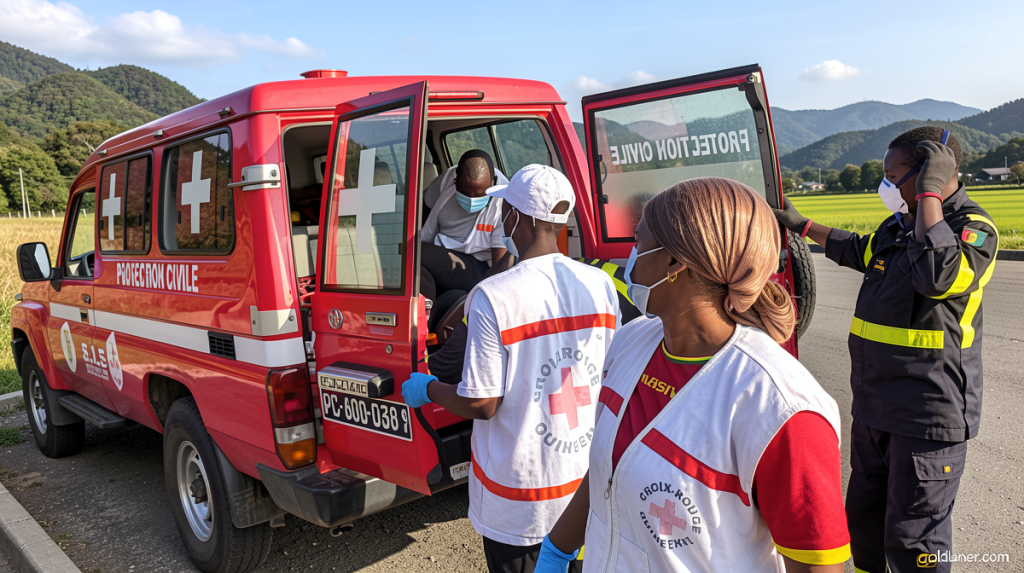
Thirty Dead as Conakry’s Largest Waste Dump Gives Way Under Monsoon Rains
Goldlaner.com – A towering mound of accumulated garbage in Guinea’s capital slid into the surrounding neighborhood in the small hours of Sunday morning, burying makeshift shelters and claiming at least 30 lives. The collapse at the Dar Es Salam open-air dump — the biggest waste disposal site in Conakry — came after a downpour that began near 2 a.m. saturated the unstable slope and sent tons of rotting material cascading downhill into homes built at its base.
The central government confirmed the death toll of 30 in the initial accounting, while rescue crews worked through the debris field searching for survivors trapped beneath the fallen refuse. Six victims sustained serious injuries, and multiple dwellings were flattened or rendered uninhabitable by the impact.
What Triggered the Collapse
Heavy rainfall, a recurring feature of Conakry’s tropical climate during the wet season, was the immediate catalyst. Water that pooled on the surface of the landfill percolated through layers of compacted waste, increasing the mass and reducing friction along the slope’s failure plane. Once the threshold was crossed, the entire upper section of the dump detached and surged downward with little warning to residents sleeping in the adjacent informal settlements.
Engineers and urban-planning specialists in West African capitals have long warned that open-air dumps of this scale, left unmanaged and ringed by poor communities, represent a compounding hazard: the waste itself grows heavier and more chemically active over time, while the surrounding population grows denser as land pressure pushes the poorest households into the cheapest available plots — often at the foot of the very mounds that threaten them.
Rescue, Relocation, and a Site Already Marked for Closure
Search-and-rescue teams were deployed immediately after the slide, combing through the collapsed material for survivors. In parallel, municipal authorities moved to clear the area and assess structural damage to remaining structures.
What made the tragedy particularly bitter was that the Dar Es Salam site had already been scheduled for closure that same Sunday. Lt. Col. Baldé Mamadou Bailo, the sanitation officer attached to the military engineering battalion responsible for waste operations in the capital, confirmed the shutdown designation. Eviction notices had been distributed to residents living in the immediate vicinity, compelling many to vacate their homes in advance. Yet a significant number of families remained in place when the rains arrived and the slope failed.
Speaking at the disaster scene, Dienabou Touré, Guinea’s minister of territorial administration and decentralization, addressed the displaced survivors directly:
“We will ensure that the remaining families are relocated elsewhere.”
The promise of relocation, however, raises practical questions. Conakry’s housing stock is already strained, and informal settlements along the city’s periphery house tens of thousands of residents who lack formal tenure. Moving displaced households into existing public housing or temporary shelters is logistically complex, particularly when the number of affected families is still being tallied.
A Resource-Rich Nation, a Poverty-Stricken Capital
The image of a garbage mountain swallowing a neighborhood in West Africa’s largest bauxite producer carries a particular irony. Guinea holds the world’s largest reserves of bauxite — the primary ore of aluminum — alongside substantial deposits of iron ore, gold, diamonds, and other industrial minerals. Revenue from these commodities has made the country a magnet for multinational extractive firms and a recurring subject of international investment briefings.
Yet that mineral wealth has not translated into broad-based prosperity. The World Bank estimates that 43.7 percent of Guinea’s population lives below the national poverty line. In Conakry, the gap between the gleaming offices of mining companies and the corrugated-iron shacks at the edge of waste dumps is a daily, visible reality. Municipal budgets for sanitation, waste management, and urban planning remain thin relative to the scale of the city’s growth, leaving open-air dumps like Dar Es Salam to operate without engineered containment, leachate collection, or slope-stabilization measures.
Broader Implications
The Sunday disaster is likely to accelerate political pressure on the government to complete the closure of Dar Es Salam and to identify a replacement disposal facility equipped with basic engineering controls. It also underscores the vulnerability of informal-settlement residents, who occupy land precisely because formal housing is unaffordable, and who therefore bear the greatest physical risk from environmental hazards that wealthier districts can engineer away.
For Conakry’s planners, the question now is whether the closure already on the books will actually be executed, whether relocated families will receive durable housing rather than temporary tarpaulins, and whether the next landfill site will be sited with slope analysis, drainage design, and a buffer zone that keeps the poorest residents out of the failure path. Thirty lives lost to a preventable geotechnical failure in a city sitting atop the world’s richest bauxite deposits makes those questions impossible to defer.
Related Reading
Frequently Asked Questions
What is A landslide at a landfill?
A landslide at a landfill is the main topic of this guide. The article explains the context, practical details, and next steps readers should understand.
Why does A landslide at a landfill matter?
A landslide at a landfill matters because readers are looking for a useful answer, not just a short summary. Good content should match search intent and help them decide what to do next.