
Switzerland’s ‘Brexit moment’: Vote on a population cap sets up potential collision with EU
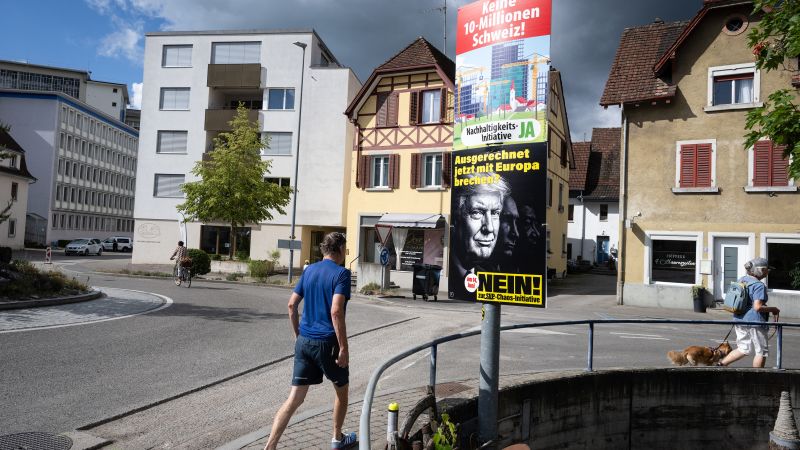
Switzerland’s ‘Brexit moment’: Population Cap Referendum Sparks EU Tensions
Switzerland s Brexit moment – Switzerland is on the brink of a historic decision this weekend as citizens prepare to vote on a proposal to cap the nation’s population at 10 million. The referendum, organized by the right-wing Swiss People’s Party (SVP), has ignited a national debate over immigration, economic growth, and cultural identity. If the measure passes, it would mark the first time a European country implements a formal population limit, potentially straining Switzerland’s relationship with the European Union (EU) and raising questions about its role as a neutral state.
Immigration and the Population Debate
The question before voters is straightforward: Should Switzerland’s population be capped at 10 million? With the current population hovering just above 9 million—a figure that has grown from 8.3 million a decade ago—the proposal reflects growing public concern over demographic changes. Government statistics reveal that over a quarter of residents are foreign-born, highlighting the country’s role as a regional hub for migrants. This influx, driven largely by its EU ties and central European location, has sparked tensions over resources, housing, and social cohesion.
“Uncontrolled immigration is pushing Switzerland toward rapid expansion,” the SVP asserts on its campaign website. “The negative consequences are visible in all areas of life, from housing markets to infrastructure, and many citizens feel like strangers in their own country.”
While the SVP frames the cap as a sustainability measure, critics argue it could jeopardize the nation’s economic health. Jürg Müller, director of the Swiss think-tank Avenir Suisse, warns that the proposal risks creating friction between businesses and workers. “Recent population growth, fueled by Switzerland’s economic success, has already strained housing and infrastructure,” Müller explains. “It’s not just about numbers—it’s about the strain on everyday life.”
Müller emphasizes that the surge in migration is directly tied to Switzerland’s economic appeal. “Quality of life remains high, and the country is strategically positioned in Europe,” he says. “Three hours to Paris, three hours to Milan—Switzerland offers a convenient lifestyle for those seeking stability.” However, this growth has also led to overcrowding, with residents reporting difficulties in accessing lakes, parks, and public services. “The feeling of overcrowding is palpable,” Müller notes. “It’s a sentiment the SVP has transformed into a political initiative.”
A Referendum System in Action
Switzerland’s unique political framework allows citizens to directly influence major policy decisions through referendums. For a proposal to qualify, it must secure at least 100,000 signatures from eligible voters within 18 months. The population cap initiative met this threshold, prompting the country to face a national vote. Recent polls indicate the outcome may be closely contested, with a May survey showing nearly equal support for both sides. More recent data from gfs.bern suggests the anti-cap faction now leads by a narrow margin, at 52%.
The referendum’s proximity to the EU has added another layer of complexity. Switzerland, though not a member, has maintained a free-movement agreement with the EU since 2002, enabling citizens to live and work across borders. This arrangement, combined with its membership in the Schengen area, has made the country a magnet for migrants from neighboring nations. “A significant portion of Switzerland’s foreign residents come from Italy, Germany, Portugal, and France,” the article states. “These four nations alone account for almost half of all foreign nationals in the country.”
Concerns Over Economic Impact
Business leaders caution that a population cap could disrupt Switzerland’s economy, which relies heavily on a skilled workforce. “Restricting immigration might leave companies scrambling to fill roles,” one analyst argues. “The labor market is already tight in certain sectors, and limiting the influx of foreign workers could slow economic growth.” Müller echoes this concern, noting that the country’s economic strength has historically been a draw for migrants. “Switzerland has long thrived on its low taxes and minimal regulations,” he says. “These factors have attracted talent from across Europe, and a population cap might threaten that advantage.”
Yet, the SVP insists that the initiative is not about closing borders but about managing growth. “We’re not rejecting migrants,” party officials claim. “We’re ensuring Switzerland can sustain its development without compromising its future.” This stance has divided the public, with some fearing the cap could lead to a brain drain, while others believe it is necessary to preserve the nation’s way of life.
Cultural Identity and Anti-Migration Rhetoric
Proponents of the cap argue that the proposal reflects a broader cultural shift. “The initiative addresses concerns about the loss of national identity,” one campaign slogan reads. “Switzerland’s charm and traditions are at risk from uncontrolled immigration.” The pro-cap website features imagery and rhetoric that highlight anxieties about cultural integration. A photo of a woman wearing a headscarf holding a Swiss passport is captioned “Loss of culture and identity,” while another section warns of “creeping Islamization” and claims that women in Swiss swimming pools are harassed by French nationals of North African origin.
“Studies show that certain migrant groups are disproportionately represented in criminal activity,” the campaign adds. “This has fueled public sentiment that migration is a threat to social stability.”
While the SVP emphasizes economic and environmental sustainability, some analysts see the proposal as a strategy to redirect public frustration. “The SVP has effectively used migration as a political tool,” Müller observes. “They’ve taken a widespread feeling of overcrowding and framed it as a crisis of national identity.” Delphine Klopfenstein, a Green Party member, criticizes the rhetoric as xenophobic. “The SVP makes foreigners scapegoats for societal challenges,” she says. “This approach is dangerous because it disguises economic concerns as cultural ones.”
A Nation in Flux
Switzerland’s population has tripled over the past century, a trend that has continued into the 21st century. By 2024, the country reached the 9 million mark, with immigration outpacing declining fertility rates. This growth has brought both opportunities and challenges, shaping the nation’s identity as a modern, multicultural society. “Switzerland’s success has always been rooted in its openness,” Müller acknowledges. “But that openness is now being questioned by a growing segment of the population.”
The referendum comes at a pivotal moment for Switzerland’s relationship with the EU. As the largest trading partner, the EU has been a key driver of migration to the country. “Switzerland’s economic stability is closely tied to its EU partnerships,” the article states. “Yet, the debate over population limits suggests a shift in priorities.” The SVP’s push for a cap could signal a desire to reduce dependency on the EU, potentially leading to renegotiations of existing agreements.
With the vote approaching, the nation stands at a crossroads. The outcome may determine whether Switzerland continues to embrace open borders or adopts a more restrictive model. For now, the referendum represents a test of public sentiment—and a potential harbinger of deeper political divides. “This is not just a question about numbers,” Müller concludes. “It’s a reflection of how Switzerland balances its traditions with its aspirations as a global economic player.”
