
Illegal excavation reveals grand Roman villa with elaborate mosaics
A Stolen Discovery: Unearthing a Roman Villa’s Hidden Treasures Through Illegal Excavation
Illegal excavation reveals grand Roman villa – Near the outskirts of Rome, a clandestine excavation has led to the revelation of a remarkable Roman villa, its intricate mosaics and architectural grandeur hidden for centuries beneath layers of earth. The excavation, uncovered by concerned neighbors, has sparked a wave of interest among archaeologists and historians, shedding light on a site that dates back to the Imperial era. The villa, located in the village of Castel di Guido—about 12 miles from Rome—was once part of a thriving settlement known as Lorium during the time of the Roman Empire. This newly exposed structure, now under investigation, is believed to have been a significant residence during the reign of emperors like Hadrian, Antoninus Pius, and Marcus Aurelius.
The Secret of Lorium
Historians suggest that Lorium, a hamlet of luxurious palaces, flourished between 27 BC and the fifth century AD. Its strategic location in the Roman countryside made it a favored spot for aristocrats and imperial officials. The villa’s discovery has reignited discussions about the region’s historical importance, with experts highlighting its potential connection to the Antonine dynasty. According to a press release from the Italian Ministry of Culture, the site’s exceptional quality of decoration indicates it was home to influential figures closely tied to the imperial court.
The excavation began when local residents noticed unusual activity at the property. With no signs of official permits, the Carabinieri military police were called in to investigate. Upon arrival, they identified the telltale signs of illicit work: shallow pits of disturbed soil, the use of heavy machinery, and the absence of markers indicating authorized digs. These clues pointed to tomb raiders, who often target archaeological sites for their valuable treasures. Such activities have contributed to the global trade of thousands of stolen artifacts, many of which have found their way into international collections.
Uncovering the Imperial Legacy
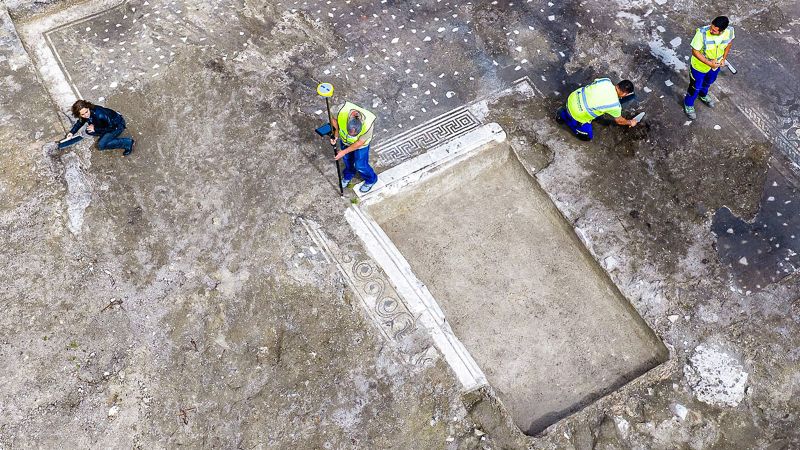
Authorities swiftly moved to halt the excavation, discovering a vast underground chamber that had been accessed via a backhoe. The looters had cut through protective fences, revealing a hidden section of the property that had remained untouched for millennia. Inside, archaeologists uncovered a grand entrance hall, featuring an atrium and a sunken basin—a sunken area used for collecting rainwater, known as an impluvium. Surrounding this space was a mosaic floor adorned with elegant black-and-white botanical and geometric patterns, showcasing the craftsmanship of the era.
Despite the damage caused by the illegal dig, the site still holds an astonishing array of well-preserved artifacts. Among the findings are elaborate marble carvings and a statue believed to depict Silvanus, the Roman god of the countryside, holding a small animal in one hand and a basket decorated with birds in the other. “The exceptional quality of the decorations testifies to the villa’s connection with the Roman aristocracy,” stated Alessia Contino, an archaeologist with the Special Superintendency of Rome, during the site’s unveiling this week. She emphasized that the mosaic designs and structural elements suggest a level of sophistication reserved for high-status individuals.
“Officials from the Ministry of Culture, in collaboration with the Carabinieri, stopped a clandestine operation,” said Italian Minister of Culture Alessandro Giuli in a statement. “They secured an archaeological area and brought to light the remains of a splendid Imperial-era villa in the Roman countryside where the residences of the Antonine dynasty were once located.”
The excavation’s abrupt end has allowed for a more methodical study of the site. While some of the villa’s structure was mildly damaged by the unauthorized digging, the majority of its features remain intact. The ministry has yet to confirm whether any artifacts were removed during the illicit operation, though it is clear the site holds immense historical value. The discovery underscores the risks of unregulated excavations, which can destroy irreplaceable evidence of ancient civilizations.
A History of Illicit Excavation
For decades, Italy has faced challenges from tomb raiders who plunder sites in search of valuable relics. These looters often target areas with rich historical deposits, using rudimentary tools to extract artifacts that are then sold on the black market. The Ministry of Culture reported that hundreds of such items have been recovered over the years, many of which have been traced back to American and European museums. Some of these stolen pieces have been returned after years of legal battles, thanks to collaborative efforts between international institutions and Italian authorities.
The current excavation serves as a stark reminder of the ongoing battle against illegal artifact trafficking. The use of modern equipment, such as backhoes and drills, has made it easier for looters to strip sites of their treasures quickly. However, the discovery of the villa’s intact mosaics and other remnants highlights the importance of swift intervention. “This site is a testament to the skill and ambition of Roman builders,” Contino added. “Its preservation provides invaluable insight into daily life and imperial culture during this period.”
Further investigations are expected to uncover more details about the villa’s purpose and its connection to the Imperial era. The general public will have the chance to view the site for the first time on Saturday, with guided tours available by appointment. The Ministry of Culture plans to announce additional dates in the coming months, allowing wider access to the find. This event marks a pivotal moment in the study of Roman architecture, offering a rare glimpse into the opulence of a residence that once belonged to a powerful faction of the empire.
As the excavation continues, experts are working to piece together the villa’s story. The mosaic floor, for instance, may contain symbols or motifs that reflect the owner’s status or the villa’s function. The presence of the Silvanus statue could indicate the site’s agricultural or religious significance, tying it to the broader network of Roman estates. These findings not only enrich our understanding of the past but also highlight the urgent need to protect archaeological heritage from future threats.
The Path Forward
With the excavation now under official control, the focus has shifted to conservation and analysis. The villa’s artifacts will be carefully cataloged, with some destined for museum displays and others studied in situ. The ministry has also pledged to increase security measures at the site to prevent further damage. “This discovery is a reminder of how much history still lies beneath our feet,” Giuli noted. “It is our duty to preserve these treasures for future generations.”
The incident has sparked debates about the balance between public access and preservation. While illegal excavations often yield quick results, they risk compromising the integrity of historical sites. In contrast, the careful work of archaeologists ensures that each layer of the past is documented with precision. The villa in Castel di Guido exemplifies this tension, as its grandeur is now a shared treasure, protected by the very institutions that once allowed it to be plundered.
As the world watches this unfolding story, the villa stands as a symbol of both the dangers and the rewards of archaeological discovery. Its mosaics, once hidden from view, now offer a tangible link to a bygone era, enriching the narrative of Roman life and legacy. The collaboration between the Ministry of Culture and the Carabinieri has proven that vigilance and teamwork can salvage history from the brink of loss. For now, the villa remains a quiet monument to the past, waiting to share its secrets with those who seek to uncover them.
