
Israeli Strike on Syrian Airbase Ignites Debate Over Netanyahu’s Electoral Calculus
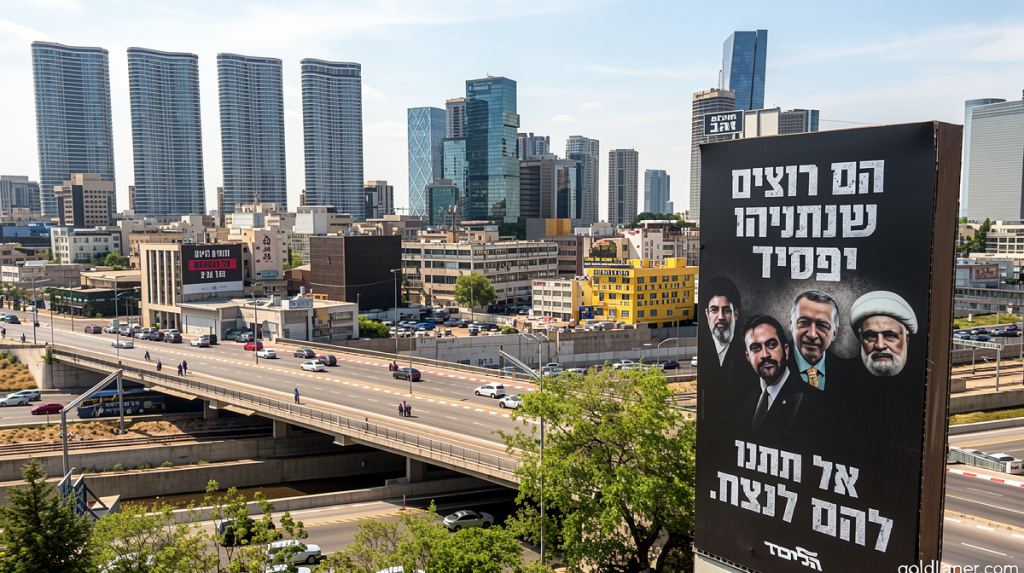
Goldlaner.com – Israeli fighter jets struck the Abu al-Dahar airbase in northern Syria, hitting what officials described as a nascent Turkish military buildup. The operation landed with extraordinary political weight because it came barely two months before Israel’s next general election, and because Prime Minister Benjamin Netanyahu had already placed Turkey at the visual center of his campaign apparatus. A massive billboard along Tel Aviv’s principal highway depicted Recep Tayyip Erdogan flanked by Iran’s supreme leader, Hezbollah’s commander, and New York City Mayor Zohran Mamdani, all framed as adversaries of Israel beneath the rallying cry: “They want Netanyahu to lose. Don’t let them win.”
The juxtaposition of campaign imagery and kinetic action has generated a sharp question inside Israel and across the broader Middle East: is the prime minister responding to a real strategic danger, or is he inflating a manageable friction point to shore up his standing at the ballot box?
The Operational Justification
Israel’s official line is straightforward. Netanyahu and Defense Minister Israel Katz both stated that intelligence indicated Ankara was preparing to station forces and equipment at the airbase. An Israeli military source explained that the IDF had collected information on Turkish plans to deploy personnel, drones, and air-defense systems at the site. Such a deployment, the source noted, would constrain Israel’s freedom of action in Syrian airspace and shift the regional strategic balance.
A second source added that the intelligence had been shared with the Trump administration and with Syria’s President Ahmed Al-Sharaa. Over the preceding year, Israel and Syria conducted deconfliction talks that Netanyahu characterized as producing a “status quo in security matters.” Following the strike, Mossad chief Roman Goffman met Syrian Foreign Minister Asaad al-Shaibani in Jordan on Sunday to manage the latest round of tension, per the Syrian state news agency.
Turkey’s Rebuke and the Timing Question
Ankara rejected the Israeli account as “untenable.” The Turkish government accused Netanyahu of “pursuing expansionist and destabilizing policies in the region” ahead of the October vote and affirmed its intention to continue cooperating with Damascus “on a legitimate basis for the establishment of peace, stability, and prosperity.”
Tom Barrack, who serves as US President Donald Trump’s envoy to Syria and ambassador to Turkey, issued what amounted to a rare public rebuke of the strike. Speaking with podcaster Mario Nawfal, Barrack called the operation an “unnecessary escalation” and floated a “theory” that Israel “simply tried to bait Turkey.” He characterized the move as “a very aggressive move, but one that might play well going into elections.”
The Netanyahu–Erdogan Feud in Context
The prime minister’s office sharpened its rhetoric against Erdogan on Friday, branding him in an X post as an “antisemitic tyrant who oppresses his own people.” The two leaders have maintained a public feud for years, one that intensified dramatically during the wars in Gaza, Lebanon, and Iran. Erdogan has called Netanyahu a war criminal and repeatedly accused Israel of atrocities in Gaza; Netanyahu has in turn accused Erdogan of backing Hamas. More recently, Netanyahu voiced opposition to the sale of US F-35 fighter jets to Ankara, warning of Erdogan’s “aggressive ambitions” in the region.
Netanyahu and Katz have pushed back on the political-motive narrative, warning instead of an impending Turkish footprint in Syria.
“We will not tolerate a military Turkish presence taking root in Syria and threatening Israel,” Netanyahu said last week.
Why the Timing Matters
Throughout decades in Israeli politics, Netanyahu has cultivated the persona of “Mr. Security,” the leader uniquely equipped to confront any threat facing the state. He is also a seasoned political operator with a long record of converting crises into electoral advantage. The proximity of the strike to his campaign messaging has made it difficult for observers to separate the operational from the political.
Amos Harel, a senior security analyst for the leftwing Haaretz newspaper, argued that both explanations carry weight. He noted that there are genuine indications Erdogan’s approach toward Israel is hostile and that Turkey is undertaking various military moves in Syria, some of which concern the IDF directly. At the same time, the electoral calendar cannot be ignored when a leader’s most visible foreign-policy action lands weeks before a vote.
Broader Regional Implications
The strike lands at a moment when Syria’s post-Assad government is still consolidating control over its territory and navigating competing external influences. Turkey’s stated interest in maintaining a security buffer along its southern border has long been a point of friction with Damascus. Israel, for its part, has sought to ensure that no foreign military presence—Turkish, Iranian, or otherwise—materializes within range of its own air operations. The Abu al-Dahar incident underscores how tightly intertwined the Syrian question, the Turkish question, and Israel’s domestic political calendar have become.
For voters heading to the polls in October, the episode will likely feature prominently in campaign discourse. Netanyahu’s camp will frame it as evidence of decisive leadership against encroachment; his rivals will frame it as manufactured confrontation designed to rally a security-minded electorate. The billboard on the highway, with its lineup of foreign adversaries, already signals which narrative the prime minister intends to amplify.
Related Reading
Frequently Asked Questions
What is As elections near Netanyahu casts Turkey?
As elections near Netanyahu casts Turkey is the main topic of this guide. The article explains the context, practical details, and next steps readers should understand.
Why does As elections near Netanyahu casts Turkey matter?
As elections near Netanyahu casts Turkey matters because readers are looking for a useful answer, not just a short summary. Good content should match search intent and help them decide what to do next.