
Ancient Sherwood Forest oak tree reputed to have sheltered Robin Hood has died
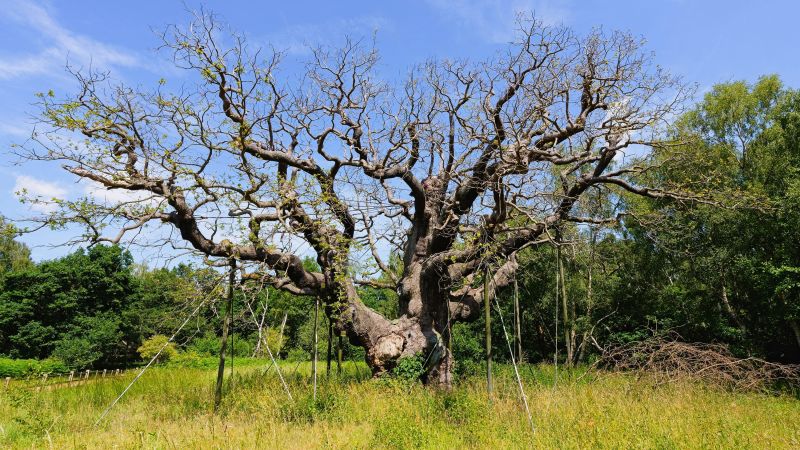
Ancient Sherwood Forest Oak Tree, Linked to Robin Hood, Has Passed Away
Ancient Sherwood Forest oak tree reputed – In the heart of England’s Sherwood Forest, a towering oak tree once believed to be the secret refuge of the legendary outlaw Robin Hood has succumbed to the passage of time. The tree, known as the Major Oak, has stood for over a millennium, becoming a symbol of the forest’s storied history and the enduring myth of the Robin Hood legend. British conservationists, including the Royal Society for the Protection of Birds (RSPB), have confirmed its death after it failed to sprout new foliage during the spring season, marking the end of an era for this iconic natural landmark.
A Monument to Myth and Nature
For centuries, the Major Oak has been a focal point for those drawn to the folklore of Robin Hood, a figure who stole from the wealthy to aid the poor and evaded the Sheriff of Nottingham. The tree’s connection to the legend is not just a matter of popular culture—it has been part of the forest’s identity for generations. Its massive size, with a canopy spanning 28 meters (92 feet) and a trunk circumference of 11 meters (36 feet), has made it one of the most significant trees in Britain. Despite its grandeur, the tree’s fate has been shaped by the very people it inspired.
Historical efforts to preserve the Major Oak have included structural supports for its branches, installed in the early 1900s, and fencing around its base in the 1970s to protect it from damage. However, these measures, while intended to sustain the tree, may have inadvertently contributed to its decline. Soil compression, exacerbated by heavy foot traffic from visitors, has created a rigid layer around the roots, limiting their ability to absorb nutrients. This, combined with the prolonged effects of extreme heat and drought, has taken a toll on the tree’s health.
“While the Major Oak team worked tirelessly to revive the environment around this iconic tree—and saw encouraging signs of life in some areas—the damage, it now seems, was already too deeply entrenched to fully reverse.”
Simon Parfey, a managing director at SoilBioLab, who collaborated with conservationists to maintain the tree, shared this assessment in a recent press release. His comments highlight the challenges faced by the Major Oak, even with dedicated care. The tree’s decline coincides with a period of intense environmental stress, including five consecutive summers of record-breaking temperatures. Reg Harris, an arboriculture director at Urban Forestry, noted that the most recent heatwave, particularly the July 2022 event where the UK recorded temperatures of 40 degrees Celsius, accelerated its deterioration.
The Legacy of a Living Legend
The Major Oak’s role in the Robin Hood narrative has evolved over time. While the earliest surviving medieval accounts of the outlaw’s exploits do not specifically mention the tree, they do reference “trystle trees” used as meeting points by Hood and his followers. Alex Brown, an associate professor of history at Durham University, explained in an email that these trystle trees were likely linked to a prominent landmark within the forest, possibly the Major Oak itself. “It is, of course, possible that this meeting tree would have been associated with a distinctive tree within the Forest from a very early stage in the legend,” Brown added.
Though the tree is no longer alive, its influence continues to shape the cultural and ecological landscape of Sherwood Forest. Hollie Drake, a senior site manager at RSPB Sherwood Forest, emphasized that the Major Oak will remain a natural monument, inspiring visitors and contributing to the forest’s ecosystem even in its absence. “The Major Oak will continue to stand at the heart of Sherwood as a natural monument for visitors to come and see,” Drake said, adding that its legacy will endure in the stories and traditions it has helped sustain.
Conservationists have long recognized the tree’s importance beyond its mythical ties. Acorns and cuttings from the Major Oak have been used to grow new saplings, which have been planted in locations around the world. One notable example is the tree’s descendants in Winfield House, the residence of the US ambassador in London. These efforts ensure that the spirit of the Major Oak lives on, even as its original form fades into history.
Challenges of Preservation
The death of the Major Oak underscores the delicate balance between preserving natural landmarks and accommodating the demands of tourism. Sherwood Forest, located near Nottingham in central England, has long drawn crowds eager to connect with the Robin Hood myth. However, the influx of millions of visitors has placed significant pressure on the tree’s environment. The RSPB noted that the heavy foot traffic and the accumulation of debris have compacted the soil, creating a solid, almost concrete-like layer that restricts root growth and water absorption.
Simon Parfey further explained that the tree’s decline was not sudden but the result of cumulative stressors. “The combination of soil compression and the repeated exposure to harsh weather conditions has likely weakened the tree’s ability to recover,” he stated. Conservationists had hoped that these efforts would mitigate the damage, but the final confirmation of the Major Oak’s demise suggests that the tree’s vitality could not be restored. This loss serves as a reminder of the fragility of ancient ecosystems and the need for ongoing stewardship.
While the Major Oak’s death is a poignant moment for history enthusiasts, its presence has left an indelible mark on the forest’s ecology. The tree’s massive roots once supported a diverse range of flora and fauna, and its canopy provided shelter for countless species. Even in its absence, its remnants will continue to play a role in the forest’s environment. “The tree will still provide support to the forest’s ecosystem in death as in life,” Hollie Drake reiterated, emphasizing the interconnectedness of nature and legend.
A Future in Myth and Memory
Despite its passing, the Major Oak remains a powerful symbol of the past. Its story is woven into the fabric of Sherwood Forest, where it has stood as a silent witness to centuries of history. For those who visit the site, the tree’s legacy offers a glimpse into the world of Robin Hood and the enduring appeal of his exploits. As Chloe Ryder, the RSPB’s estate operations manager, noted, “The tree has seen an enormous amount of activity, and its decline has corresponded with the changing climate and the pressures of modern tourism.”
Ryder also expressed hope that the Major Oak’s legacy will continue to inspire future generations. “With proper care, the Major Oak could remain standing for decades, even centuries,” she said, highlighting the possibility of new saplings taking root in its place. The RSPB has already begun planning for the tree’s future, including measures to ensure that its historical and ecological significance is not forgotten. While the original tree is now gone, its story will live on through the trees that grow from its seeds and the stories that have been told for centuries.
The Major Oak’s demise marks the end of an era but also opens a new chapter in the forest’s history. Its role as a symbol of resistance and freedom will continue to resonate with visitors, even as its physical presence diminishes. The tree’s journey—from a thriving ancient giant to a cherished monument—reflects the enduring power of both nature and myth. As conservationists and historians work to preserve its legacy, the Major Oak remains a testament to the resilience of the past and the challenges of protecting it in the present.
For those interested in the intersection of science and myth, the Major Oak’s story is a compelling reminder of how human activity and natural forces shape the world. Its death is a moment of reflection, but also an opportunity to appreciate the efforts made to sustain it. As the RSPB continues its work in Sherwood Forest, the Major Oak’s legacy will endure, ensuring that its role in the Robin Hood legend remains a part of the region’s cultural heritage for years to come.
Sign up for CNN’s Wonder Theory science newsletter to explore more stories like this, including fascinating discoveries and scientific advancements that shape our understanding of the world.
