
A 48-star US flag, the size of a single bedroom apartment, has draped a Minnesota community in red, white and blue mystery
A 48-Star American Flag Unveiled in Minnesota’s Historical Mystery
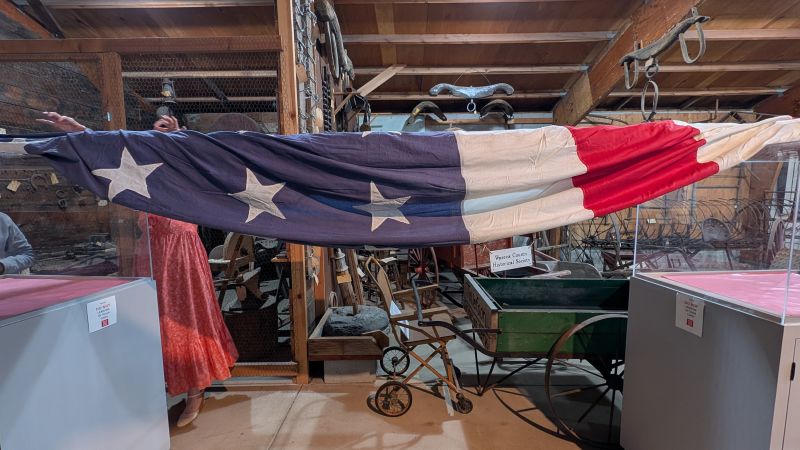
A 48 star US flag the size – During the routine cleanup of a historic cabin for the annual Waseca County fair, a peculiar object caught the eye of local volunteers. Tucked into the eaves of the structure, a large bundle wrapped in oil cloth was uncovered, sparking curiosity among the community members. “What’s that?” one county commissioner asked as the group gathered, their attention drawn to the mysterious item. After careful removal, the bundle revealed 13 wide red and white fabric strips, each about 1.5 feet in width, stitched together into a pattern that suggested a flag. When fully unfurled, the banner measured 19 by 36 feet, spanning over 680 square feet—an area comparable to a small one-bedroom apartment in New York City. The discovery has left residents in Minnesota wondering about its origins, its maker, and its historical significance.
The Historical Puzzle of the Flag’s Design
Historians at the Waseca County Historical Society are piecing together the flag’s story. The 48 stars on the blue field indicate a design from the early 20th century, specifically the era before Alaska and Hawaii joined the United States in 1959. This configuration was last used in 1912, when New Mexico and Arizona became states, increasing the total number of stars from 45 to 48. “The United States emerged from the Great Depression and World War II as one of the leading nations of the world,” noted the National Park Service, highlighting the flag’s symbolic connection to that pivotal period in history.
The flag’s construction offers additional clues. Its white stars, each larger than an outstretched hand, are arranged in six horizontal rows. However, the maker(s) missed some edges on several stars, a detail that hints at the craftsmanship involved. “It’s very uneven, and you can tell multiple people had their hands going to make it come to life,” Elizabeth Anselmo, a member of the historical society, told CNN. The combination of hand-stitched stars and machine-sewn stripes suggests a blend of traditional and modern techniques, indicating the flag may date to a time when both methods coexisted.
A Relic of Community and Ceremony
Until recently, the flag had been stored rolled up in a county fair building, untouched for decades. Its size made it challenging to display without risking damage, as the US Flag Code mandates that the flag should not touch the ground. Volunteers would only reveal small sections of it at a time, carefully rolling it out to avoid any contact with the floor. This cautious handling, while preserving the flag, also deepened the enigma surrounding its history.
“It probably came in more than 50 years ago, and nobody that currently works here, or recently worked here, knows,” said Amy Danielson, former co-director of the Waseca County History Center. The lack of a formal record has left the society without a clear timeline or provenance. “It’s not catalogued… so that makes it more mysterious,” she added. The flag’s sheer scale implies it was designed for visibility, possibly as a ceremonial display. Yet, the question remains: where was it displayed, and who once beheld its colors?
The Challenge of Unfurling a National Treasure
To finally examine the flag in its entirety, the historical society sought assistance from the local fire department. The plan was to hoist the massive fabric, but the existing wooden brace along the edge nearest the flagpole posed a challenge. Without significant reinforcement, the structure could not support the weight of the fully unfurled flag. “The uneven workmanship of the double stitching suggests it was likely made by amateurs,” Anselmo explained, emphasizing the blend of skill and effort that went into its creation.
Despite the difficulties, the society rallied over 50 volunteers and community representatives to help. On Monday morning, the group gathered at the fairgrounds hall, ready to take on the task. The event marked a pivotal moment in the flag’s history, as it was about to be revealed in a way it hadn’t been since its storage began. The process of unfurling the flag was both a logistical challenge and a symbolic act of honoring its legacy. “Its size alone tells us it was meant to be seen,” Danielson said. “But the real question is: where was it seen, and by whom?”
While the flag’s origin remains uncertain, its presence in a historic cabin suggests a possible connection to early 20th-century communities. The cabin, part of the fairgrounds exhibit, has been a focal point for local history enthusiasts, and the flag’s discovery has added a new layer to its significance. Historical society members are now scouring archives, consulting experts, and reaching out to former residents to trace its journey. Each thread and stitch may hold a story, but the mystery of its creation and purpose continues to intrigue those who study it.
The flag’s design and construction reflect the era’s transition from handcrafted artistry to industrial production. The careful placement of the stars, the machine-sewn stripes, and the partial hand-stitching all point to a community effort rather than a commercial product. “It’s a mix of old and new,” Anselmo said, noting that the flag could symbolize a time when traditional methods and modern tools were still intertwined. Whether it was a gift for a local event, a symbol of pride for a community, or a hidden treasure waiting to be found, the 48-star flag now stands as a testament to Minnesota’s historical curiosity and the enduring fascination with American symbols.
As the community prepares for the final reveal, the flag’s potential role in local history is being reimagined. The act of unrolling it may not only restore its physical presence but also connect it to the stories of those who once raised it. For now, the historical society remains dedicated to uncovering the full narrative behind this remarkable artifact, ensuring its place in the annals of American heritage. The journey to decode its past is far from over, but the red, white, and blue mystery has already captured the imagination of a whole town.
