
The chef with 18 Michelin stars who’s still largely undiscovered outside of France
The chef with 18 Michelin stars who’s still largely undiscovered outside of France
A legacy rooted in Parisian tradition
The chef with 18 Michelin stars – Nestled along the iconic Champs Élysées, the Pavillon Ledoyen stands as a testament to the rich history of French gastronomy. This Neoclassical structure, with its buttercream and forest green exterior, has long been a cultural landmark, having hosted literary giants like Monet, Degas, and Zola since 1792. Some say it even witnessed the first meeting between Napoleon Bonaparte and Joséphine de Beauharnais, though the exact details remain a matter of local lore. Today, the building is a prestigious venue, its legacy preserved through the hands of chefs who have continued to elevate its status.
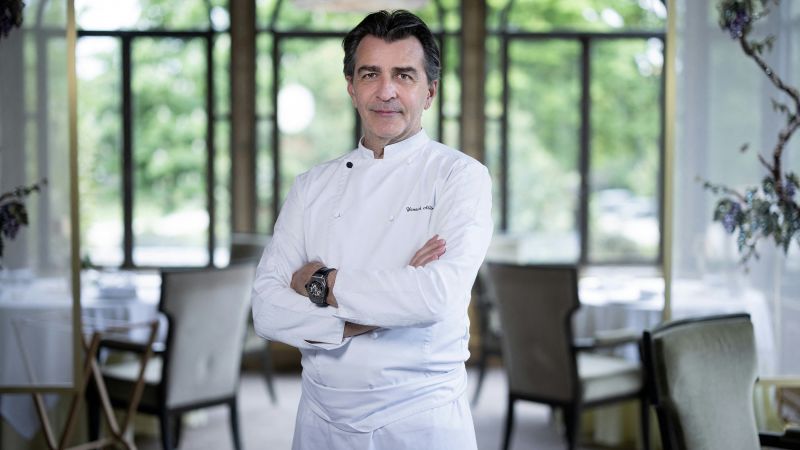
When Yannick Alléno took over as head chef, he brought a bold vision to the table. Known for his mastery of flavors, Alléno swiftly transformed the space into a beacon of culinary excellence. Just seven months after opening his own restaurant under the Pavillon Ledoyen’s name, he earned three Michelin stars—a remarkable feat that underscored his ability to redefine the boundaries of classic French cuisine. His success has since expanded beyond the capital, with a network of 21 eateries worldwide, each contributing to his impressive tally of 18 stars, a record shared with Alain Ducasse.
Despite his global reach, Alléno remains a household name primarily within France. His innovations, particularly in the art of sauce-making, have earned him a place among the country’s most celebrated chefs. Yet, his influence is quietly growing, as evidenced by his recent venture into the world of fast-casual dining. Earlier this year, during the 2026 Michelin Guide France & Monaco ceremony, Monsieur Dior—a restaurant he established in the historic building where the fashion house Dior was founded—secured its first Michelin star. This achievement highlights his ability to adapt traditional techniques to modern tastes, even as he maintains a deep respect for the foundations of French cooking.
From the suburbs to the world stage
Alléno’s journey began in the Parisian suburbs, where he was raised in a large family that embodied the spirit of everyday French life. His parents ran a beloved neighborhood bistro, and his grandmother and cousins played a pivotal role in shaping his early culinary interests. “It was thanks to them that I was inspired to pursue this career,” he explains in a conversation with CNN Travel. His upbringing, he notes, was anything but glamorous—more akin to the pages of a novel than the glossy pages of a Michelin guide.
After honing his skills in Paris’ elite kitchens, Alléno became a protégé of some of the city’s most respected chefs, many of whom held the prestigious Meilleurs Ouvriers de France title. This honor, reserved for culinary artisans, reflected the high standards of the French gastronomic tradition he was eager to embrace. His first breakthrough came in 2000, when he earned a Michelin star at Scribe, a restaurant known for its fine dining reputation. This early success laid the groundwork for his later ventures, including his six-star career at the legendary Le Meurice and Le 1947 à Cheval Blanc, both located in the French Alps and the ski resort of Courchevel.
But Alléno’s ambitions extended far beyond France. He has since opened restaurants in Monaco, Dubai, the UK, Japan, the UAE, South Korea, and Qatar, each tailored to the tastes of its local audience. His expansion strategy is deliberate, blending the essence of French cuisine with international influences. At Pavyllon London, nestled within the Four Seasons Hotel, he introduced a Michelin-starred breakfast menu, further demonstrating his adaptability. “I come from a big family, one of those families that feels out of the novels we romanticize today,” he tells CNN Travel. This humble yet confident perspective underscores his ability to balance tradition with innovation.
Reviving the saucier’s craft
Alléno views Michelin stars not as a static achievement but as a validation of his evolving philosophy. For him, the stars represent the proof that his approach to cooking—rooted in creativity and precision—resonates with discerning palates. He has long been fascinated by the role of sauce in French cuisine, describing it as “the verbs of French cuisine” that bind ingredients into a unified experience. Under Auguste Escoffier’s 19th-century framework, the Saucier was one of the most revered positions in a kitchen, but this role diminished with the rise of nouvelle cuisine in the 1970s.
Now, Alléno is reviving the saucier’s art with a modern twist. His technique, which he calls “extractions,” involves methods like dehydration, fermentation, and cryoconcentration to distill the core of a flavor into a single spoonful. This approach transforms once-complex ingredients, such as beef fillet and asparagus, into dishes that feel both familiar and revolutionary. “It means that all of the reform we’ve undertaken actually works,” he says, reflecting on the impact of his work. His goal is not to replace tradition but to build upon it, creating a new language for French cooking that speaks to contemporary sensibilities.
His dedication to this craft is evident in the way he has reinvented the dining experience at the Pavillon Ledoyen. The restaurant’s heritage-listed dining room, bathed in sunlight, now serves as a stage for his bold interpretations. Diners pay upwards of 330 euros, or roughly $390, for a meal that combines historical grandeur with avant-garde techniques. Even within this iconic space, Alléno has introduced two additional venues: the two-star L’Abysse Paris, which fuses Franco-Japanese elements, and Pavyllon Paris, a one-star establishment that offers a more accessible take on high-end French fare.
While his name may not yet echo globally as it does in France, Alléno’s influence is undeniable. His ability to balance tradition with experimentation has allowed him to maintain a loyal following while attracting new audiences in diverse markets. Yet, he remains grounded in his origins, often speaking of the Parisian streets and bistro culture that first ignited his passion. “The stars are just a reflection of the work we do,” he says. “But they also show that there’s room for reinvention.”
As the world of gastronomy continues to evolve, Alléno’s story exemplifies the enduring power of French cuisine. His success, measured not only in accolades but in the satisfaction of his patrons, speaks to a broader truth: that even in an era of fast food dominance, the foundations of haute cuisine can still inspire and transform. His journey from a suburban upbringing to a global culinary icon is a reminder that innovation often begins with a deep respect for the past—and the courage to reimagine it for the future.
