
Teenager stuns Novak Djokovic at Roland Garros in another major upset
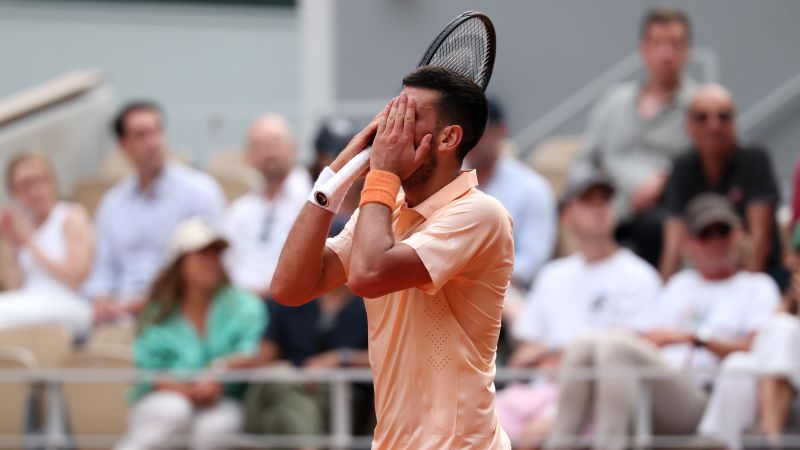
João Fonseca Upsets Novak Djokovic at Roland Garros in Historic Grand Slam Victory
Teenager stuns Novak Djokovic at Roland – Novak Djokovic’s bid for a record-breaking 25th Grand Slam title took an unexpected turn at Roland Garros, as the 19-year-old Brazilian João Fonseca stunned the Serbian tennis legend in a third-round clash. The match, which stretched into five sets, ended with a 4-6, 4-6, 6-3, 7-5, 7-5 result, marking Fonseca’s first major triumph and Djokovic’s first loss to a teenager in the tournament’s history. The outcome has shaken the tennis world, casting doubt on Djokovic’s ability to retain his dominance as the men’s singles tournament faces a seismic shift in momentum.
The Unstoppable Force of João Fonseca
Fonseca, ranked 28th in the world, clawed his way back from a seemingly insurmountable deficit to dethrone one of the sport’s most decorated players. After Djokovic took control of the first two sets, the Brazilian challenger displayed remarkable resilience, overturning the deficit with a series of composed performances. His relentless power and calculated patience became defining elements of the match, as he managed to outmaneuver the 39-year-old Serbian star, who had previously maintained an impressive 289-1 record in majors when leading two sets to none.
While Djokovic was enduring the physical toll of the Parisian sun, Fonseca appeared to grow stronger, fueled by a booming serve that shifted the dynamics of the game. The youngster’s ability to capitalize on key moments—such as his decisive return of a drop shot—highlighted his growing maturity. As the fifth set unfolded, Fonseca’s serves dominated the court, culminating in a series of aces that sealed his victory. “I felt like John Isner,” he joked during his post-match interview, referencing the retired American known for his explosive first serve. The comparison underscored Fonseca’s belief in his own potential, even as he credited his fellow Brazilians in the crowd for their unwavering support.
A Record-Breaking Moment in Doubt
Djokovic’s quest to surpass the Grand Slam record of Margaret Court, which he had previously shared with the Australian legend, now hangs in the balance. The loss marks not only his first defeat to a teenager at Roland Garros but also a rare moment of vulnerability in an era where he has been nearly invincible. As the on-court clock ticked past four hours and 53 minutes, the match became a testament to the unpredictable nature of tennis, where even the most seasoned champions can be toppled by a bold underdog.
With Carlos Alcaraz and Jannik Sinner both absent from the tournament, Fonseca’s victory has created an opening for a new contender to emerge. The absence of two top-ranked players—Alcaraz, the reigning champion, and Sinner, who had struggled earlier in the event—allowed Fonseca to rise as the unexpected hero. Djokovic, who had been expected to cruise to victory, found himself on the defensive, his game exposed by Fonseca’s relentless pressure and tactical precision. The match was a rollercoaster of emotions, with Fonseca’s crowd-pleasing moments, including a birthday shoutout to his mother, adding a personal touch to the historic upset.
The Turning Point: A Five-Set Thriller
The turning point came in the fifth set, when Fonseca seized control with a deft touch that countered Djokovic’s aggression. After exchanging blows, the Brazilian capitalized on a dropped shot by Djokovic, returning it with a finesse that left his opponent stunned. The crowd’s reaction shifted dramatically, with many in attendance sensing the possibility of an epic comeback. Fonseca’s confidence surged as he dominated the final stages, his serves becoming a weapon that dismantled Djokovic’s rhythm.
Djokovic, who had seemed in command after the first two sets, was visibly fatigued by the end of the match. His signature poise wavered as he struggled to maintain consistency, while Fonseca’s ability to adapt and seize opportunities proved decisive. The teenager’s victory was not just a personal milestone but also a symbolic moment for the sport, as it signaled the arrival of a new generation of players challenging the old guard. “It’s a pleasure just stepping on the court against him,” Fonseca said in his TNT interview, expressing gratitude for the honor of facing one of the greatest ever.
Djokovic’s Reflections and the Tournament’s New Direction
Following the match, Djokovic displayed his trademark grace, acknowledging Fonseca’s achievement with a heartfelt embrace at the net. “He played an unbelievable match and should be proud of himself,” the Serbian said, highlighting the respect he felt for his opponent. Despite the loss, Djokovic remained optimistic, vowing to remain competitive in future matches. When asked if this could be his last appearance at Roland Garros, he replied, “I don’t know,” underscoring the uncertainty that now looms over his legacy.
The implications of Fonseca’s victory are profound. For the first time since the 2024 Australian Open, the men’s singles tournament is guaranteed to produce a new Grand Slam champion, with Fonseca now positioned as a formidable threat. His triumph has also drawn comparisons to the likes of John Isner, who once redefined the game with his thunderous serves. Fonseca’s ability to blend raw power with strategic patience has positioned him as a “generational talent,” according to tennis analysts. The match, described as “an all-time match” by fans, will be remembered as a defining moment in the evolution of the sport.
A Fairytale for the Young Star
Fonseca’s journey to this moment has been a fairytale in the making. From the outset, the 19-year-old had shown flashes of brilliance, but his victory at Roland Garros has transformed those glimpses into a full-fledged narrative. The crowd’s support, which had initially been reserved for Djokovic, gradually shifted to Fonseca as the match unfolded. His celebration after the final point, which included a beaming smile and a nod to his mother in the stands, captured the joy of a player who had turned his dreams into reality.
The final moments of the match were particularly dramatic, with Fonseca’s three consecutive aces in the fifth set sealing his fate. These aces, which flew past Djokovic’s defenses with unrelenting force, became the talking point of the day. The crowd erupted in applause, and social media platforms buzzed with reactions, including a tweet that highlighted the pivotal point: “THE POINT THAT SEALED IT FOR JOÃO FONSECA 🔥🇧🇷AN ALL-TIME MATCH.” The hashtag #RolandGarros trended globally, with fans celebrating the underdog’s rise and questioning the future of Djokovic’s reign.
Looking Ahead: The Road to the Final
Fonseca’s next challenge will be a Sunday showdown against Casper Ruud, who secured a hard-fought five-set win over Tommy Paul on Friday. The Norwegian, known for his tenacity, will be eager to test Fonseca’s newfound confidence. For Djokovic, the loss is a reminder of the stakes in this tournament, where the pressure to perform is relentless. Even with the absence of his fiercest rivals, the Serbian star will need to regroup quickly if he hopes to reclaim the title.
The match has already reshaped the narrative of Roland Garros, which is typically a stronghold for Djokovic. His defeat has opened the door for a new era of competition, with Fonseca’s victory serving as a catalyst for optimism. As the tournament progresses, fans will be watching closely to see if this moment signals the beginning of a new dynasty or merely a fleeting setback for the game’s longest-reigning champion. Regardless of the outcome, one thing is certain: the world of tennis has been forever changed by this unexpected upset.
As the dust settles on the third-round clash, the focus shifts to Fonseca’s potential to carry this momentum into the later stages of the tournament. His performance has not only showcased his talent but also his ability to thrive under pressure—a trait that could define his career. For Djokovic, the loss is a lesson in humility, proving that even the most dominant players must adapt to survive. The men’s singles tournament is now a stage for the unscripted, where history is written with every serve, every volley, and every moment of brilliance.
