
A Southern city’s ‘50-year overnight success story’
A Southern city’s ‘50-year overnight success story’
A Southern city s 50 year – On a warm spring evening, the streets of downtown Greenville buzz with activity as baseball enthusiasts, music lovers, and families enjoying weekend dinners move through the lively sidewalks. This vibrant atmosphere is a far cry from the decline of the 20th century, when American towns experienced a loss of urban vitality as suburbs grew and air-conditioned malls became the primary destinations. Today, Greenville’s downtown thrives with energy, its historic core reimagined as a hub of culture, commerce, and community. The city’s transformation is emblematic of a broader revival across the South, where once-silent streets now echo with the footsteps of residents and visitors alike.
Reviving the Heart of the City
The heart of Greenville’s renaissance lies in its historic downtown, anchored by the Swamp Rabbit Trail—a 28-mile pedestrian and bike network that connects the city to its natural surroundings. Lined with parks, local businesses, and community spaces, the trail has become a lifeline for residents and tourists, fostering a renewed appreciation for urban living. Alongside this green corridor, the city has cultivated a dining scene that blends innovation with tradition, featuring establishments like a Michelin-starred restaurant that has joined a growing roster of culinary venues.
Art and culture have also found a fresh foothold in the area. What was once a thriving textile district now hosts a friendly arts district, with galleries, studios, and creative spaces repurposed from old mill buildings. Nearby, serene lakes and expansive state parks offer opportunities for outdoor recreation, from hiking to kayaking. The city’s performing arts landscape has expanded too, with two new concert venues recently joining a lineup that includes Broadway shows and major arena acts. Minor league baseball games further draw crowds to the historic West End, where a handsome ballpark has become a symbol of Greenville’s blend of old and new.
From Downturn to Revival
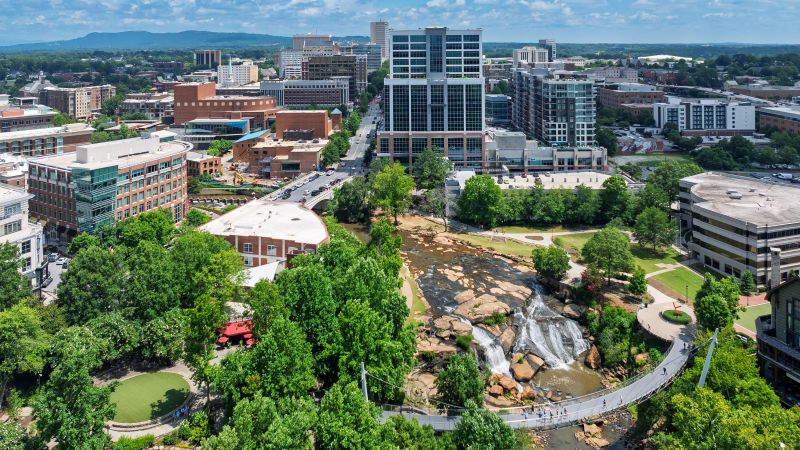
Greenville’s journey from decline to resurgence began decades ago, but its most dramatic shift occurred in the early 2000s. A pivotal moment was the removal of the four-lane bridge that once spanned the Reedy River, a decision that sparked both debate and optimism. The former bridge, which dominated the skyline, gave way to a redesigned Falls Park on the Reedy, now home to a curved pedestrian suspension bridge that crosses over a rare natural urban waterfall. This transformation, hailed as one of the city’s most significant revitalizations, has reshaped the area into a beloved public space.
“We tend to call it ‘a 50-year overnight success story,’” said Russell Stall, executive director of the Greenville County Historical Society. “The changes have been remarkable, but they didn’t happen overnight.”
Stall’s perspective highlights the long-term effort behind Greenville’s rebirth. In the 1980s, the same area that now radiates charm was known for its grit, serving as a hub for drugs and prostitution. The Reedy River, once called the “Rainbow Reedy” due to the dyes and chemicals from the textile industry, was a stark reminder of the city’s industrial past. Greenville, which earned the nickname “Textile Capital of the World” in the early 20th century, saw its mills fall silent in the 1970s as manufacturing declined and suburbs expanded. Yet, this period of stagnation set the stage for a renaissance that would take decades to unfold.
Key Catalysts for Change
Greenville’s revival was driven by a series of strategic developments. In the early 1980s, the arrival of the Hyatt Regency hotel marked a turning point, drawing attention to the city’s potential. A decade later, the Peace Center—a performing arts compound—solidified Greenville’s role as a cultural destination. The facility recently added two music venues, The Mockingbird and Coach Music Factory, further diversifying its offerings. The 2006 opening of Fluor Field, the home of the Greenville Drive (a minor league baseball team affiliated with the Boston Red Sox), brought a new dimension to the city’s recreational scene, with the ballpark modeled after Fenway Park’s iconic Green Monster.
These initiatives were part of a broader vision led by Mayor Max Heller, who is often credited as the “Father of Modern Greenville.” Heller, who fled Nazi-occupied Austria in the 1930s, spearheaded revitalization efforts that transformed the city’s identity. His legacy continues today under Mayor Knox White, who has presided over Greenville since 1995. “The city’s appeal today can’t be tied to any one standout attribute,” said Stall. “It’s that package of a place that feels safe, vibrant, and active—qualities that took years to cultivate.”
Local Flavors and Community Spirit
Greenville’s cultural shift is also evident in its local businesses. A stroll near Falls Park reveals hidden gems like Plant Stella, a unique space that combines a plant store, café, and terrarium bar. Visitors can craft their own botanical wonders in a setting that blends rustic charm with modern creativity. Just a short walk away, Local Honey Coffee Co. offers a different kind of experience, serving handcrafted beverages on petite bamboo trays paired with artfully arranged bud vases. These small details reflect the city’s commitment to fostering a sense of place and community.
Yet, the transformation hasn’t been without challenges. Stall, who teaches city planning at Clemson University and served on the city council, noted that some historic structures were lost during the redevelopment. “We tore down a lot of the historic buildings we shouldn’t have,” he said, including the “beautiful, musty, moldy City Hall.” Despite these missteps, the city’s residents and leaders remain focused on balancing progress with preservation.
A Future of Growth and Connection
As Greenville continues to evolve, its success story remains a testament to the power of community-driven change. The city’s downtown, once a fading relic of the past, now serves as a vibrant destination that combines history with modernity. From the elegant Grand Bohemian Lodge to the bustling Reedy Riverfront, every corner of Greenville tells a story of resilience and reinvention. For longtime residents like Andria and Terry Hancock, who moved to the area 35 years ago, the transformation is nothing short of remarkable.
“One of the biggest changes is downtown—the Falls Park area,” said Andria Hancock, who was training alongside her husband for a 50k on a Saturday morning. “When we first came here, there was a four-lane bridge going over the river. It wasn’t an area you’d want to hang out in.”
Terry Hancock echoed his wife’s sentiment, noting that the city’s evolution has been both gradual and impactful. “The river used to be a dumping ground for chemicals,” he added. “Now it’s a place people gather, relax, and enjoy.” These personal reflections underscore the emotional and social dimensions of Greenville’s transformation, a process that has redefined the city’s character for generations. As the city moves forward, its ability to adapt while honoring its roots ensures it remains a compelling destination for those seeking both history and the promise of the future.
