
Finding the art in the beautiful game
Finding the art in the beautiful – “`html
When Sports Meets Masterpieces: The Viral Art Comparisons of LJ Rader
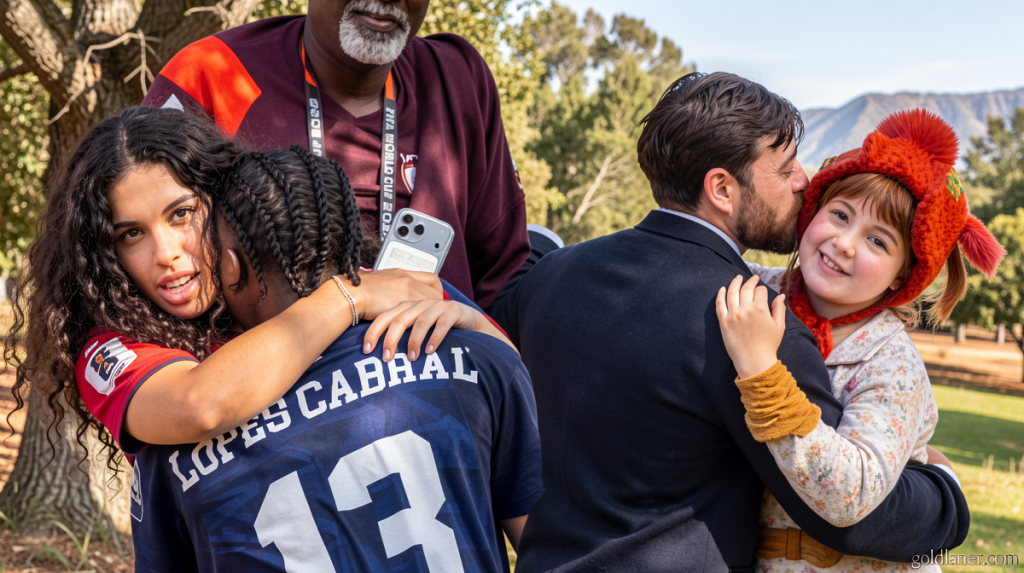
During the final moments of an unforgettable World Cup encounter between Cape Verde and Argentina, something extraordinary happened that would capture hearts worldwide. In the 102nd minute, with audiences across the planet transfixed by the dramatic contest, Cape Verde defender Sidny Lopes Cabral unleashed a magnificent strike. The ball curved gracefully through the air before finding the back of the Argentine goal. Immediately after scoring, Cabral dashed toward the spectator area where he found his partner, Jayley da Cruz. Their passionate embrace was captured on camera and soon spread rapidly across social media platforms.
It was this very moment that inspired LJ Rader to begin his creative work. The digital artist behind the beloved “Art But Make It Sports” accounts recognized the potential for artistic comparison. “Regardless of whether or not Cape Verde was going to win that match, that was the image that would summarize that game,” he explained. Rader’s platform transforms ordinary sports photography into extraordinary visual dialogues by placing dynamic athletic moments alongside classical artworks and sculptures.
A Growing Collection of Artistic Connections
Earlier this year, Rader published a compilation featuring many of his most celebrated comparisons. One particularly striking pairing juxtaposed a 1999 photograph of Brandi Chastain celebrating shirtless after scoring for the US Women’s National Team against a twelfth-century sculpture of a kneeling female deity housed within the Metropolitan Museum of Art. During the current FIFA World Cup, Rader has been working tirelessly as social media users tag him with hundreds of images from various matches, requesting his artistic interpretations.
Sometimes the perfect match appears instantly. Rader recalled seeing a photograph of English midfielder Jude Bellingham scoring with a header. The player’s pose reminded him immediately of a Sibylle Bergemann photograph documenting a statue of Friedrich Engels being positioned in East Berlin. “I had just been waiting for the day where a player went completely horizontal to use it,” Rader noted with satisfaction.
Understanding Soccer’s Unique Challenges
In a recent conversation, Rader discussed how soccer differs from other athletic competitions when creating these artistic pairings. “On a day-to-day level, soccer tends to be harder just because there are only so many positions they can be, since can’t use their hands,” he explained. He contrasted this with football, noting that while facial recognition proves difficult due to helmets, the greater number of participants and constant motion create a balancing effect that ultimately makes matching easier.
According to Rader, basketball represents the most straightforward sport for his creative process. Players constantly jump and compete, with limbs moving in every direction, generating abundant visual variety. However, the World Cup creates something special. “With the World Cup, everybody is dialed into the same event,” he observed. The global community actively contributes photographs, and professional photographers from numerous countries share their captures, providing Rader with an extensive library of material to work with.
The Creative Process Behind the Comparisons
Rader admitted that summer typically offers a quieter period across most sports, aside from the WNBA, baseball season, and Wimbledon. Yet the World Cup transforms everything into a singular focus. “I’m a big WNBA fan, and even my attention is definitely focused on the World Cup,” he shared.
When evaluating potential pairings, Rader seeks the ideal moment rather than settling for screenshots whenever possible. He explained that his drafts folder contains numerous attempts that fell short of his personal standards. During major tournaments, he sometimes envisions capturing the frame immediately following a photograph, anticipating that a hand or arm might shift into a more compelling position. Occasionally, he contacts photographers directly to inquire about their available images—a practice uncommon outside of significant sporting events.
When working with screenshots, Rader returns to video footage to examine frames before or after the captured moment, searching for better positioning of specific body parts. He recalled one particular instance from a Spain versus Portugal match in Dallas featuring Spanish defensive midfielder Rodri and Portuguese midfielder Bernardo Silva. The two former teammates were captured taunting each other from behind. Rader possessed artwork he wanted to use but needed a frontal angle where facial expressions would be visible. Though he didn’t obtain the perfect shot, the attempt demonstrated his commitment to finding the ideal composition.
“`
