
Beloved British artist David Hockney dies at 88
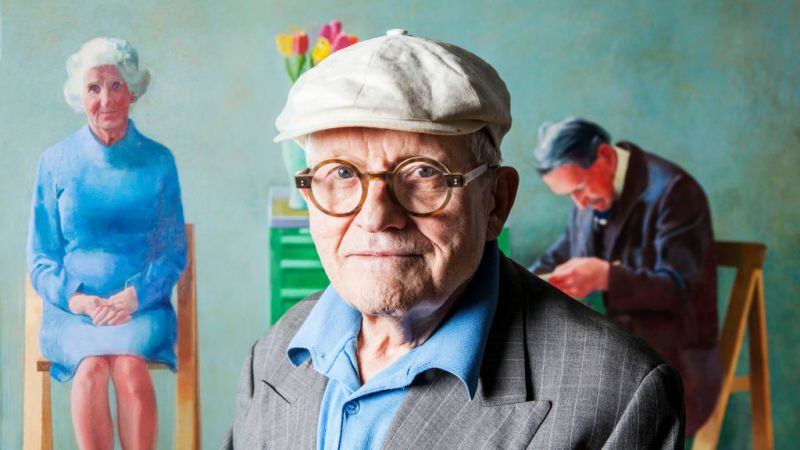
Beloved British Artist David Hockney Dies at 88
Beloved British artist David Hockney dies – David Hockney, the acclaimed British painter renowned for his vivid portrayals of everyday life and luminous depictions of the world around him, has passed away at the age of 88. His death occurred “peacefully at home” on Thursday, just a month before his 89th birthday, as shared by his longtime publicist, Erica Bolton, with CNN. Hockney’s work, spanning decades and multiple mediums, left an indelible mark on contemporary art, blending technical mastery with a playful, deeply personal vision.
A Legacy of Innovation and Expression
Hockney’s career was defined by its versatility and evolution, from his early days in the UK to his later experiments with digital technology. Born in Bradford, England, in 1937, he began his artistic journey at his local school before enrolling at the Royal College of Art in London. His early success was not only a testament to his talent but also to his ability to capture the essence of modern life through bold colors and dynamic compositions.
By the 1960s, Hockney had relocated to Los Angeles, where he would spend the majority of his professional life. This move coincided with a pivotal moment in his career, as he became a central figure in the Pop Art movement. While contemporaries like Andy Warhol focused on consumer culture and mass production, Hockney brought a distinct sensibility to his work—prioritizing the immediacy of the present moment and the intimacy of his surroundings. His art often featured self-portraits, still-life scenes, and intimate snapshots of loved ones, including his iconic dachshunds, Stanley and Boodgie, whom he celebrated in a series of paintings and a dedicated book.
“I’m perfectly happy doing this,” he said in 2017. “I feel 30 when I’m in the studio, so I come in every day and work, because then I feel 30.”
His signature style, marked by luminous light and precise lines, became a hallmark of his work. Among his most celebrated pieces are the “light-filled swimming pool paintings” of the 1970s, which seemed to encapsulate a fleeting, almost eternal moment. These works, often depicting two figures in a pool, have since become iconic, fetching record prices at auction. In 2018, “Portrait of an Artist (Pool with Two Figures)” sold for $90.3 million, briefly holding the title of the most expensive artwork by a living artist. The following year, his double portrait “Henry Geldzahler and Christopher Scott” was sold for $49.5 million at Christie’s, further cementing his reputation as a master of visual storytelling.
A Lifelong Pursuit of Creativity
Despite his commercial triumphs, Hockney remained deeply committed to his creative process. He often emphasized that his work was driven by personal passion rather than market demand. Even as his art gained immense value, he continued to produce with the same enthusiasm, as evidenced by his statement in 2017 about painting for six to seven hours daily. This dedication extended into his later years, where he embraced new technologies to expand his artistic horizons.
During the pandemic, Hockney spent time in Normandy, France, and created a series of digital paintings using an iPad. These works, which depicted the surrounding countryside, were later printed and displayed in prestigious venues such as London’s Royal Academy and the de Young Museum in San Francisco. His ability to adapt and innovate underscored a career that spanned nearly 60 years, proving that his creative spirit remained undimmed by time or circumstance.
Hockney’s exploration of sexuality was another defining aspect of his oeuvre. Having come out as gay in his early 20s, a period when homosexuality was still criminalized in England, he used his art to express themes of intimacy and domestic life. His canvases often featured men in candid, almost mundane moments—showering together or sitting in quiet companionship—bringing a sense of authenticity and vulnerability to his work. This approach not only resonated with audiences but also challenged traditional narratives in art.
Awards and Recognition
Throughout his career, Hockney was honored with numerous accolades, both in the UK and internationally. He joined the Royal Academy of Arts, a distinction that recognized his contributions to the field. Additionally, he received the John Moores Painting Prize and the Praemium Imperiale prize from the Japan Art Association, among other honors. His refusal to accept a knighthood, despite his widespread influence, highlighted his preference for artistic freedom over formal titles.
Despite his many achievements, Hockney remained humble about his success. A record-breaking painting, for instance, was sold by his New York dealer in 1972 for just $18,000—a stark contrast to its later auction prices. This anecdote reveals his belief that the value of art lies not in its financial worth but in its ability to connect with viewers on an emotional level. His work’s enduring appeal is a testament to this philosophy.
Hockney’s influence extended beyond his own creations. His retrospectives, including a major exhibition in 2017 that traveled to Tate Britain, the Pompidou Centre in Paris, and the Metropolitan Museum of Art in New York, showcased the breadth of his contributions. A statement from Tate Britain’s director, Alex Farquharson, praised Hockney as “an endlessly inventive artist” who “taught us about the joy of looking, seeing things the rest of us failed to notice—his witty and sharp observations a constant presence in his work and in person.”
From his early days in Bradford to his final years in California, Hockney’s art reflected a lifetime of curiosity and experimentation. Whether through traditional brushwork, photographic collages, or digital renderings, he consistently challenged the boundaries of artistic expression. His legacy will continue to inspire generations of creators, reminding them that art is not only about technique but also about capturing the beauty and complexity of the world in a way that feels both personal and universal.
Technological Pioneering and Cultural Impact
As a lifelong innovator, Hockney was never afraid to embrace new tools. His use of the iPad to create digital art in the 2010s demonstrated his adaptability and visionary approach. This shift from canvas to screen allowed him to explore fresh perspectives, blending precision with spontaneity. His pandemic-era digital works, for example, showcased his ability to translate the visual language of his earlier pieces into a modern format, bridging the gap between tradition and technology.
Hockney’s impact on art history is undeniable. His ability to merge realism with whimsy, and to find beauty in the ordinary, set him apart from his contemporaries. While Pop Art often celebrated consumer culture, Hockney focused on the human experience, infusing his work with warmth and immediacy. This approach not only defined his style but also invited viewers to see the world through his eyes—colored, textured, and alive with possibility.
His career serves as a reminder of the power of artistic reinvention. From the vibrant, sun-drenched scenes of his early works to the abstract landscapes of his later years, Hockney’s evolution reflects a mind that never stopped questioning, creating, or experimenting. Even as he celebrated his 80th birthday in 2017, he spoke of his unyielding drive to produce, describing the studio as a place where time seemed to stand still. That same energy carried him through his final years, ensuring his contributions would be remembered for decades to come.
