
FIFA stunned the soccer world by allowing the USA’s Folarin Balogun to play on Monday. Trump’s role is under the microscope
FIFA’s Surprising Decision Sparks Debate Over Trump’s Influence
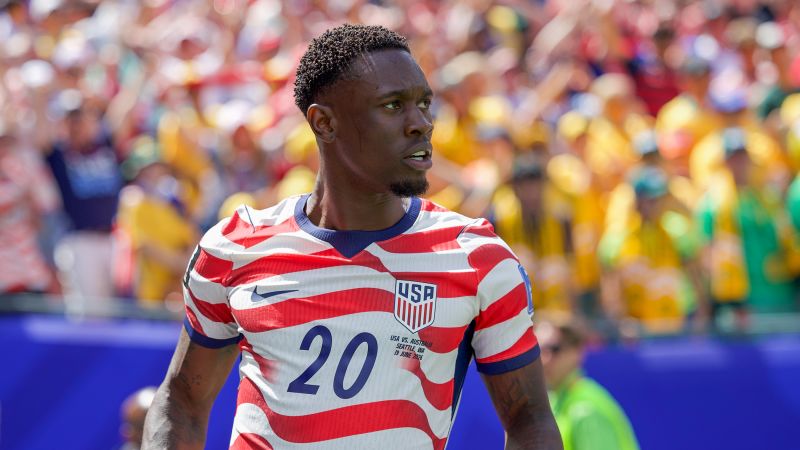
FIFA stunned the soccer world by allowing – On Monday, the global soccer community was left in disbelief as FIFA made a contentious ruling that allowed striker Folarin Balogun to compete against Belgium in the Round of 16. The decision, which overturned a one-match ban for a red card received during the US’ 2-0 victory over Bosnia and Herzegovina, has raised questions about the role of Donald Trump in the process. US Soccer and its supporters are now grappling with the implications of this last-minute reprieve, which was granted through an obscure rule in FIFA’s disciplinary code.
The twist came after a report from The Athletic revealed that FIFA had decided to suspend Balogun’s automatic suspension under Article 27 of its regulations. This clause permits the disciplinary committee to temporarily halt the enforcement of a penalty, provided the player is placed on probation. While such a move isn’t entirely unprecedented, the timing and circumstances of this reversal have drawn particular attention, especially with the White House seemingly involved in the decision-making.
A Last-Minute Lifeline for the USA’s Key Player
Folarin Balogun, the 25-year-old forward, had been on track for a one-match ban following a straight red card in the 64th minute of the US’ Round of 32 match against Bosnia and Herzegovina. The incident involved a VAR-confirmed challenge that stepped on the ankle of Bosnian defender Tarik Muharemovic, classified as “serious foul play” under FIFA’s rules. Balogun’s exit left his team shorthanded, but the suspension was erased just days later, allowing him to take part in the crucial Round of 16 clash.
“We accept the decision of the Disciplinary Committee and are pleased that Folarin Balogun is eligible to compete tomorrow,” said US Soccer in a statement released on Sunday. The federation emphasized its focus on the upcoming game against Belgium, a high-stakes encounter in Seattle. However, the maneuver has sparked discussions about whether the ruling was influenced by external pressures, particularly from Trump, who has been closely tied to FIFA’s leadership.
“We were punished enough against Bosnia and Herzegovina to play with 10 men for 30 minutes, in a decision that was completely unfair. It’s not only because I’m the head coach of the USA national team, I need to defend my side. … 99.9% (of people) agree it was an unfair red card. Maybe today we were lucky.”
Mauricio Pochettino, the US team’s manager, praised FIFA’s decision as “fair” during a Sunday press conference. Though he denied direct involvement in the suspension reversal, Pochettino acknowledged the pressure to justify the ruling. The coach highlighted the impact of the red card, which had disrupted the team’s attacking flow during a pivotal moment in the match. With Balogun scoring in the first half, his absence was a significant blow, and the suspension reversal has been seen as a critical lifeline for the squad.
Trump’s Direct Line to FIFA’s Leadership
According to a source close to the situation, Trump initiated a conversation with FIFA President Gianni Infantino just days before the suspension decision was announced. The call reportedly came after Balogun’s red card, with Trump urging Infantino to reconsider the automatic ban. This intervention appears to have played a role in the committee’s choice to apply Article 27, which grants flexibility in enforcing disciplinary actions. While the exact nature of Trump’s influence remains unclear, his relationship with Infantino has long been a topic of discussion.
Trump quickly took to his social media platform, Truth Social, to express his approval of FIFA’s decision. “Thank you to FIFA for doing what was right, and reversing a great injustice! President DONALD J. TRUMP,” he posted. The message not only celebrated the ruling but also reinforced the idea that the decision was a victory for US interests. However, the timing of the call and the subsequent action have led to speculation about how much sway the president had over FIFA’s judgment.
The Probationary Rule and Its Implications
Under Article 27, FIFA’s disciplinary committee has the authority to suspend the implementation of a penalty, subjecting the player to a probationary period. In Balogun’s case, the one-match ban was paused for a year, meaning the red card remains on his record but does not immediately prevent him from playing. If he repeats a similar offense during this time, the suspension will be reinstated along with any additional penalties. This rule, while designed to provide a second chance for players, has been rarely invoked in high-profile cases, making this decision stand out.
Experts note that the use of Article 27 here is unusual, particularly given the stakes of the World Cup. The forward’s inclusion in the Round of 16 match against Belgium is seen as a strategic move by FIFA to support the host nation. However, critics argue that the ruling could be perceived as a political favor, especially with Trump’s direct engagement. The situation has also brought attention to the broader influence of US political figures on international sports governance, a trend that has been growing in recent years.
Belgium’s Reaction and the Weight of the Decision
The USA’s opponents, Belgium, expressed surprise at the decision, with their coaching staff and players reviewing potential responses. “The decision is in direct contradiction with the provisions of the FIFA code,” one Belgian representative noted, underscoring the debate over the fairness of the ruling. While the suspension reversal allows Balogun to play, it has also created a sense of uncertainty about how FIFA applies its rules in high-pressure scenarios. For the US team, the focus now shifts to maximizing this opportunity, with Pochettino and his players working to ensure a strong performance.
Historically, FIFA has awarded the Peace Prize to Trump at the World Cup draw, a gesture seen as both a nod to his political stature and a way to offset his lack of success in securing a Nobel Peace Prize. This act of recognition has further fueled the narrative that Trump’s influence extends beyond domestic politics into international sports decisions. As the debate continues, the question remains: Did the president’s call to Infantino directly impact the suspension reversal, or was it a coincidence?
US Soccer has maintained that the decision was made in the best interest of the team, but the connection to Trump’s involvement cannot be ignored. The federation’s silence on whether the White House played a role has added to the intrigue, with CNN and other media outlets seeking clarification. As the World Cup progresses, the incident serves as a reminder of the complex relationship between sports governance and political power, with FIFA now at the center of global scrutiny.
What’s clear is that Balogun’s return to the pitch has been a game-changer for the USA. His ability to score in the first half of the Bosnian match, despite the red card, showcased his importance to the team. With the suspension now on hold, he has the chance to contribute in the Round of 16, a stage where the stakes are higher than ever. For fans, the decision is a mix of relief and curiosity, as they await the outcome of the match while questioning the behind-the-scenes dynamics that led to this reversal.
In the end, FIFA’s choice to suspend Balogun’s ban highlights the flexibility of its disciplinary rules, but it also underscores the potential for external influence in sports decisions. As the US prepares for its showdown with Belgium, the narrative around Trump’s role will continue to shape public perception, adding a layer of political intrigue to an already high-stakes tournament. Whether this was a calculated move or an unexpected outcome, the decision has left the soccer world wondering about the boundaries of fairness in international competition.
