
Trump’s recent insults show just how strained his relationships with G7 leaders have become
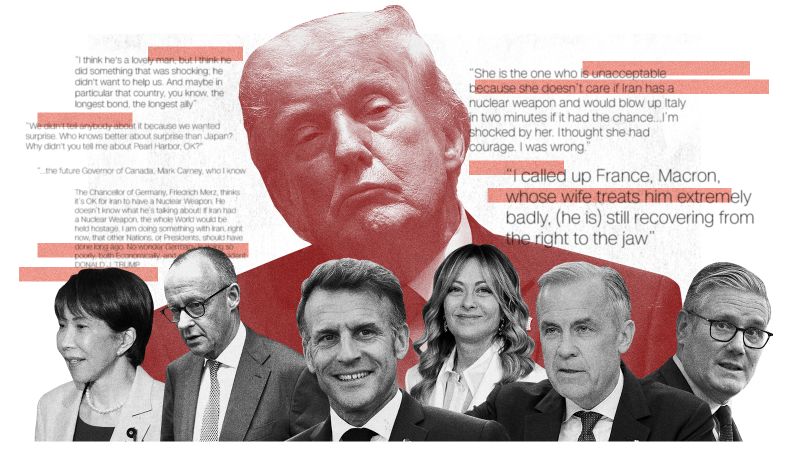
Trump’s recent insults show just how strained his relationships with G7 leaders have become
The Summit Setting
Trump s recent insults show just – As President Donald Trump arrived at the Évian-les-Bains spa resort in France for a G7 summit, the tranquil lakeside setting masked underlying tensions. The gathering, held in a picturesque location, was meant to foster unity among the world’s leading democracies, yet the atmosphere seemed more fraught than serene. Over the past months, Trump’s sharp rhetoric toward his counterparts has grown increasingly frequent, reopening old rivalries and creating new ones. This pattern of behavior, now a hallmark of his presidency, has placed the G7 in a precarious position, as their diplomatic ties with the U.S. leader fray under the weight of repeated personal attacks.
The Root of the Tensions
The current discord appears to stem from the leaders’ reluctance to endorse the U.S.-Israeli campaign against Iran. Trump’s recent agreement with Tehran has become a focal point of contention, with allies questioning the decision’s implications for regional stability and American foreign policy. Despite the deal, the president has continued to criticize his G7 peers for not aligning with his aggressive stance on Iran. This has led to a growing sense of frustration among European leaders, who have long viewed the Middle East conflict as a critical test of U.S. global leadership.
Country by Country Breakdown
French President Emmanuel Macron, host of the summit, has had a particularly complex relationship with Trump. Their bond, forged over years of political collaboration, has been tested by Trump’s recurring barbs. Macron, known for his diplomatic finesse, has grown increasingly exasperated with the president’s unpredictable nature. One day, Trump might praise Macron’s leadership, only to later mock his personal life—specifically his marriage—during a heated exchange. This back-and-forth has left Macron struggling to maintain a composed demeanor, even as he tries to shield the G7 from further divisiveness.
“Trump’s attacks on me are like a punch in the gut, but I keep my head up,” Macron said in a recent interview, hinting at his growing patience with the U.S. leader’s provocations.
The dynamic between Trump and Canadian Prime Minister Mark Carney has also shifted. Last year, their relationship seemed promising, a contrast to the acrimony with Carney’s predecessor, Justin Trudeau. However, Trump’s dissatisfaction with trade deals and Carney’s bold criticism of U.S. policies at a Davos forum have soured the rapport. Trump’s use of the title “Governor Carney” reflects his tendency to reduce leaders to caricatures, a strategy that has both amused and alienated his allies. While Carney initially welcomed the nickname as a sign of camaraderie, it now symbolizes a deeper rift.
British Prime Minister Keir Starmer, who has invested heavily in building trust with Trump, has found his efforts questioned. The leader’s hesitation to back Trump’s Iran campaign has sparked criticism from the U.S. president, who dismisses him as “no Winston Churchill.” Starmer, who once prided himself on his ability to navigate Trump’s mercurial temperament, has had to defend his stance amid mounting pressure. This has led to a sense of disillusionment, as Trump’s sharp tongue undermines the carefully cultivated relationships.
Regional Alliances Under Strain
German Chancellor Friedrich Merz, who once had a favorable rapport with Trump, has seen his standing in the group decline. His initial goodwill was bolstered by presenting the birth certificate of Trump’s grandfather, a gesture that symbolized a shared cultural heritage. Yet, Merz’s doubts about the Iran war have sparked Trump’s ire, with the president accusing him of “humiliating” the U.S. leadership. This criticism has echoed through Berlin, where Merz’s team now faces the challenge of balancing Trump’s demands with Germany’s strategic interests.
Even Italy’s Prime Minister Giorgia Meloni, often cited as Trump’s most steadfast European ally, has not been spared. Her refusal to join the U.S.-Israeli war against Iran earlier this year led to a public backlash from Trump, who labeled her as “weak” in a tweet. Despite this, Meloni has remained a key figure in Trump’s foreign policy agenda, particularly in efforts to strengthen ties with the Mediterranean region. However, the incident highlights how even close allies can become targets of the president’s frustration.
“Trump’s comments were unacceptable,” Meloni stated during a press briefing, though she acknowledged the need for continued dialogue with the U.S. leader.
Japan’s Unique Position
Japan, the newest member of the G7, has managed to stay relatively unscathed by Trump’s verbal jabs. Prime Minister Sanae Takaichi has actively worked to establish a personal connection with the president, leveraging their shared admiration for the late Prime Minister Shinzo Abe. This effort has been praised by some as a model of patience and diplomacy, yet Trump’s criticism of Japan’s nonparticipation in the Iran war has not gone unnoticed. During an Oval Office meeting, the president made a joke about Pearl Harbor that drew sharp reactions in Tokyo, underscoring the delicate balance between admiration and irritation.
While Japan’s leaders have consistently supported U.S. interests, the president’s remarks suggest a growing impatience with their cautious approach. Takaichi, who has emphasized economic cooperation and cultural ties, now faces the challenge of repairing a relationship that has been strained by Trump’s bluntness. The incident at the summit has reignited debates about the role of Japan in regional security, with critics arguing that Trump’s behavior risks undermining the country’s strategic partnerships.
A Legacy of Tension
Trump’s strained relationships with the G7 are not a recent phenomenon but a continuation of a pattern that has defined his tenure. From his first term, when he often clashed with European leaders over trade and foreign policy, to his current administration, the president’s approach has been marked by a mix of charm and confrontation. His ability to pivot between respect and disdain has left his allies in a state of perpetual uncertainty, forcing them to navigate a complex web of diplomacy and defensiveness.
As the G7 summit progresses, the question remains: can Trump’s allies withstand his relentless criticism, or will the discord continue to grow? The outcome may hinge on whether the leaders can find common ground despite their differences, or if the summit will serve as another chapter in the evolving saga of U.S.-allied tensions. For now, the placid lakeside setting remains a stark contrast to the stormy discussions that lie ahead.
