
Trump greets the fallen as he faces a decision point on Iran
A President’s Burden: Trump Witnesses Fallen Heroes Return Home
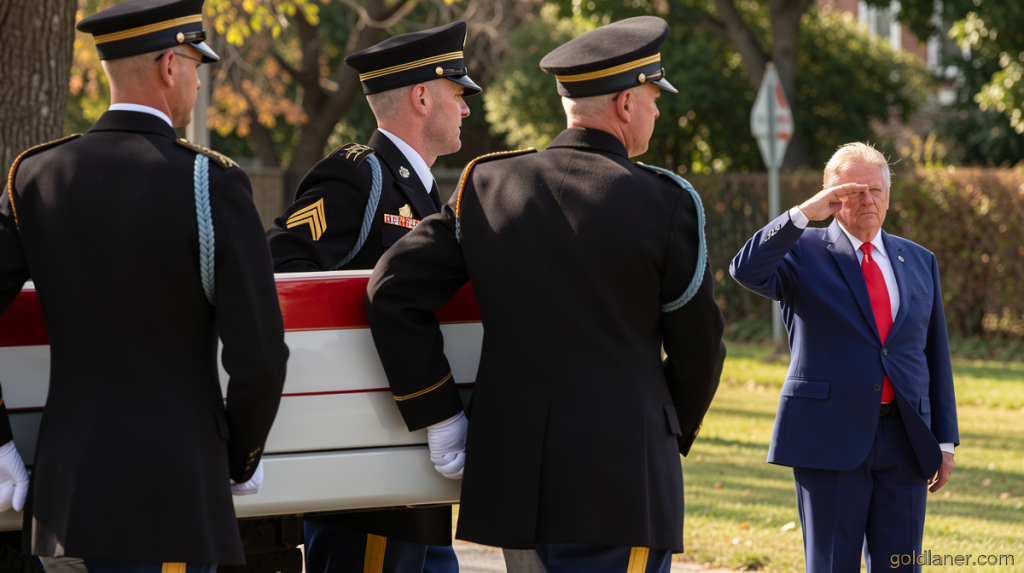
Goldlaner.com – On Wednesday, the somber ritual of honoring America’s dead unfolded at Dover Air Force Base as President Donald Trump stood among grieving families. Four silver caskets draped in American flags emerged from a military cargo aircraft, carrying the remains of service members lost during the ongoing conflict with Iran. The transfer process, lasting barely twenty minutes, moved from the aircraft to waiting vehicles that would transport the fallen across the country.
Trump observed the proceedings with characteristic solemnity, his gaze fixed forward as he saluted. The quiet ceremony was broken only by the hum of the plane’s auxiliary engine and one family member’s anguished cry from across the tarmac. This moment captured something essential about presidential responsibility—the weight of decisions made in distant conflicts that ultimately touch American soil.
The Dover Test and Public Opinion
Before departing Washington for this journey, Trump reflected on the significance of the occasion.
For me, it’s one of the hardest things to do as a president, but has to be done,
he stated while boarding his new Air Force One, which had been donated by Qatar.
The president insisted that the conflict he initiated over four months ago was passing what military leaders call the “Dover Test”—an informal assessment of whether wars justify their human cost to the American public.
Americans aren’t against the war,
Trump declared confidently.
A poll just came out. Americans don’t want high gasoline prices, but they’re not against the war.
However, recent polling data tells a different story. A Washington Post survey published last week revealed that 68 percent of Americans consider the Iran war unworthy of pursuit, while only 28 percent support continuing the conflict. This forty-point negative margin exceeds the divisions seen during either the Iraq or Afghanistan wars according to Washington Post-ABC News polling. Trump has frequently referenced those longer conflicts, which resulted in greater casualties, to argue that the current situation remains manageable despite its challenges.
The Fallen Service Members
The four Americans returning home represented the breadth of the nation. They were 1st Lt. Tyler James Feehan, Staff Sgt. Michael Emmanuel Swinton, Sgt. Angel S. Rampersad, and Pvt. Isabella Gonzales. Their ages spanned from nineteen to twenty-five years old, and they came from every corner of America—from Hawaii to North Carolina, from New York to Texas. Each lost their life far from home, in the countries of Jordan and Iraq.
Trump met privately with the families before the ceremony concluded. He extended a personal invitation to Feehan’s relatives to travel with him aboard Air Force One to Georgia. Speaking at an event in Marietta, the president described the morning as particularly difficult.
Standing there watching this sight, which is – very, very tough to – very tough to watch,
he explained.
To be honest with you, very tough. I think it’s the toughest thing I do. If anything, I do all this stuff, but I think it’s the toughest thing I do.
Addressing Feehan’s family, who Trump noted lived in the nearby area, he painted a portrait of a young man with extraordinary promise.
This is a son who was like a flawless, perfect person. Beautiful, beautiful son, handsome in every way, brilliant, respected by everybody,
he said as Feehan’s grieving relatives listened.
Escalation and Uncertainty
The Iran war differs from previous conflicts in one crucial way: it belongs to Trump’s presidency. American patience grows thinner as the president struggles to define a clear path toward resolution. During recent policy discussions, options for intensifying military operations have been presented, including strikes against critical infrastructure like roads and bridges.
Trump has increased his public threats significantly. Hours before traveling to Dover, he posted on Truth Social that the United States would
destroy
a bridge or power plant whenever Iran targeted a vessel in the Strait of Hormuz. He also shared an article indicating he had directed Central Command to
open the gates of hell.
Despite these threats, officials report that Trump has not yet authorized the most aggressive measures. Instead, he has maintained a pattern of nightly strikes against Iranian positions. These operations have so far failed to extract meaningful concessions from Tehran or sufficiently degrade Iranian capabilities to prevent deadly attacks on American forces. The recent deaths of the four service members serve as a stark reminder of the ongoing risks facing troops deployed throughout the region.
