
‘The thing I do best in life is build’: How Trump has made construction his second job as president
Trump’s Construction Obsession: A Second Career in the White House
The thing I do best in life – President Donald Trump has transformed construction into a central focus of his presidency, weaving it into the fabric of his daily routine. This dedication is evident in the ongoing overhaul of the White House, where his attention to detail has extended far beyond traditional executive duties. As the political landscape shifted this month with proposals for an Iran peace deal, Trump remained fixated on architectural matters, particularly the East Wing ballroom. During a brief exchange in the West Wing halls, he questioned an associate about discrepancies in the latest blueprints, emphasizing the need for clarity on the structure’s design. This moment highlighted his deep engagement with the project, a pattern that has defined his tenure.
Designing with Precision
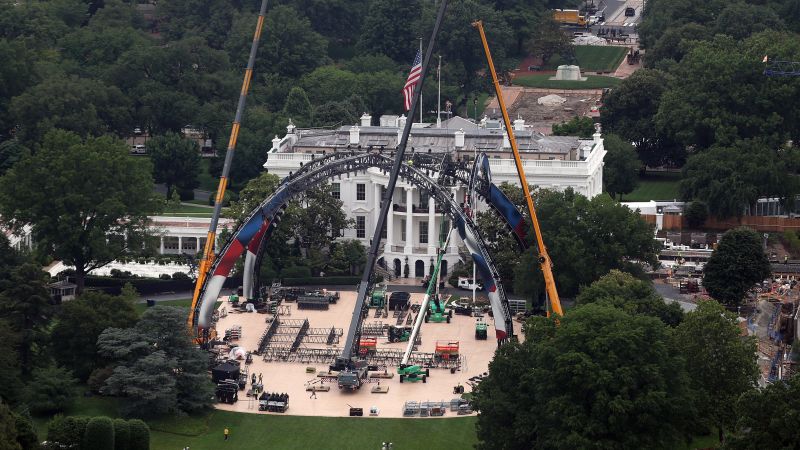
Trump’s approach to design and construction is marked by an unrelenting personal touch. Unlike his predecessors, who streamlined their schedules to minimize distractions, he has embraced a hands-on role, participating in meetings with tangible materials. Sources describe how he arrives armed with fabric swatches, tile samples, and visual references, a level of involvement typically reserved for project managers rather than heads of state. “He’s not just approving plans—he’s fine-tuning every element,” said a White House official, who requested anonymity to speak candidly. This meticulous approach has extended to projects across Washington, DC, including the recent temporary arena erected for June’s White House UFC event, which now dominates the South Lawn and is visible from the North Lawn.
His influence is palpable in the White House’s evolving aesthetics. The Rose Garden, once a simple public space, has been redesigned with stone pavers and reconfigured to mirror the layout of his Mar-a-Lago estate. Meanwhile, the Lincoln Bedroom bathroom has been transformed into a sleek marble sanctuary, while the Palm Room has undergone a similar renovation. These changes, though subtle in appearance, reflect a broader vision of the executive mansion as a personal statement. “It’s not just about function—it’s about making a statement,” noted a design team member. Trump’s signature projects often blend practicality with his trademark flair, as seen in the “Presidential Walk of Fame,” a tongue-in-cheek installation along the West Colonnade that features biographies written in his distinctive voice.
Public Perception and Political Challenges
Despite his enthusiasm, Trump’s construction initiatives have not been without controversy. Critics argue that the focus on these projects has diverted attention from pressing national issues, including the Iran negotiations. A source close to the president revealed that he intentionally delayed major renovations until his second term, a move aimed at reducing political backlash. “It’s politically toxic, any way you cut it. Everyone’s watching, and he’s taking heat for it,” the individual said. Yet Trump remains undeterred, framing construction as the bedrock of his legacy. “I’m a really good builder. The thing I do best in life is build,” he asserted to reporters last week, his voice cutting through the din of ballroom construction.
His personal connection to these projects is both a strength and a source of scrutiny. From selecting the image of an auto-pen to represent former President Joe Biden on the “Presidential Walk of Fame” to insisting that his proposed arch be the tallest in the world, Trump’s vision is as grandiose as it is specific. This commitment has even led to impromptu inspections, such as the six-minute evaluation of columns on the North Portico after a Memorial Day ceremony. Such moments underscore his belief that construction is not a distraction but a defining pursuit. “I have two jobs,” he recently stated, “and the construction one is my favorite because it’s like relaxation.”
Legacy in Stone and Steel
Trump’s architectural ambitions are not confined to the White House. Across town, the K [source text continues here]. His influence has seeped into other landmarks, including the World War II memorial, where he proposed repainting the fountain’s base—a detail he has replicated at the Reflecting Pool. This parallel suggests a deliberate effort to align the nation’s history with his own brand of modernity. “He’s not just building for the present; he’s creating a legacy that’s visible to future generations,” said a senior advisor, who added that Trump’s team often jokes about his habit of treating meetings as design workshops.
Behind the scenes, Trump’s construction team works tirelessly to meet his exacting standards. One source described how his insistence on technical specifics has surprised even seasoned professionals. “He comes into meetings with a level of detail that’s uncommon for a leader, but it’s his way of ensuring everything aligns with his vision,” the insider explained. This includes selecting materials like marble and onyx, which he personally shops for at South Florida stone showrooms. The result is a White House that feels more like an extension of his personal brand than a seat of government.
Yet, the scale of these efforts raises questions about their impact on his presidency. While some view the renovations as a testament to his drive and creativity, others see them as a diversion from critical policy work. The temporary arena for the UFC event, for instance, has drawn mixed reactions. Proponents praise the spectacle, while detractors argue it symbolizes a focus on entertainment over governance. However, Trump sees no contradiction in his dual role. “Construction is part of my DNA,” he said, referencing his career as a real estate mogul. “It’s what I’ve done all my life, and it’s what I’m doing now.”
As the East Wing ballroom nears completion, Trump’s projects continue to shape the White House’s identity. The massive structure on the South Lawn, a temporary venue for the upcoming UFC event, is a stark example of his ability to execute ambitious ideas swiftly. Sources note that his preference for immediate action has led to a rapid pace of transformation, with several key projects already realized. “He doesn’t wait for perfection—he wants it done,” said a White House decorator. This philosophy has driven the redesign of the Oval Office, a project that began with the addition of gold leaf accents, a detail Trump insists is “none of the fake stuff.”
For Trump, the construction of the East Wing ballroom and other projects is more than a pastime—it’s a political strategy. By personalizing the White House, he aims to leave a lasting mark on the nation’s symbol of power. “These changes aren’t just about aesthetics; they’re about making the presidency feel like mine,” he told reporters, his tone unwavering. While the public may debate the merits of his efforts, one thing remains clear: Trump’s construction projects are an integral part of his presidential identity, a testament to his belief that building is the essence of leadership.
“I’m a really good builder. The thing I do best in life is build,” the president told reporters last week over the raucous sound of ballroom construction.
As the nation watches the White House’s metamorphosis, Trump’s dedication to his construction endeavors continues to blur the lines between his roles as executive and entrepreneur. His ability to intertwine personal passion with political ambition has created a unique narrative, one that challenges traditional notions of presidential priorities. Whether viewed as a visionary or a disruptor, Trump’s legacy in construction is undeniably woven into the White House’s evolving story.
