
Former Olympic canoeist indicted for allegedly damaging Reflecting Pool
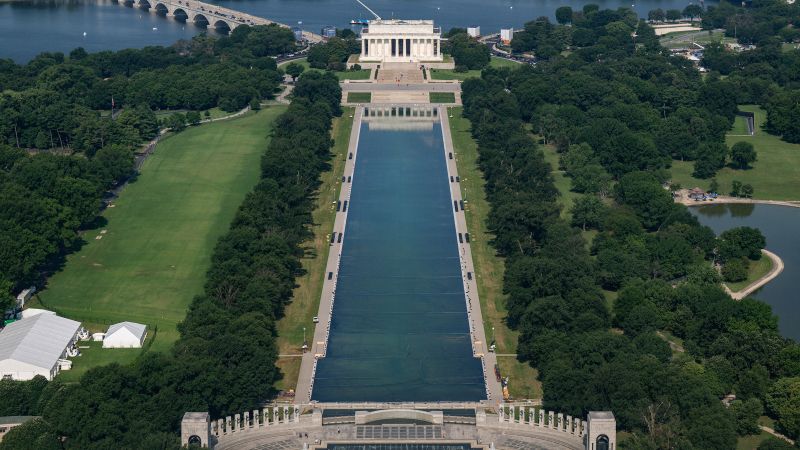
Former Olympic Canoeist Faces Felony Charges Over Damage to Reflecting Pool
Former Olympic canoeist indicted for allegedly – David Hearn, a retired Olympic canoeist, has been charged with a felony by a grand jury in the Washington, DC Superior Court, accused of damaging the Lincoln Memorial Reflecting Pool. The indictment, announced Thursday, alleges that Hearn “maliciously did injure, break and destroy certain property, that is, the lining material of the Lincoln Memorial Reflecting Pool,” according to the official document. The charge of destruction of property with a value exceeding $1,000 could result in up to 10 years in prison if he is found guilty.
Trump Administration’s Focus on Vandalism Claims
The indictment marks a pivotal moment in the Trump administration’s efforts to frame the peeling bottom layer and algae growth in the Reflecting Pool as deliberate acts of vandalism. The pool, which was recently renovated at a cost of millions, reopened last month ahead of the Independence Day celebrations. Hearn’s arrest and subsequent felony charge are seen as part of a broader campaign to hold individuals accountable for the pool’s condition, which Trump had previously criticized.
US Attorney Jeanine Pirro’s office has taken the lead in prosecuting Hearn, who was previously dismissive of the situation. The grand jury’s decision to charge him with a felony, rather than a lesser offense, has sparked debate about the political motivations behind the case. Pirro stated that the evidence presented was “tremendous” and that it dictated the charges, even though she declined to elaborate further. “The evidence is clear,” she said, adding that the witnesses on the scene—described as having “no agenda” and simply performing their duties—confirmed the damage to the national monument.
“This is a case with tremendous evidence and the evidence dictates where we land,” Pirro said during a press briefing. She noted that the US Attorney’s office is examining “about a half dozen” other cases, some of which could be classified as misdemeanors or violations. However, the focus on Hearn remains prominent, with the felony charge highlighting the administration’s commitment to prosecuting those involved in the pool’s deterioration.
Defense Claims the Charges Are Politically Motivated
David Hearn’s attorney, Norm Eisen, has strongly criticized the indictment, calling it a “concocted narrative” used to shift blame for the pool’s issues. In a statement, Eisen argued that the charges reflect an attempt to misuse government power against a “simple citizen.” He emphasized that Hearn was merely curious about the pool’s condition and that the allegations against him lack solid proof.
“Davey Hearn is innocent. These charges are outrageous and should be alarming to every American,” Eisen stated. He pointed to the inconsistency in the evidence, noting that the federal government has not yet provided definitive proof of the vandalism. “On the eve of our nation’s Independence Day, Americans should be deeply concerned by the administration’s efforts to criminalize what was simply an act of observation,” he added.
According to Hearn, he was arrested after touching a flap of blue material that had partially come loose from the pool’s bottom. The incident occurred shortly after he visited the site, where he was warned by a National Park Service worker not to reach into the water. Despite this, he was handcuffed by Park Police and later charged with destruction of property. Hearn denied any intention to damage the pool, insisting he was only trying to understand the situation.
FBI Investigation into Georgia 2020 Election
Meanwhile, the FBI has deployed 260 staff members to investigate the 2020 election in Georgia, a move that has drawn comparisons to the current case against Hearn. The bureau’s involvement in the election probe has been closely tied to the Trump administration’s stance on alleged voter fraud. While the Georgia investigation focuses on election procedures, the Hearn case is seen as part of a pattern where political figures use legal action to address issues that may not have clear culpability.
Pirro, who oversees the DC federal prosecutors, stated that the pool’s damage was part of a larger narrative the administration sought to control. She noted that Trump had warned of “lengthy prison sentences” for those responsible for the pool’s condition, even though the extent of the damage remained uncertain. The president had previously claimed that someone had carved a long gash into the pool using a sharp instrument, a claim that has not been substantiated by federal authorities.
“We have about a half a dozen other cases. Some of them will be misdemeanors, and some of them could be less, like a violation,” Pirro said. She stressed that the pool’s situation was a key example of how the administration was prioritizing “serious vandalism” as a political issue, even though the evidence for such acts was not fully established.
Renovation Challenges and Public Concern
The Lincoln Memorial Reflecting Pool was renovated at a cost of millions of dollars, intended to be completed before the Independence Day celebrations. However, shortly after its reopening, reports emerged about algae growth, peeling paint, and other maintenance issues. These problems, which had been present for some time, were exacerbated by the pool’s recent use, leading to public frustration and questions about the renovation’s quality.
Hearn’s incident, though minor, became a focal point for the administration’s efforts to highlight the pool’s condition. The president had previously pointed to the damage as evidence of “vandals” undermining the nation’s landmarks. However, critics argue that the focus on Hearn is more about political messaging than actual wrongdoing. “The federal government has not provided proof of those claims,” one analyst noted, “and Trump’s estimates of the damage have fluctuated wildly, suggesting a lack of clarity in the investigation.”
The case against Hearn has also drawn attention to the role of federal law enforcement in addressing what some view as symbolic acts of dissent. The pool, a iconic feature of Washington, DC, has long been a site of political and cultural significance. Its damage, whether intentional or accidental, has been used as a metaphor for broader issues of public trust and governance. Hearn’s arrest, while seemingly small, has been amplified by the administration to underscore its commitment to justice.
Public Reaction and Legal Implications
The indictment has sparked mixed reactions from the public. Some support the charges, seeing them as a necessary step to hold individuals accountable for harming a national monument. Others, however, argue that the case is being used to target critics of the administration. “This is a political move to send a message,” said one local resident. “It’s about showing strength, not about solving the problem.”
Hearn’s legal team plans to challenge the evidence presented during the trial, emphasizing that the pool’s damage was likely due to natural factors rather than malicious intent. They also plan to highlight the inconsistency in the federal government’s claims, particularly regarding the extent of the damage and the tools used to inflict it. “The administration is using this case to divert attention from their own failures,” Eisen said, adding that Hearn’s arrest was a result of “misinterpretation” and “exaggeration.”
As the case proceeds, it will serve as a test of how the federal government handles public scrutiny and the balance between accountability and political agenda. Hearn’s trial may also set a precedent for how similar incidents are prosecuted, especially in the context of national landmarks. With the pool’s condition remaining a point of contention, the outcome of this case could have broader implications for both the administration and the citizens they represent.
CNN’s Casey Gannon contributed to this report. The story has been updated with recent developments and additional context. The indictment not only raises questions about the legal process but also about the motivations behind the charges, as the pool’s damage becomes a symbol of larger political struggles. Whether Hearn is guilty or not, the case underscores the role of law in shaping public perception and reinforcing the administration’s narrative. As the trial approaches, the spotlight remains on the former Olympian and the federal government’s handling of what could be a simple act of curiosity.
