
Burt Jones makes Rick Jackson’s big spending his closing argument in Georgia gubernatorial runoff
Burt Jones Targets Rick Jackson’s Spending Strategy in Georgia Runoff
The Spending War in Georgia’s Gubernatorial Race
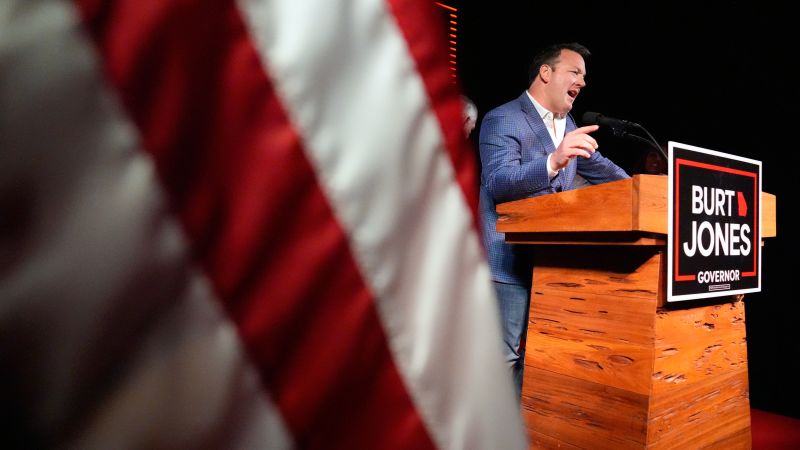
Burt Jones makes Rick Jackson s big – In the tightly contested Georgia gubernatorial runoff, Burt Jones is leveraging Rick Jackson’s financial campaign tactics as a central argument against his opponent. With the election set for Tuesday, Jones is framing Jackson’s massive spending as a way to “buy votes,” contrasting it with his own message of fiscal responsibility. A recent ad from Jones’s campaign highlights this critique, using AI visuals to show voters overwhelmed by Jackson’s relentless messaging. The ad underscores the idea that Georgia’s electorate should be guided by principles, not just money.
Rick Jackson, a billionaire with a background in healthcare, has spent over $100 million on ads and mailers to maintain his visibility. His campaign’s saturation of the media landscape has created an impression of omnipresence, securing roughly a third of the primary vote. However, Jones’s campaign is now accusing Jackson of using wealth to dominate the race, suggesting that his financial strategy is a distraction from real issues. The focus keyword, “Burt Jones makes Rick Jackson,” appears in the opening paragraph, setting the tone for the article’s core theme.
From Poverty to Power: Jackson’s Narrative
While Jackson’s wealth is a defining aspect of his campaign, he has crafted a narrative around his rags-to-riches journey to humanize his spending. The candidate, who grew up in a broken family, shares stories of overcoming hardship to become a successful business leader. This background is used to justify his financial approach, portraying it as a necessary investment in Georgia’s future. Yet, Jackson acknowledges that his campaign’s spending has drawn “legitimate concern,” even as he insists his money is “hard-earned” and not a tool for corruption.
“Burt Jones makes Rick Jackson’s big spending his closing argument,” Jackson remarked in an interview with WJCL, emphasizing that voters should support a candidate who is “spending to make a difference.” He argues that his financial resources allow him to outspend traditional candidates, ensuring his message reaches every corner of the state. This rhetoric aims to distinguish Jackson from the influence of special interest groups, positioning him as a self-made leader driven by purpose rather than profit.
Primary Results and the Runoff Context
Jackson’s performance in the May primary was a surprise. He narrowly missed the top vote-getter spot, finishing just six points behind Jones. This result came despite his late entry into the race in February, challenging established figures like Secretary of State Brad Raffensperger and Attorney General Chris Carr. His ability to gain traction with limited name recognition has sparked analysis, with political experts noting the unusual success of a candidate who initially relied heavily on financial firepower.
“Burt Jones makes Rick Jackson’s big spending his closing argument,” said Charles Bullock, a political science professor at the University of Georgia, highlighting the strategic shift in the race. Bullock points out that Jackson’s campaign has used aggressive spending to secure a third of the primary vote, a significant achievement. However, he warns that Georgia’s political history shows mixed outcomes for wealthy candidates, suggesting that Jackson’s financial dominance may not guarantee victory.
Financial Impact and Media Presence
As the runoff approaches, both campaigns are pushing the limits of spending. Jackson’s campaign has already surpassed $90 million in advertising, according to AdImpact, a firm tracking campaign expenditures. This has led to over 380 unique ads, generating more than 450 million impressions. His financial strategy has made him the second-largest advertiser of the 2026 cycle, a testament to his ability to outspend opponents. Meanwhile, Jones has also invested significantly, loaning his campaign $25 million and spending over $35 million on ads.
Despite the spending arms race, Jones is using Trump’s endorsement as a key asset. The former president’s support has bolstered Jones’s appeal to conservative voters, who prioritize affordability. “It’s very important you get out and vote for Burt,” Trump said in a recent tele-rally, reinforcing the idea that Jones represents a return to principled politics. This contrast between Jackson’s wealth-driven approach and Jones’s Trump-backed strategy is shaping the final narrative of the race.
Key Questions for the Runoff
With the runoff fast approaching, the question remains: can Jackson’s financial edge translate into a decisive victory? Analysts are divided, with some praising his ability to fund a strong media presence, while others warn of the risks of overreliance on money. “Burt Jones makes Rick Jackson’s big spending his closing argument,” Bullock reiterated, suggesting that the debate over campaign finance will be central to the outcome. The electorate will have to decide whether they prioritize Jackson’s message of bold action or Jones’s call for fiscal restraint.
As the final days of the campaign unfold, the focus keyword, “Burt Jones makes Rick Jackson,” is strategically placed to reinforce the narrative. The race has become a test of how voters perceive the role of money in politics, with both candidates using their resources to shape public opinion. The result could set a precedent for future elections, highlighting the growing importance of financial strategy in competitive races.
