
Trump rings opening bell to mark first day of trading for Trump Accounts
Trump Accounts Debut with Presidential Ceremony on July 4
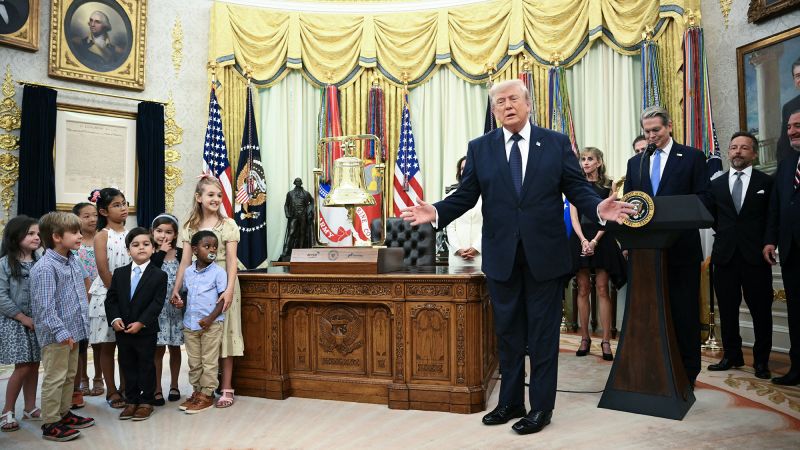
Trump rings opening bell to mark – On Saturday, July 4, 2026, the Trump Accounts, a new savings and investment initiative for children, officially began operations. This marks the first anniversary of the legislation that established the program, which aims to provide a structured way for families to invest in their children’s financial futures. President Donald Trump participated in the event by ringing the opening bell at both the Nasdaq and the New York Stock Exchange from the Oval Office on Monday, symbolizing the start of the accounts’ availability. The ceremony was attended by officials from the NYSE and Nasdaq, White House representatives, and Republican Senator Ted Cruz, who played a key role in advancing the legislation.
A New Addition to Tax-Advantaged Savings Tools
The Trump Accounts have been added to the roster of established tax-advantaged financial instruments designed for children, such as custodial Roth IRAs and 529 plans. These accounts offer distinct rules, limitations, and benefits, tailored to help families secure long-term financial resources for their children. While the program does not simplify the decision-making process for parents, it introduces a fresh approach to fostering early investment habits. The initiative emphasizes the importance of starting financial planning for children from birth, offering a platform for third parties to contribute to their futures and providing federal seed money for newborns.
According to the Treasury Department, over 6 million Trump Accounts have been opened for children under 18 as of the launch. Among these, 1.4 million will receive a $1,000 federal pilot contribution, a feature highlighted as a key component of the program. However, the number of accounts remains relatively small compared to the tens of millions of children who could qualify. Trump, during his remarks, described the accounts as “absolutely incredible for children,” underscoring their potential to shape future generations’ financial landscapes.
“This will be one of the president’s most enduring legacies, and the great bounty of this will go for generations to come,” Treasury Secretary Scott Bessent stated during the event.
The initiative has also garnered support from prominent figures. Michael and Susan Dell, who pledged a $6.25 billion donation to fund the program in December, were present to share their perspectives. Additionally, Brad Gerstner, CEO of Altimeter Capital and the driving force behind the campaign to establish Trump Accounts, addressed the audience. The program’s structure ensures that eligible investments are made through mutual funds or exchange-traded funds (ETFs) that track indices focused on U.S. equities. Annual fees are capped at 0.1% of a child’s assets, meaning a maximum of $1 for every $1,000 invested.
Default Investments and Philanthropy Contributions
As part of the rollout, the Treasury Department announced that the default investment option for all accounts will be the State Street SPDR Portfolio S&P 500 ETF (SPYM), which mirrors the performance of the S&P 500 index. However, parents will have the flexibility to choose from four additional ETFs in the coming months, expanding their options for diversification. This flexibility aligns with the program’s goal of offering a range of financial tools to suit different family needs.
The Treasury also introduced a new feature allowing large philanthropic contributions in the form of publicly available stock to be accepted for Trump Accounts. This means individuals can donate shares they own directly into the accounts, providing a unique avenue for wealth transfer. Notably, SpaceX president Gwynne Shotwell pledged to donate shares of SpaceX to more than two million Trump Accounts, demonstrating the program’s appeal to both private and corporate contributors.
Accessibility and Parental Tools
To monitor their children’s investments, parents can use an app developed by Robinhood, a commission-free trading platform, and the Bank of New York, which was selected to manage the accounts during their initial phase. The app is accessible via the Apple or Google stores, as well as through the official TrumpAccounts.gov website. This digital tool simplifies tracking and provides real-time insights into the account’s performance.
Opening an account requires parents or legal guardians to complete Form 4547 and submit it to the IRS. The process allows families to apply for the $1,000 federal pilot contribution, which is available to children born between January 1, 2025, and December 31, 2028. To qualify, the child must be a U.S. citizen with a valid Social Security number. These requirements ensure the program targets eligible children while maintaining administrative clarity.
Understanding the Program’s Structure
The Trump Accounts are designed to function similarly to existing tax-advantaged accounts but with distinct features. For instance, the federal pilot contribution serves as a foundational investment, reducing the financial barrier for families. This is particularly beneficial for low- and middle-income households seeking to build a financial cushion for their children. The program also allows funds to be used for a variety of purposes, including education, healthcare, and other long-term goals, without restrictions on withdrawal.
One of the primary advantages of the Trump Accounts is their integration with the U.S. financial system. By using ETFs that primarily track returns from U.S. companies, the program encourages exposure to domestic markets while maintaining a low-cost structure. The cap on annual fees ensures that the majority of investment returns are retained by the child, minimizing the impact of management costs over time. This approach aligns with the broader objective of promoting wealth-building opportunities for American families.
FAQ and Next Steps
The Treasury Department has released an FAQ document to address critical questions about the Trump Accounts. This resource covers topics such as taxation rules, how funds can be utilized, and the potential effect on federal benefits. It is intended to help parents navigate the program’s complexities and make informed decisions. For example, the accounts are structured to allow tax-free growth, similar to traditional 529 plans, but with a unique federal contribution component.
As the program gains traction, the Treasury is expected to expand its reach and refine its offerings. The initial phase focuses on establishing a robust framework, with plans to introduce additional investment options and streamline the account-opening process. With the support of major donors and financial institutions, the Trump Accounts represent a significant step toward creating a national initiative for early childhood investment. However, experts note that long-term success will depend on sustained participation and the program’s ability to adapt to evolving economic conditions.
While the Trump Accounts are still in their early stages, their launch has already sparked discussions about the role of government in shaping family financial strategies. The program’s combination of federal support, private contributions, and a simplified investment structure positions it as a potential model for future savings initiatives. As more parents explore this option, the impact on children’s financial futures could grow substantially, making the Trump Accounts a noteworthy addition to the U.S. economic landscape.
