
Death toll rises in Japan. Why does the country experience so many large earthquakes?
Death Toll Rises in Japan: Understanding the Nation’s Earthquake Vulnerability
Goldlaner.com – Death toll rises in Japan once again as the island nation faces another devastating seismic event. Japan sits on the boundary of four tectonic plates, making it one of the most earthquake-prone countries globally. The country also lies on the “Ring of Fire,” a 25,000-mile arc stretching around the Pacific where the world’s most active volcanoes and earthquakes occur.
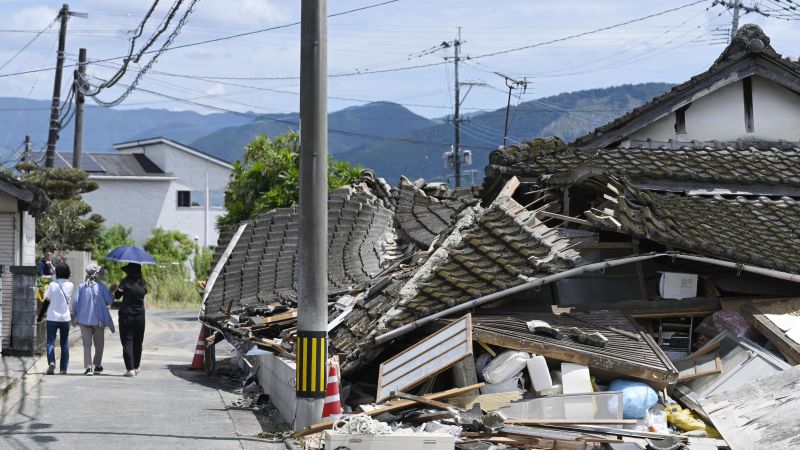
The recent impact of these quakes was on full display this week after a deadly 6.8-magnitude earthquake hit Japan’s southern Kumamoto prefecture. Emergency responders mobilized in thousands for search, rescue, and relief efforts across the affected region.
Current Emergency Response and Casualty Figures
Officials confirmed that the death toll rises in Japan with 34 people having died, though this figure includes some deaths where a link to the earthquake was yet to be confirmed, according to public broadcaster NHK. The earthquake struck around 4:30pm local time in Uki, a city with a population of 56,000 people south of Kumamoto prefecture.
A wave of aftershocks has struck since the main event, with the strongest measured at 5.4-magnitude further south according to USGS data. Authorities warn that similarly strong tremors could shake the region in coming days. Rescuers continue working to locate people trapped beneath rubble, while the quake brought down buildings and a shopping mall in Kumamoto was partially destroyed after a suspected gas leak and explosion.
“For those who are waiting for aid, we will be devoting our full efforts to rescue activities and aid,” Prime Minister Sanae Takaichi said Thursday, adding she’s doing her best to restore electricity in areas affected.
Five people died in Aeon Mall Kumamoto, while several others were killed when a chimney collapsed at a paper factory in Yatsushiro. High temperatures are making rescue efforts increasingly difficult, with authorities warning residents about the dangers of heatstroke and reminding people to stay hydrated.
Historical Context and Future Preparedness
Temperatures are expected to pass 35 degrees Celsius (95 degrees Fahrenheit) from Thursday. The Kumamoto region had just recovered from a larger quake that hit in 2016, causing widespread damage and killing more than 270 people. Japan is well-prepared for disasters like these, having invested billions of dollars into cutting-edge quake detection technology, response and evacuation systems, and quake-proof infrastructure.
For residents, quakes are a regular part of life – children start practicing earthquake and evacuation drills from kindergarten. But the threat looms large in the public imagination, especially with the government regularly warning that Japan could eventually see a once-in-a-century “megathrust earthquake.”
Japan’s history is littered with devastating quakes. Throughout its classical and feudal eras, quakes regularly swept through cities and towns, wiping out structures made of wood and paper that were acutely vulnerable to fires breaking out in the aftermath. One particularly damaging quake in 1498 is thought to have killed more than 30,000 people, though estimates differ.
The Great Kanto earthquake of 1923 was another devastating moment, laying waste to swathes of the capital Tokyo and killing some 140,000 people. Japan began introducing stronger building codes in the 1980s – which demonstrated their effectiveness in the 1995 Kobe earthquake, which killed more than 6,000 people.
Nearly all of the collapsed buildings were built prior to the new codes, kickstarting a major drive to improve the country’s quake resilience, emergency response systems, and retrofitting older buildings with new standards. As one of the world’s wealthiest nations, Japan was in a strong position to embrace technology and spending to fortify itself against the threat of tectonic catastrophes.
Why Does Japan Experience So Many Large Earthquakes?
The 2011 Tohoku disaster remains the worst in living memory – a magnitude-9.1 earthquake and tsunami that triggered the Fukushima nuclear meltdown and killed nearly 20,000 people. Thousands more were never found. It remains one of the strongest quakes of this century.
Smaller quakes can still routinely bring death; a magnitude-7.1 earthquake killed more than 700 in Noto in 2024, western Japan. Other countries such as Chile, Indonesia, the Solomon Islands, and the west coast of the United States all lie on the “Ring of Fire” on either side of the Pacific Ocean.
When these plates move against each other and produce friction, energy builds up and is released through earthquakes. Japan is bracing for a once-in-a-century earthquake. Does it need to?
Local resident Shoji Yonemitsu told CNN: “Why? Why does this keep happening around us here in Kumamoto? The shaking back then was on a whole different level. But yesterday’s quake was still pretty terrifying.”
Frequently Asked Questions
What causes Japan to experience frequent earthquakes?
Japan sits on the boundary of four tectonic plates and lies on the “Ring of Fire,” a 25,000-mile arc around the Pacific where the world’s most active volcanoes and earthquakes occur. When these plates move against each other and produce friction, energy builds up and is released through earthquakes.
How many people died in the recent Kumamoto earthquake?
Officials confirmed that the death toll rises in Japan with 34 people having died, though this figure includes some deaths where a link to the earthquake was yet to be confirmed.
What is Japan’s “megathrust earthquake” warning?
The Japanese government regularly warns that the country could eventually see a once-in-a-century “megathrust earthquake” – a massive seismic event that could cause widespread devastation across the nation.
How has Japan improved its earthquake preparedness over the years?
Japan has invested billions of dollars into cutting-edge quake detection technology, response and evacuation systems, and quake-proof infrastructure. Stronger building codes introduced in the 1980s have significantly improved the country’s resilience to seismic events.
