
Chinese ship shoots water cannon at Philippine vessel with CNN crew on board near flashpoint shoal
Maritime Tensions Escalate Near Scarborough Shoal as Chinese Vessels Target Philippine Ships
Goldlaner.com – A series of confrontations between Chinese and Philippine maritime forces reached new intensity this week, with the latest incident involving water cannon fire directed at Philippine vessels near the contested Scarborough Shoal. The encounter, which occurred on Friday, marked the third such tense situation in the region within a single week, highlighting the volatile nature of this strategic waterway.
Exclusive Access to Philippine Mission
CNN secured unique access to a vessel operated by the Philippine Bureau of Fisheries and Aquatic Resources, which was undertaking a critical mission to deliver fuel supplies to local fishing communities in the vicinity of Scarborough Shoal. This sandbar, claimed by both Beijing and Manila, sits approximately 140 miles west of Luzon and roughly 530 miles from China’s Hainan province. While the shoal may appear unremarkable at first glance, its strategic importance cannot be overstated.
The region serves as a vital corridor for international commerce, with one-third of global maritime trade passing through these waters annually. Combined with the mutual defense agreement between the Philippines and the United States, and China’s ongoing efforts to strengthen its territorial claims, even minor incidents could potentially trigger significant diplomatic or military consequences.
Confrontation Unfolds
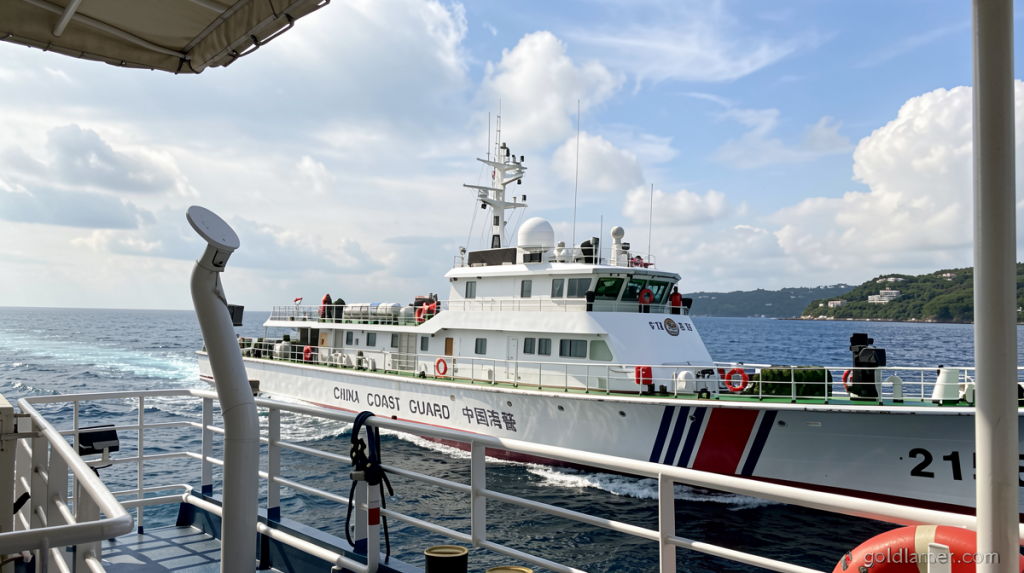
As Philippine ships made their approach to the shoal on Friday, several larger China Coast Guard vessels moved into close proximity, allowing CNN’s camera crew to clearly observe the personnel aboard the Chinese ships. A warning was broadcast over a megaphone: “Leave immediately … Otherwise, we will take firm action in accordance with the law.”
“Leave immediately … Otherwise, we will take firm action in accordance with the law,” the China Coast Guard warned over a megaphone.
The Chinese vessel maintained a continuous circling pattern around the Philippine ship while deploying its water cannon system. According to the Philippine Coast Guard, their vessels “subjected to a series of water cannon attacks and dangerous maneuvers by China Coast Guard.” One Chinese ship approached within seven meters—approximately 23 feet—of the Philippine vessel carrying CNN’s crew, creating what officials described as a “serious risk of collision.”
Numbers and Aftermath
Philippine authorities subsequently reported that 15 Chinese vessels were involved in the incident, comprising both Coast Guard ships and members of the so-called “maritime militia.” The Philippine contingent consisted of 10 ships, including three coast guard vessels, while a small government propeller plane conducted aerial surveillance throughout the mission.
The Philippine ships ultimately decided to abort their mission and return to port, citing weather conditions related to a developing typhoon in the area. Although tensions subsided considerably once the Philippine vessels departed, Chinese Coast Guard ships remained visible in the distance for several hours, continuing to shadow the retreating Philippine fleet.
Official Responses
China’s state media reported that its coast guard “took enforcement measures on Friday in accordance with the law against several Philippine vessels engaged in illegal activities in the waters under China’s jurisdiction around Huangyan Island.” When questioned by CNN’s Mike Valerio regarding the incident, Beijing’s foreign ministry spokesperson Lin Jian defended the actions, stating they were “legitimate and lawful for China to take necessary measures to uphold its rights and security, which is professional, standard, and beyond reproach.”
“Legitimate and lawful for China to take necessary measures to uphold its rights and security, which is professional, standard, and beyond reproach,” said Lin Jian.
Broader Context of Regional Tensions
While the South China Sea dispute has received less attention compared to conflicts elsewhere in recent years, it remains one of the world’s most significant potential flashpoints. China, the Philippines, and Taiwan all assert sovereignty over Scarborough Shoal, though China has maintained effective control since 2012 through a nearly continuous coast guard presence in the surrounding waters.
This week’s confrontation followed an earlier clash at Second Thomas Shoal, another disputed location within the Spratly Island chain. The Philippines maintains a small military contingent aboard the BRP Sierra Madre, a World War II-era vessel that has been grounded at the shoal since 1999. On Monday, Philippine military officials reported that a Chinese Coast Guard ship sent a smaller boat toward the Sierra Madre, prompting the Philippines to deploy two rigid-hulled inflatable boats for escort purposes. Video footage captured what appeared to be eight Chinese personnel ramming one of the smaller Philippine craft, with wooden batons and oars being used in what seemed to be a physical exchange. Two Philippine service members sustained injuries and were evacuated for medical treatment.
The shoal, known as Bajo de Masinloc in the Philippines, features an uninhabited rock formation with a central lagoon and rich fishing grounds in its surrounding waters. Despite its seemingly modest appearance, this corner of the world continues to serve as a deceptively fraught geopolitical hotspot where navigational errors or errant shots could potentially spark serious international conflict.
