
The addictive 8 seconds where ‘nothing else in the world matters’
The addictive 8 seconds where ‘nothing else in the world matters’
The Rodeo Experience
The addictive 8 seconds where nothing – At the sound of the gate creaking open, 14-year-old Johnathon Carlo charges into the rodeo arena, his right hand flailing as he mounts a miniature bull. The crowd erupts in cheers as he tumbles to the dirt, his left wrist pressed against the earth. “You hurt?” a spectator asks. “Nah,” he replies, his voice calm despite the fall. For bull riders, the sensation of pain is secondary to the fleeting eight seconds spent balancing on the back of a bull. Any less than that results in a B/O, a buck off, or a failed attempt. This universal goal unites rodeos worldwide, yet in Australia, the sport takes on a unique character shaped by the vast, unfenced cattle stations that stretch across the land.
Johnathon’s journey is part of a broader effort to bring Australian talent to the global stage. In July 2026, nine young riders from across the nation will travel to Texas for the Youth Bull Riders World Finals, a prestigious event that could transform their lives. Among them is Bella Brinner, a 12-year-old cowgirl determined to “show the boys who’s boss.” Her confidence is matched by Jake Washband, 13, who has been riding since he was seven. EJ Morris and Kobi Evans, also 13, share a similar ambition: to one day claim a world title in the United States. While none of these athletes currently leads the Australian rankings, their families have become crucial allies in their pursuit. A team of passionate parents, through the non-profit Red Dirt Australian Rodeo, has raised funds to support the trip.
“It’s just a great experience for them,” says Clint Morris, a parent involved with the organization. “They get over there and they’re messing with the world.”
Australia’s Rodeo Culture
Australia’s cowboy culture, though less mainstream than its American counterparts, shares many similarities. The term “stockmen” is commonly used instead of “cowboys,” and trainees are referred to as “jackaroos” for boys or “jillaroos” for girls. These nuances reflect a localized yet familiar tradition, one rooted in the hardships of frontier life. White settlers established massive cattle stations, often without fences, to harness the land’s potential. These stations, spanning thousands of hectares, became the backbone of a hardy, rugged culture that persists in rural communities today.
Folk music, cowboy hats, and the sight of trucks creaking over dirt roads are as much a part of Australian rural life as they are in the Midwest. This cultural blend, however, carries a deeper history. For Johnathon, growing up in Cherbourg—a former Aboriginal mission in Queensland—means the sport is intertwined with his heritage. His ancestors were forcibly relocated from their traditional lands to government reserves between 1900 and the 1970s, often under harsh colonial policies. Yet, despite the displacement, they adapted, becoming stockmen who mastered the art of mustering cattle on horseback across vast landscapes.
“The cattle industry, it was built off the backs of my people,” says Damien Bond, a third-generation bull rider from Cherbourg. “Anything to do with horses, cattle, rodeo, we adopted that into our culture, too.”
Pursuing the American Dream
The allure of the United States remains a powerful motivator for many young Australian riders. In Texas, eight seconds on a “bovine athlete” can translate into millions of dollars—just like Troy Dunn, Australia’s sole PBR World Champion, or Brady Fielder, the current U.S. number two. While the dream of international fame drives some, others find fulfillment in the sport’s local impact. The Australian rodeo scene, though smaller, nurtures a fierce passion and resilience that echoes its American counterpart.
Training for the World Finals is a test of endurance. Johnathon, whose family owns a farm, spends weekends driving across Queensland to rodeos, often with his five siblings in the backseat. His mother, Elizabeth Davidson, admits to a mix of anxiety and excitement each time he enters the arena. “Then I get really excited when he rides,” she says. “The way he just looks for his family, and he gives us a wave.” This emotional connection is a common thread among parents who support their children’s ambitions, blending pride with the hope of seeing them achieve greatness.
Competing in the U.S. is no small feat. The journey from Australia requires significant financial investment, with families often funding travel, equipment, and training. Yet, the rewards of success are immense. For example, Troy Dunn’s rise to world champion status has inspired countless Australians to pursue the sport. His story underscores the potential for rodeo to transcend borders and elevate athletes from humble beginnings to international stardom.
Cultural Parallels and Indigenous Legacy
While Australia’s rodeo culture may seem distinct, it is deeply connected to the global cowboy tradition. The same values of perseverance, skill, and camaraderie that define rodeos in the Americas are evident in Australian events. However, the sport also carries the weight of history. In Cherbourg, the legacy of indigenous stockmen lives on. These early practitioners, many of whom were forcibly brought into the cattle industry, used their intimate knowledge of the land to thrive in an environment that was both challenging and transformative.
Johnathon’s own path began at Charlie’s house, where he first learned to ride horses. His brother, Charlie Bond, is a mentor figure in the community, guiding young riders like him. The Bond brothers’ involvement highlights how rodeo is not just a sport but a way of life for many in Cherbourg. The town, once a hub of Aboriginal culture, has become a training ground for the next generation of riders, who carry forward a legacy of resilience and adaptability.
As the sport gains traction in Australia, it faces competition from more popular games like football, soccer, and netball. These sports, with their structured leagues and media attention, often overshadow rodeo’s raw, unfiltered appeal. Yet, the thrill of the 8-second ride remains irresistible. For those who dare to step into the arena, the risk of injury is a small price for the chance to be remembered for a brief, electrifying moment.
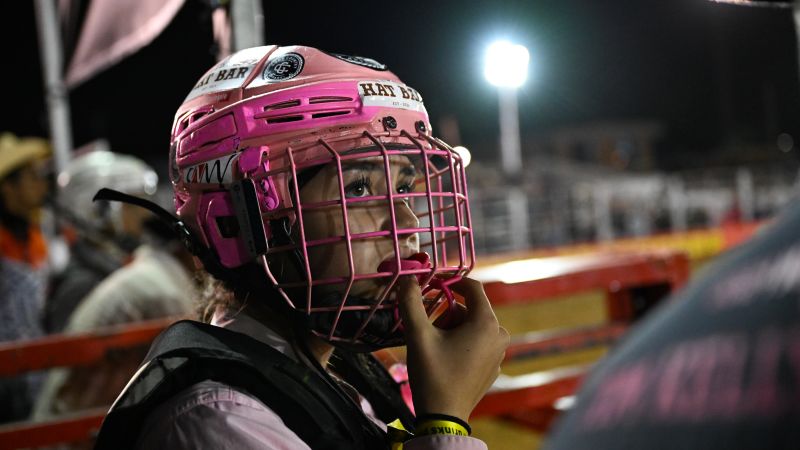
Queensland, the state where Johnathon and his peers compete, is more than twice the size of Texas. Its sprawling landscapes and remote towns create a unique setting for rodeo events. For young riders like Bella Brinner, who lives in Narangba—a semi-rural area north of Brisbane—the sport is a blend of tradition and innovation. Bella, with her pink helmet and chaps, represents the next wave of Australian cowgirls challenging stereotypes and redefining what it means to be a “stockman.” Her favorite bulls, named Ice Cube, Monkey, and Flopp, are more than just animals; they are partners in a high-stakes dance of skill and nerve.
