
Trump’s Freedom 250 gives the founders an AI glow-up
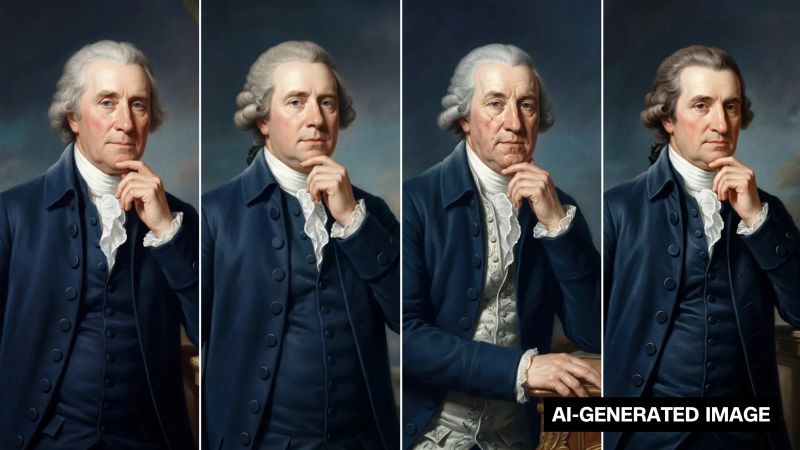
Trump’s Freedom 250 Redesigns Founding Fathers with AI
Trump s Freedom 250 gives the founders – The Freedom 250, a nonprofit initiative launched to commemorate the semiquincentennial of the American Revolution, has embraced artificial intelligence to revitalize historical figures. Among the most striking examples is the digital portrait of Dr. Benjamin Rush, a physician and Founding Father, whose image now features a porcelain-smooth brow, glossy curls, and a faint smile. This modernized version, created by the AI system, diverges significantly from traditional depictions of Rush, who in his lifetime was often portrayed with flat hair and pinched facial features. The updated portrait also includes a subtle methylene-blue hue in his eyes and a posture that suggests contemplation, as if he were about to tilt his head and gesture with an index finger—a pose that feels more contemporary than colonial.
A Digital Reimagining
The project, backed by Trump’s administration, aims to educate the public about the Revolution’s 250th anniversary. However, its approach has sparked debate among historians. While the AI-generated images are visually striking, they blend elements from different eras, creating a sense of unfamiliarity. A digital watermark on each portrait confirms their AI origin, yet the results often seem more like fictional characters than accurate representations. For instance, the 1812 portrait of Rush by Thomas Sully, which showed him with a long downturned nose and a contemplative expression, is contrasted with the Freedom 250 version—a man whose features appear more idealized and polished. This transformation raises questions about how technology reshapes historical narratives.
Historians note that the AI’s uniformity extends beyond Rush. Many of the Revolutionary War-era figures in the gallery now share strikingly similar attributes. Their hairstyles, physiognomies, and clothing choices have been standardized, often resembling the canonical portrait of George Washington by Gilbert Stuart. The AI’s reinterpretation has led to a paradoxical blend of historical accuracy and modern aesthetics. For example, the men in the gallery wear nearly identical blue coats, a detail that contrasts with the varied garments they wore in real life. As Zara Anishanslin, a historian at the University of Delaware and author of “The Painter’s Fire,” explained, “The cut of the shoulders and the cravats in these portraits align more with 19th-century fashion than 18th-century norms.” This shift, she argues, reflects a corporate vision of American history—one that prioritizes consistency over complexity.
The Case of Abigail Adams
Among the most notable examples of AI’s influence is the portrait of Abigail Adams, who died in 1818. Her digital likeness, while detailed, appears slightly anachronistic. Her face, for instance, is rendered with a taut expression and oversized eyes, evoking a more stylized or even anime-like aesthetic. This contrasts sharply with Benjamin Blyth’s 1766 pastel portrait, which captures Adams as a 21-year-old newlywed with almond-shaped features, a slightly hooked nose, and a thin upper lip. The AI version of Adams, however, seems to have undergone an artistic transformation—what Anishanslin calls a “rhinoplasty” and “lip filler”—making her look more refined and youthful. “She doesn’t resemble any available historical images of Abigail Adams,” she said in a recent interview. The result is a figure that feels both familiar and foreign, as if she were plucked from a different era entirely.
Further complicating the project is the inclusion of the “Ladies of the Revolution,” a subset of the gallery that features four women. These portraits often depict them with swan-like necks, snub noses, and nearly identical attire, creating a sense of uniformity that stands out. Isabelle Roughol, a public historian, highlighted the anachronism in a widely shared video. “Dolley Madison, shown as an adult woman, would have been just eight years old during the Revolution,” she noted. This inconsistency is particularly jarring given that Martha Washington, known as “Lady Washington,” is a key figure in the war but appears absent from the gallery. The absence of Martha, along with the altered features of other women, has prompted criticism about the project’s selective representation.
Conformity in Design
The AI-generated portraits are not merely artistic liberties—they reflect a deliberate effort to standardize visual elements. The neoclassical columns and banisters in the background, for instance, are decorative features that align with the Trump administration’s aesthetic preferences. These elements, though common in modern architecture, were rare in Revolutionary-era portraiture, where settings were often more subdued and grounded in the sitter’s immediate environment. The choice to incorporate such designs suggests a broader strategy to reframe historical figures within a contemporary context.
Additionally, the repeated poses in the gallery have drawn attention. Many of the men are depicted with arms crossed over their chests or fingers resting on their chins, gestures that feel more like modern CEO imagery than 18th-century portraiture. Rush’s portrait, for example, combines both poses: his arms are crossed, and his fingers cradle his chin, an arrangement that would have been unusual for the time. Anishanslin pointed out that these poses, while visually cohesive, lack the diversity seen in historical portraits. “The Revolution was a time of change and individuality,” she said, “but the AI’s portrayal suggests a uniformity that may obscure that legacy.”
Historical vs. Artificial Reality
Despite the AI’s ability to create detailed images, some elements feel overly polished. The blue coats worn by the founders, for example, were not a standard feature of their era. In the 18th century, clothing varied widely based on status, region, and occasion. Franklin’s 18th-century portrait by Joseph Duplessis, which showed him in a plain gray coat, is reimagined in the Freedom 250 version as a blue-coated figure with a tightened jawline. This alteration, Anishanslin argues, reflects a desire to project a more streamlined, authoritative image—one that aligns with the Trump administration’s branding.
While the project’s creators aim to make history more accessible, the AI’s uniformity has sparked conversations about its impact. The digital gallery, though visually engaging, may prioritize aesthetics over authenticity. “It’s like modern corporate branding applied to historical figures,” Anishanslin said in a
recent statement
. “The result is a version of the past that feels more like a logo than a living record.” Yet, the project also offers a unique opportunity to explore how technology can reinterpret historical imagery. By blending real data with creative elements, the Freedom 250 challenges viewers to question the boundaries between fact and fiction in visual storytelling.
The use of AI in this context highlights the growing role of technology in historical interpretation. While the project’s goal is to educate, the standardized features of the portraits—such as the identical blue coats and repeated poses—may simplify the complexity of the Revolution. Historians like Roughol and Anishanslin emphasize that this approach, while innovative, risks erasing the individuality of the figures. For example, the AI’s portrayal of Abigail Adams resembles Anne Hathaway in a biopic, a comparison that underscores the departure from historical accuracy. As the project continues to evolve, it will be interesting to see how these digital representations shape public understanding of the past. For now, the Freedom 250 stands as a testament to the power of AI to both revive and reimagine history in ways that are as thought-provoking as they are unconventional.
