
Keiko Fujimori declared winner of razor-edge Peru election
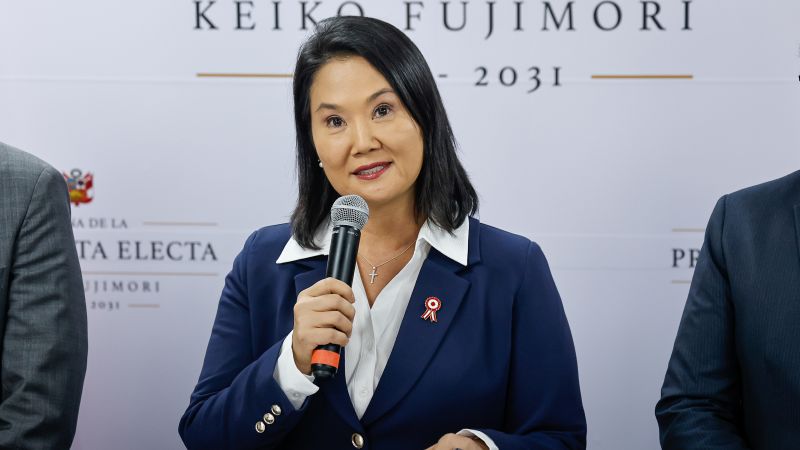
Keiko Fujimori Secures Peru’s Presidency in Tight Election
Keiko Fujimori declared winner of razor – Peru’s electoral body has officially announced Keiko Fujimori as the victor of the country’s presidential race, marking a pivotal moment in a campaign that spanned weeks of intense scrutiny. The outcome, which emerged from a closely contested runoff vote held on June 7, saw Fujimori narrowly surpass her opponent, leftist candidate Roberto Sánchez, by just 49,641 ballots out of approximately 18 million cast. This slim margin of victory has ignited renewed debate about the nation’s political divides, as Fujimori’s Popular Force party secured 50.13% of valid votes to Sánchez’s 49.86%. Her triumph caps a fourth attempt for the presidency, following earlier bids in 2011, 2016, and 2021, all of which ended in defeat.
A Political Journey Through Controversy
Fujimori, 51, has long been a central figure in Peru’s political arena. Her path to the presidency began in 1990, when she became first lady at the age of 19 during her father, former President Alberto Fujimori’s, tenure. The election results, which came after months of delayed counting, underscore her resilience in a deeply polarized landscape. The National Office of Electoral Processes confirmed her win on Friday, with the final tally showing her Popular Force party’s lead over Sánchez’s Together for Peru coalition. The margin, though narrow, has been described as a defining threshold for the country’s future.
Fujimori’s campaign was marked by both fervent support and fierce criticism. Her victory, however, has not only redefined her political trajectory but also signaled a shift in Peru’s governance. She will take the oath as president on July 28, beginning a five-year term that will be accompanied by Luis Fernando Galarreta as first vice-president and Miguel Ángel Torres Morales as second vice-president. This lineup reflects a blend of continuity and change, as Fujimori’s faction aims to consolidate power while addressing longstanding economic and social challenges.
The Legacy of Alberto Fujimori
Fujimori’s ascent to the presidency is inextricably tied to the legacy of her father, whose tenure left a complex imprint on the nation. Alberto Fujimori, a former leader ousted in 2000, was later convicted on charges including corruption, embezzlement, and human rights violations. His ouster triggered a period of political instability that has persisted through multiple administrations. The recent controversial pardon of Alberto Fujimori in 2023 has further deepened the divide, with his daughter’s victory seen by some as a continuation of his influence and by others as a break from his past.
The political tension surrounding Fujimori’s win is not merely historical but deeply current. Her father’s policies, which once brought economic growth to Peru, are now scrutinized for their role in authoritarian practices and inequality. Fujimori, however, has framed her leadership as a new era, emphasizing her commitment to “responsibility, humility, and a profound sense of duty” in a post-election statement. This sentiment, delivered via a message on X, resonated with her supporters, who view her as a stabilizing force in a country grappling with uncertainty.
Sánchez’s Challenge and Electoral Reforms
Despite the official results, the victory has not been without controversy. Sánchez, who had previously expressed skepticism about the electoral process, immediately questioned the validity of the count. He highlighted irregularities in overseas voting and pledged to appeal the decision to the Inter-American Commission on Human Rights (IACHR). His claim, however, was met with swift rebuttals from the National Jury of Elections, which stated that its review found no inconsistencies in the vote tally.
The closely contested race has sparked discussions about the need for electoral reforms in Peru. With the margin of victory so minimal, questions have arisen about the integrity of the voting process, particularly in the context of widespread distrust in institutions. Analysts note that Fujimori’s win could pave the way for significant policy changes, especially in sectors like infrastructure, education, and economic policy, where her father’s legacy was both praised and criticized. The election’s outcome, they argue, may also influence regional dynamics, as Peru’s political stability could affect its relationships with neighboring countries in Latin America.
Looking Ahead: A New Chapter for Peru
Fujimori’s path to the presidency is emblematic of a broader trend in Peru’s political history. Her ability to mobilize a base that has long been disillusioned with mainstream parties has positioned her as a key player in the nation’s evolving political scene. The final count, which was released after weeks of deliberation, has been hailed as a critical moment for Peru’s democratic process. While some celebrate the clarity of the result, others remain wary, pointing to the deep ideological rifts that have shaped the election’s narrative.
As the country prepares for Fujimori’s inauguration, the focus will shift to her administration’s agenda and how it navigates the challenges of a divided electorate. Her campaign promises, which include revitalizing the economy and reducing corruption, will be tested against the backdrop of her father’s legacy. Meanwhile, Sánchez’s legal challenges serve as a reminder of the ongoing political battles that define Peru’s recent past. The nation now watches closely as Fujimori steps into the role of leader, her victory poised to either heal or deepen the fractures in its political system.
“Peru is entering a new chapter, one defined by responsibility, humility, and a profound sense of duty,” Fujimori stated in a post on X after the official proclamation. Her words carry weight, not just for her supporters, but for a country that has long been in search of direction.
The election’s outcome reflects a broader electorate fatigue with political stagnation and a desire for decisive leadership. Fujimori’s margin of victory, while narrow, has been interpreted as a mandate for change, particularly in an environment where voter turnout and engagement have been crucial. As she prepares to assume office, her ability to unify the nation will be a key test of her political acumen. The road ahead is fraught with challenges, but Fujimori’s journey from first lady to president underscores her enduring influence in Peruvian politics.
