
Planet found orbiting a dead star could preview what will happen to our solar system
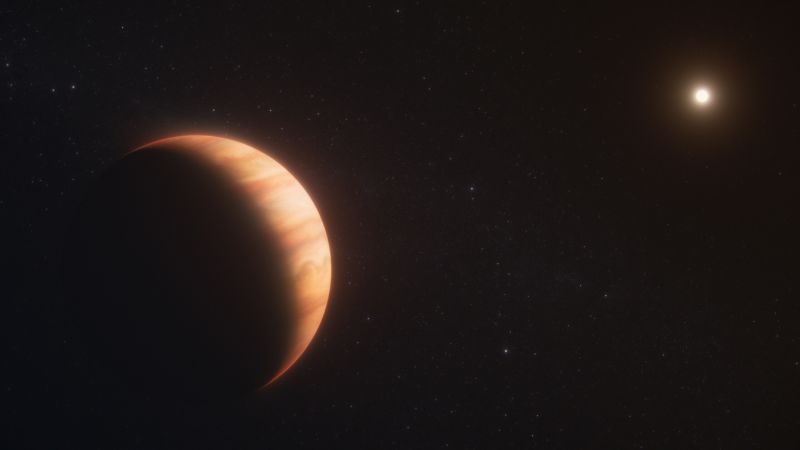
Exoplanet Surviving Dead Star’s Collapse Offers Solar System Preview
Planet found orbiting a dead star – Astronomers have discovered a planet orbiting a dead star, providing a unique glimpse into the future of our own solar system. This exoplanet, named WD 1856 b, was identified in a recent study published in *Nature*, offering insights into how massive planets can persist after their host star undergoes dramatic transformation. The planet’s existence in such a close orbit around a white dwarf—a remnant of a once-sunlike star—raises intriguing questions about the resilience of planetary systems during stellar evolution. As the sun is expected to expand into a red giant and eventually become a white dwarf in about 5 billion years, this finding could serve as a cosmic preview of what might happen to Jupiter and Saturn.
Unveiling the Strange Orbit of a Dead Star’s Companion
The planet, which orbits the white dwarf at a distance less than 2 million miles, completes an orbit every 34 hours. This proximity is remarkable, as it is 50 times closer than Earth’s orbit to the sun. Researchers detected WD 1856 b in 2020 using advanced observational techniques, but its unusual location has sparked debates about its survival. The planet’s mass, estimated to be between four and 11 times that of Jupiter, and its temperature of around 260°F (127°C) suggest a history of extreme conditions. These findings challenge existing models of how planets endure the chaotic processes of stellar collapse.
“The discovery of a planet orbiting a dead star is a game-changer,” remarked Dr. Christopher O’Connor, a coauthor of the study. O’Connor, based at Northwestern University, emphasized that this system exemplifies the unpredictable nature of cosmic evolution. “Understanding how such a planet could survive the destruction of its star is crucial for predicting the fate of our own planetary bodies.”
Observational Challenges and JWST’s Role
Studying WD 1856 b posed significant challenges due to the dimness of white dwarfs compared to their former luminosity. The team relied on the James Webb Space Telescope (JWST) to capture detailed data on the planet’s atmospheric composition and orbital dynamics. “Only the JWST’s advanced capabilities allowed us to measure the planet’s temperature and mass accurately,” said Victoria Boehm, a graduate student at Cornell University. The telescope’s precision was vital in analyzing the brief transits—when the planet passes in front of its host star—lasting just 8 minutes.
Transit timing is critical for confirming a planet’s existence and understanding its characteristics. The narrow window of observation for WD 1856 b highlights the technical demands of studying exoplanets in close orbits. Boehm noted that such transits are “if you blink, you miss it” events, requiring precise instruments and strategic observations. These efforts underscore the importance of cutting-edge technology in unraveling cosmic mysteries.
Theories on How the Planet Survived
Two primary theories attempt to explain how WD 1856 b endured the star’s transformation. The first, the “engulfment model,” suggests the planet was partially consumed during the red giant phase but retained enough mass to remain intact. The second, the “gravitational interaction model,” posits that the planet was pulled inward by gravitational forces from other bodies in the system. Both scenarios indicate that planetary survival is not guaranteed, even in the aftermath of a star’s death.
By combining observational data with theoretical models, scientists have begun to piece together the planet’s history. Its current orbit around the white dwarf implies a journey of cosmic upheaval, possibly involving the star’s expansion and subsequent contraction. This discovery not only deepens our understanding of stellar evolution but also offers a rare opportunity to study the long-term fate of planets in a system that has been reshaped by its star’s demise.
“This exoplanet orbiting a dead star is like a time capsule of our solar system’s future,” explained O’Connor. “It shows us how planets might survive when our sun eventually becomes a white dwarf. The implications are vast, from planetary formation to the survival of life in distant systems.”
