
Justice Department charges two more in alleged plot to attack White House UFC event
Justice Department Charges Two More in Alleged Plot to Attack White House UFC Event
New Arrests Expand Investigation into Potential Threat to Presidential Gathering
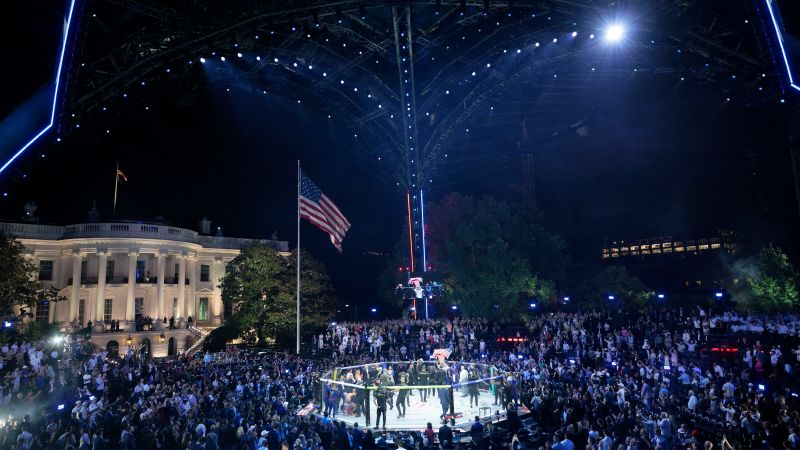
Justice Department charges two more in alleged – Two additional individuals have faced federal charges in connection with a suspected plot to disrupt a UFC fight at the White House earlier this month. The latest arrests add depth to the Justice Department’s understanding of the group’s preparations, indicating they had progressed significantly toward executing the attack. The case now includes detailed accounts of how suspects communicated plans and exchanged resources, shedding light on the level of coordination involved.
The newly charged suspect, Jordan Rincker, was apprehended at his mother’s residence in Missouri on Sunday. According to a criminal complaint, Rincker informed authorities that he believed he had “armed a terrorist” by providing a firearm, a computer, and a 3D printer to another defendant. This exchange was part of a broader effort to assemble drones equipped with explosives, as outlined in the complaint. However, Rincker later claimed he was misled about the group’s intentions, stating he lacked the technical knowledge to construct the drones and had no explosives of his own.
“I was just giving them bullsh*t ideas to make them think I was building a drone,” Rincker allegedly told investigators. “I planned to pocket the money and keep the printer.” The complaint notes that he later said Alvarez gave him the 3D printer to create drones, and he wasn’t certain whether the group intended to load them with explosives, but “from the sounds of everything, that’s probably where this [was] leaning.”
William Lee Spartacus Falkner, another suspect, reportedly engaged in extensive discussions with fellow defendants in a group chat about the logistics of the attack. The messages, detailed in the criminal complaint, reveal Falkner’s confidence in his ability to control over 40 drones simultaneously. He also advised on the selection of explosives, emphasizing the need for materials capable of causing maximum damage. The complaint highlights Falkner’s focus on acquiring drones that could not be remotely jammed by law enforcement and could carry at least 12 pounds of payload.
Messages Reveal Frustration and Strategic Planning
According to the complaint, Falkner’s conversations in early June showed signs of urgency. One suspect warned the group they had only a week before the UFC event to complete their drone preparations, joking, “It’s gonna be a f*cking bloodbath (heartface emoji).” Falkner responded by stating they already had five drones, though the complaint does not confirm whether he actually possessed them. He added, “We’re looking at 200-300$/drone if you want this done right,” according to the documents. Falkner’s comments suggest a calculated approach to the attack, with an emphasis on quality over quantity.
When news of the initial arrests broke last week, Falkner allegedly shared his reaction on Instagram. “Work trip is canceled. My boss got picked up,” he wrote, attaching an article about the arrests. The complaint states that Falkner claimed the article excluded him and others, implying he believed the group had taken precautions. He added, “My phone is jailbroken btw,” hinting at efforts to obscure his communications. Falkner also emphasized his skepticism of the group’s leadership, saying, “We didn’t trust my boss to do this right going into everything,” and that “we all felt something was going wrong.” He further noted, “I’m still being paid,” suggesting his involvement remained active despite the arrests.
Group Structure and Suspect Roles
As the UFC event approached, Rincker was integrated into a private chat by Abraham Alvarez, the alleged leader of the group. Alvarez introduced Rincker as “our manufacturer” and provided him with a 3D printer, a shield, night vision goggles, over $1,000, and a Mac minicomputer. Rincker allegedly shared images of the 3D printer with Alvarez, claiming it was functioning “like a damn champ brother.” However, the complaint indicates Rincker may have been more interested in financial gain than the actual attack, as he described his role in the group as a means to “make them think I was building a drone.”
Rincker also revealed to agents that he had knowledge of a separate plan by Alvarez to target a FIFA World Cup game in Missouri earlier this year. The details of this plot, which may or may not have been linked to the White House UFC event, were shared with the group as part of their broader strategy. Rincker stated he understood the purpose of the investigation but had only joined the group to “want a friend,” according to the complaint. His claim that he had no explosives in his possession raises questions about the group’s overall preparedness.
Both Rincker and Falkner appeared in federal court on Monday, marking the first formal steps in their legal proceedings. The Justice Department has not yet disclosed the specific charges against them, but the complaint outlines their roles in the alleged conspiracy. CNN has contacted their attorneys for further comment. The case continues to unfold as investigators piece together the group’s intentions and the extent of their preparations.
Key to the investigation is the group’s use of digital communication to coordinate attacks. Falkner’s messages in the group chat, which included discussions about drone specifications and explosive options, demonstrate a clear plan. However, the lack of concrete evidence linking him to actual explosives or drones at the time of his arrest suggests the group may have been in the planning phase rather than the execution phase.
While the White House UFC event was the primary target, the group’s ambitions appear to have extended beyond a single attack. Rincker’s awareness of Alvarez’s FIFA World Cup plan hints at a broader network of potential threats. The Justice Department’s ongoing investigation aims to determine whether the group had the capability to carry out the attack and whether their intentions were premeditated or opportunistic.
The case has sparked renewed interest in the security measures surrounding high-profile events at the White House. With the UFC event serving as a focal point, the alleged plot highlights vulnerabilities in the planning process. As more suspects are brought into the fold, the narrative of the attack becomes increasingly complex, blending personal motives, strategic planning, and collective effort.
