
How Ukraine broke through Russia’s air defenses
How Ukraine’s Drone Campaign Upended Russia’s Air Defense Strategy
A Challenging Night in Moscow
How Ukraine broke through Russia s air – In the early hours of Thursday, a coordinated swarm of Ukrainian drones targeted Moscow, exposing the chaos within Russia’s air defense operations. The attack, described as the largest strike on Russian territory since the war’s escalation, revealed a fragmented response from Moscow’s military. Footage captured by CNN and verified by analysts shows soldiers scrambling to deploy portable anti-aircraft systems along a heavily trafficked highway, their efforts disrupted by civilian vehicles passing nearby. The scene was one of disorder, with citizens fleeing as a drone, likely intercepted by Russian defenses, crashed into a structure in a bustling market square.
“The video capturing the firing of man-portable air defense systems (MANPADS) on a busy highway is indicative of a hasty, ad-hoc and frankly unprofessional response to the attack,” said Stu Ray, a senior analyst at McKenzie Intelligence Services. He emphasized the lack of coordination, noting that military equipment was positioned perilously close to civilian traffic, creating a dangerous proximity.
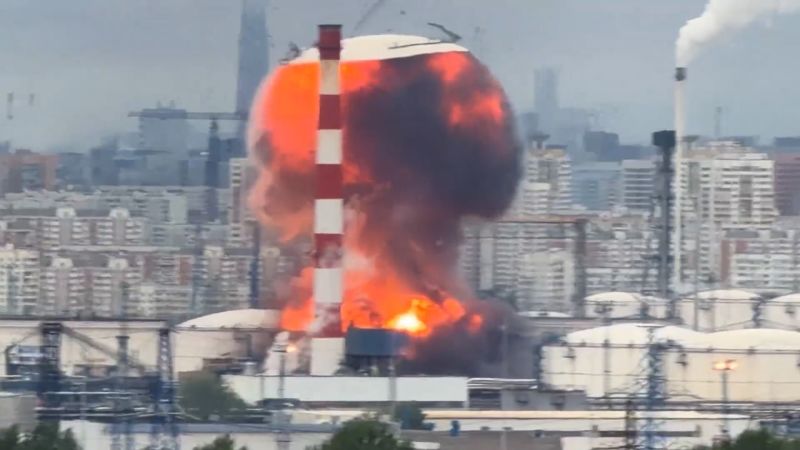
Further evidence of Russia’s struggle came from a separate clip where a defense missile, seemingly intended to neutralize the drones, veered off course and struck an oil storage facility on the city’s outskirts. The impact generated a plume of smoke and a dramatic explosion, with the tank’s upper section torn from its base. A weapons expert from the Stockholm International Peace Research Institute called this a “Russian self-inflicted mistake,” underscoring the growing vulnerability of Moscow’s air defenses.
Strategic Shifts and Escalating Pressure
Ukraine’s strategy has evolved significantly since the war began. Instead of concentrating on border areas, Kyiv has targeted a wide range of locations within occupied zones, forcing Russia to stretch its defenses thin. This approach has led to a more dispersed network of air defense systems, particularly in eastern Ukraine and Russian cities like St. Petersburg, where Ukrainian strikes have targeted critical infrastructure repeatedly.
According to Ukrainian military sources, the shift in tactics has been deliberate. “The goal is to create a multi-front pressure that overwhelms Russia’s ability to respond effectively,” one official stated. This strategy has not only weakened Moscow’s defensive posture but also brought the war closer to home, with strikes now hitting the heart of Russian urban centers. The recent attack on Moscow, which targeted key air defense assets, exemplifies this tactical evolution.
“Russia has a track record of old systems not being 100% reliable,” noted Markus Schiller, a senior researcher at the Stockholm International Peace Research Institute. He argued that the confusion during Thursday’s assault highlighted the limitations of Russia’s air defense infrastructure, which was originally designed to counter larger, faster threats like fighter jets and ballistic missiles.
The vulnerability of Russia’s systems is further compounded by their inability to adapt quickly. Thomas Withington, a military sciences fellow at the Royal United Services Institute, explained that the current air defense architecture is ill-suited for drone warfare. “They were built to engage conventional aircraft and missiles, not the slow, low-flying, and stealthy drones Ukraine has been deploying,” he said.
The Role of Technology and Sanctions
Russia’s reliance on outdated technology has been a critical factor in its defensive shortcomings. Ukraine’s drones, equipped with advanced navigation systems and small, maneuverable designs, exploit gaps in Russia’s radar and tracking capabilities. This has allowed the drones to bypass traditional air defenses and strike high-value targets with precision.
International sanctions have also played a role in limiting Moscow’s ability to upgrade its systems. Withington pointed out that Russia faces challenges in accessing cutting-edge components necessary for modernizing its air defense network. “Even if production can be increased, the existing systems are not sufficient to handle the scale of drone attacks,” he explained. This has created a situation where Russia is fighting a losing battle, relying on older models that are increasingly ineffective against Ukrainian capabilities.
“The complete lack of traffic control during the attack underscores the improvisation in Russia’s response,” said Ray. “They’re using military hardware in areas where civilian populations are concentrated, which raises the risk of collateral damage and further destabilizes their defensive operations.”
Ukraine’s progress in this domain is no accident. The country has invested heavily in developing its drone technology over the years, with its Armed Forces reporting the destruction of 166 Russian “anti-air elements” in 2024 alone. Since the full-scale invasion began in 2022, more than 1,432 such systems have been neutralized, a testament to the sustained effort in this area.
Impact on Russian Morale and Operations
The effectiveness of Ukraine’s drone attacks has had tangible consequences for Russian operations. During the Victory Day celebrations in May, the Kremlin scaled back its public display of military hardware, citing the “current operational situation” as a reason. This decision reflected the growing concern over the threat posed by Ukrainian strikes, which have disrupted supply lines and damaged key facilities.
Despite the challenges, experts acknowledge that Russia is still managing to intercept a significant number of drones. On Friday, the Russian military claimed to have downed 216 Ukrainian drones nationwide, a figure that suggests some level of success in countering the attacks. However, Ukraine’s commander of Unmanned Systems Forces, Robert Brovdi, argued that the Russian capital still maintains over 100 air defense launchers and more than 50 “Pantsir” systems, which are critical to its defense capabilities.
Brovdi’s assessment highlights the ongoing battle between the two sides. While Russia’s systems are not entirely obsolete, they are struggling to keep pace with the evolving nature of the conflict. “The drones are proving to be a game-changer,” he stated. “They allow us to strike without the risk of heavy losses, which is vital for maintaining pressure on the enemy.”
Broader Implications for the War
The success of Ukraine’s drone campaigns has reshaped the dynamics of the war. By targeting air defense systems and forcing Russia to divert resources, Kyiv has created a situation where the enemy is constantly reacting rather than proactively defending. This has led to increased casualties and disruptions in Moscow’s ability to project power.
Moreover, the attacks have amplified discontent among Russian citizens. As the war’s effects become more visible in their own cities, public frustration grows. The combination of military setbacks and the visible destruction of infrastructure has placed additional strain on the government, which is already grappling with economic and social challenges.
As the conflict continues, the question remains: can Russia adapt quickly enough to counter this new threat? Withington believes the answer lies in technological innovation and strategic realignment. “The key is to modernize the air defense network, but without international support, Russia may struggle to keep up,” he said. The future of the war, he argues, hinges on whether Moscow can develop systems capable of effectively neutralizing drones or risk being outmaneuvered by Kyiv’s growing arsenal.
In the meantime, Ukraine’s strategy appears to be bearing fruit. The ability to bypass traditional defenses and strike deep into Russian territory has forced a reevaluation of Moscow’s military posture. As the war enters its third year, the focus on drone warfare signals a new chapter in the conflict—one where speed, precision, and adaptability will define the outcome.
