
G7 leaders — and the rest of the world — wait for clarity on US-Iran agreement
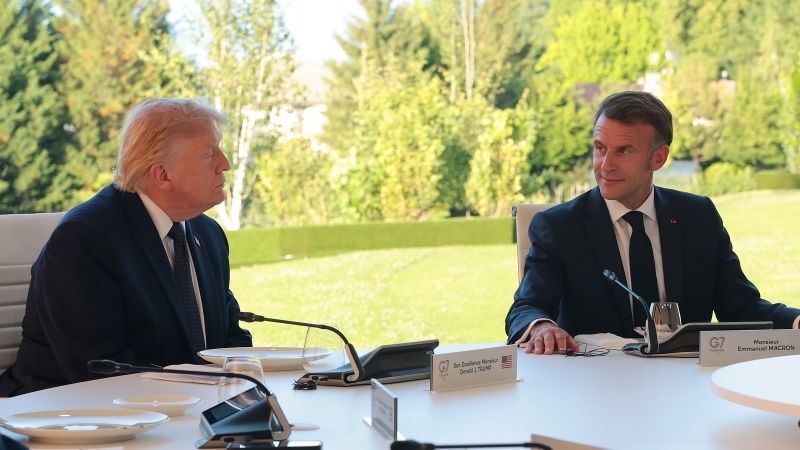
G7 Summit Navigates Uncertainty Over US-Iran Agreement
G7 leaders – As the G7 leaders gathered in the scenic alpine resort of Évian-les-Bains for their annual summit, the focus shifted to an unresolved diplomatic matter: the precise terms of a new US-Iran agreement. The group, comprising the world’s most influential nations, had hoped for clarity during a Monday evening meal overlooking Lake Geneva. However, despite the two-hour gathering, the sun had dipped below the horizon, and some attendees left the dinner with as many questions as when they arrived, according to two officials privy to the situation.
A Pact in Shadows
The agreement, formalized in a virtual signing on Sunday, remains shrouded in secrecy. Neither the US nor Iran has released the one-and-a-half page document, leaving international observers in the dark about its contents. This lack of transparency has resulted in conflicting statements from Washington and Tehran, with officials on both sides offering slightly divergent interpretations of the plan. The absence of a public text has also fueled speculation and confusion among the global community.
One senior US official suggested the memorandum would be unveiled shortly before Friday’s formal signing ceremony in Switzerland. This would allow for a timeline of a day or two to ensure “transparency” before the document is made public. Yet, just a few hours later, President Donald Trump, seated beside French President Emmanuel Macron, hinted at a different timeline. “I want it to be released. So probably pretty soon,” Trump said. “I would say some time after Friday.” His remarks left room for interpretation, as did the statements from his advisors.
“I have asked for days, why can’t we, the people, see the damn MOU? Not through people briefed by an anonymous person. Honestly, I’ve never seen anything like this. If it is a great outcome for peace, then release it,” conservative commentator Mark Levin wrote on X.
Levin’s frustration reflects the broader sentiment among some of Trump’s allies, who are wary of the agreement’s implications. Even within the administration, there is a degree of ambiguity. While the president has frequently praised Levin and his Fox News program, the secrecy surrounding the pact has raised eyebrows. The US is expected to reveal the text soon, but the exact timing remains unclear, creating a sense of anticipation among the G7 nations.
Strait of Hormuz and the Road Ahead
The agreement’s most contentious aspect lies in its treatment of the Strait of Hormuz, a vital waterway for global oil trade. During Monday’s dinner, Trump declared the strait would operate “permanently toll-free,” a statement that contrasted sharply with Iran’s insistence that it would retain control over the passage and impose fees as needed. This divergence has sparked debate, with some European officials expressing concern about the agreement’s future impact on the region.
Vice President JD Vance, the other American signatory, echoed this uncertainty. While the US “expectation” was a strait without tolls, he acknowledged that a final decision would depend on upcoming discussions. “That’s the sort of thing we’ll clarify in future talks,” Vance stated, emphasizing that the current arrangement was a stepping stone rather than a definitive resolution.
The G7 leaders, including Macron, have been eager to review the agreement before Friday’s ceremony. Despite offering public congratulations to Trump for securing the deal, they remain unaware of its specifics. The lack of shared understanding has complicated their ability to make informed commitments, particularly regarding the reconstruction fund for Iran. The US anticipates support from Gulf nations, including Egypt, Qatar, and the United Arab Emirates, which have played a pivotal role in the negotiations. However, without clear details, securing funding for the $300 billion initiative may prove challenging.
Monday’s dinner, originally billed as a chance to “work together to address major international challenges,” highlighted the tension between Trump and his European counterparts. The president, seated between Macron and British Prime Minister Keir Starmer, had been critical of both leaders for their perceived inaction during the Iran war. This dynamic has created a backdrop of strained relations, with some European officials hesitant to fully endorse the agreement without more information.
Trump’s aides had anticipated that the G7 would step up to assist in clearing mines from the Strait of Hormuz, a task they had previously emphasized as crucial for regional stability. France and Britain had both pledged their willingness to contribute, but the absence of clarity on the agreement’s terms has made it difficult to move forward. “Without knowing the exact provisions, it’s hard to commit to specific actions,” said a European diplomat, underscoring the importance of transparency in diplomatic negotiations.
As the summit progresses, the focus will remain on the upcoming Friday ceremony. The formal signing in Switzerland is expected to mark a significant milestone, yet the uncertainty surrounding the agreement’s details persists. The G7 leaders, while hopeful for progress, are acutely aware that their support hinges on the clarity of the pact. With the world watching, the question remains: will the US-Iran deal provide the answers they seek, or will it deepen the divide between the two sides?
