
UK’s ban on Palestine Action under terror legislation was lawful, Court of Appeal says
UK’s ban on Palestine Action under terror legislation was lawful, Court of Appeal says
UK s ban on Palestine Action – The UK government’s decision to classify Palestine Action as a terrorist organization was deemed lawful by the Court of Appeal, which issued its ruling on Monday. This conclusion marked a reversal of an earlier decision by High Court judges in February, who had argued that the group’s actions, while politically motivated, did not justify the use of terror laws. The appeal, which focused on the legal validity of the ban, found that Palestine Action’s activities met the criteria for being labeled as a terrorist entity under the UK’s legal framework.
Key Arguments in the Ruling
Chief Justice Sue Carr, who presided over the appeal, emphasized that the group’s claim of being a non-violent organization was “seriously flawed.” She noted that Palestine Action had employed covert cells to carry out acts of sabotage, targeting defense companies and military installations. “The group’s assertion that it is a civil disobedience organization does not hold up under scrutiny,” Carr stated. “Its methods include the destruction of property, which aligns with the characteristics of terrorist activity.”
“In our judgment, that premise was seriously flawed. It was not a sustainable proposition to portray Palestine Action as a non-violent organization,” Carr said.
The Court of Appeal’s decision cited the group’s historical actions, including a major break-in at a Royal Air Force base in June 2025. This event, which occurred during a protest against British military support for Israel’s actions in Gaza, was pivotal in the government’s case. Activists had infiltrated the base, disrupting operations and highlighting what officials described as a threat to national security. The ruling underscored that such targeted attacks, even if part of a broader political campaign, fall within the scope of terror legislation.
Legal Consequences of the Ban
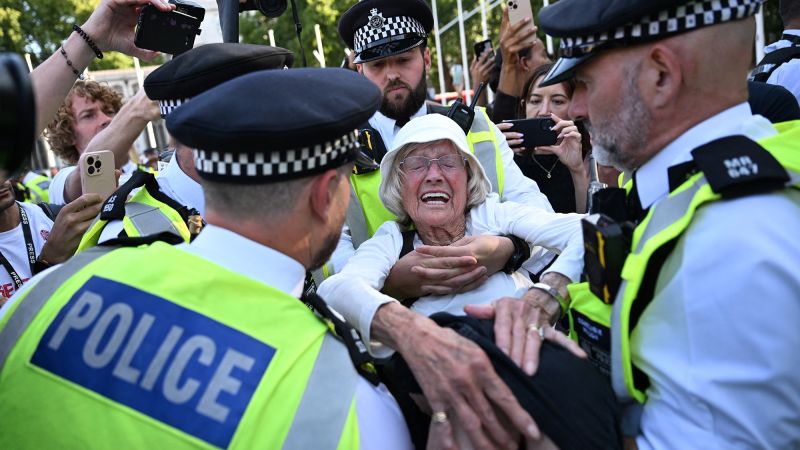
Since its designation as a terrorist organization in 2025, Palestine Action has faced significant legal repercussions. Membership or support for the group is now considered a criminal act, punishable by up to 14 years in prison. Over 3,300 individuals have been arrested at protests for displaying signs that read, “I oppose genocide. I support Palestine Action,” with more than 700 charged under the UK’s Terrorism Act. Notably, no one has yet been convicted, but the legal pressure on protesters has intensified.
Civil liberties advocates have criticized the ruling, arguing that it disproportionately targets peaceful dissent. Defend Our Juries, a prominent group opposing the designation, warned that the decision could lead to the misuse of police resources and the silencing of activists. “It appears the courts have been instrumentalized to suppress opposition to genocide, when they should be doing the precise opposite,” the group stated in a statement following the appeal.
Background on Palestine Action’s Activities
Palestine Action, founded in 2020, has been actively engaged in direct action protests across the UK. These efforts have included breaking into facilities of Israeli weapons manufacturer Elbit Systems UK, an event that took place in 2024 and was cited by officials as evidence of the group’s organized threat. The attack in Bristol, southwest England, involved four members who were later imprisoned for their roles in the sabotage. The case against them was based on their alleged involvement in terrorist acts, despite their claims of peaceful intent.
Supporters of Palestine Action have defended the group’s tactics as necessary to draw attention to the humanitarian crisis in Gaza. They argue that the designation of the organization under terror laws has been used to criminalize dissent and stifle public debate. “The ban represents one of the most extreme attacks on free speech and the right to protest in modern British history,” said Huda Ammori, a co-founder of the group. Ammori vowed to challenge the ruling at the Supreme Court and the European Court of Human Rights, asserting that the decision undermines fundamental rights.
Contrasting Views on the Ban
While the Court of Appeal affirmed the ban, the earlier High Court judges had expressed doubts about its necessity. They had noted that although Palestine Action had engaged in acts of vandalism and property damage, these actions were not of a scale that warranted the application of terror laws. The government, however, argued that the group’s activities, including coordinated attacks on military and industrial sites, posed a clear and present danger to national security.
The ruling has sparked renewed debate about the balance between security and civil liberties. Critics claim that the use of terror legislation against a political group has blurred the lines between legitimate protest and criminal activity. They point to the arrests of over 100 protesters outside the London court during the sentencing of the Elbit attackers as an example of how the law is being applied to suppress dissent. Supporters, on the other hand, argue that the government has overreached, using the legal system to target those who challenge its policies on Israel.
Impact on Protest Movements
The decision to label Palestine Action as a terrorist organization has had a chilling effect on protest movements in the UK. Activists now face the risk of being criminalized for their participation in demonstrations, even if their actions are non-violent. This has led to concerns about the suppression of free speech and the potential for increased surveillance of pro-Palestine groups. The High Court judges had previously acknowledged that some of the group’s crimes, such as vandalism, could be prosecuted independently of the ban, but the appeal judges emphasized the need for a more stringent legal standard.
Despite the ruling, Palestine Action continues to assert its commitment to its cause. The group has vowed to persist in its efforts, even as it faces legal challenges. Ammori highlighted the symbolic weight of the ban, describing it as a tool to intimidate activists and discredit their message. “This ruling is not just about one organization,” she said. “It’s about the broader fight against the erosion of our democratic rights.”
The Court of Appeal’s decision reinforces the government’s stance that the group’s actions meet the criteria for terrorism. Officials maintain that the damage caused by Palestine Action has reached millions of pounds, with its activities directly threatening the operations of defense contractors and military installations. This justification has been central to the government’s argument, positioning the ban as a necessary measure to protect national interests.
As the debate over the ban continues, its implications for the UK’s legal and political landscape remain significant. The ruling has set a precedent for the use of terror legislation in labeling political groups, raising questions about its long-term effects on freedom of expression. For Palestine Action, the challenge is not only to overturn the designation but also to reframe its identity in the eyes of the public and the judiciary.
