
Four UK pro-Palestinian activists jailed over raid at Israeli firm Elbit
Four UK pro-Palestinian activists jailed over raid at Israeli firm Elbit
Four UK pro Palestinian activists jailed – On Monday, a British court handed down sentences to four pro-Palestinian activists, totaling over 20 years of imprisonment, for their roles in a 2024 attack on an Elbit Systems UK facility in Bristol. The incident, which occurred during a period of heightened conflict in Gaza, involved significant damage to the factory and was deemed to have a “terrorism connection” by the judge, leading to extended penalties. The group Palestine Action, which organized the assault, had previously been acquitted of aggravated burglary charges, but the new convictions focused on criminal damage and, in one case, grievous bodily harm.
The Raid and Its Aftermath
The attack took place approximately 10 months after Israel began its bombardment of Gaza in response to a Hamas-led strike in October 2023. During the raid, activists targeted the Elbit Systems factory, causing over £1 million in damage. Specialist military drone equipment, IT systems, and computers were among the items destroyed, according to statements from the company. Elbit claimed the financial loss was partially offset by £1.2 million in insurance reimbursements, though the incident left a lasting impact on staff safety and morale.
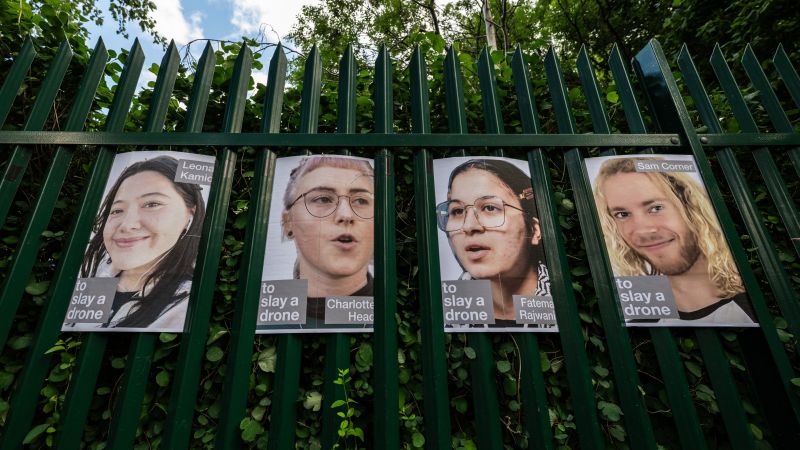
Charlotte Head, 30; Samuel Corner, 23; Leona Kamio, 30; and Fatema Zainab Rajwani, 21, were members of Palestine Action, a group that had been designated as a banned organization under terrorism laws. Despite this classification, the High Court recently ruled that the group’s proscription was unlawful, though the decision remains pending as the government prepares an appeal. The ruling, set for Monday, could affect the legal status of the group and its activities in the UK.
The Judge’s Rationale
Judge Jeremy Johnson emphasized that while Palestine Action was not formally proscribed at the time of the offense, the attack’s connection to terrorism was a key factor in the sentencing. He described the damage as an “aggravating factor” due to its intent to influence British government policy toward Israel. However, the judge also acknowledged the activists’ previous good character as a mitigating element, which influenced the severity of their punishments.
Corners, the youngest of the four, received the harshest sentence, seven years and eight months, for his conviction in the criminal damage case and an additional charge of grievous bodily harm. Prosecutors argued that his use of a sledgehammer to strike a police officer demonstrated “extreme and gratuitous” force, which they claimed was emblematic of the terrorist nature of the assault. Despite his autism, the judge found it insufficient to justify the use of such force.
Kamio and Head were each sentenced to five years for their roles in the criminal damage case, while Rajwani received four years and eight months. All four will serve one additional year on probation after their release. The sentences have sparked debate, with legal experts and rights groups questioning whether the classification of the attack as terrorism was justified.
Legal and Political Context
The case has intensified discussions about the treatment of pro-Palestinian activism in the UK. Lawyers for the activists argue that their actions should not be equated with terrorism, as they had not been charged with any specific terrorist offense. Instead, they emphasized that the group’s primary goal was to dismantle weapons used in Gaza, not to harm civilians.
“Criminal damage has never been treated as terrorism within the UK justice system before,” stated Kerry Moscogiuri, chief executive of Amnesty International UK, in a court statement. “It is dangerous to treat them as the same thing, and the sentences will stay with them for the rest of their lives.” The activists had argued that their actions were a form of protest against Israel’s alleged “genocide” in Gaza, and they disavowed violence against people.
The prosecution’s case relied heavily on the notion that the raid was part of a broader strategy to sway British policy. This perspective has drawn criticism from human rights advocates, who claim the punishment is disproportionate. “It is completely disproportionate to punish protesters for criminal damage as if they were terrorists,” Moscogiuri added. “Such sentences send a chilling message to activists.”
Public Reaction and Broader Implications
Outside the courtroom, the sentences have elicited strong reactions from the public and political figures. Over 100 prominent individuals, including author Sally Rooney, environmental activist Greta Thunberg, and actor Steve Coogan, signed an open letter condemning the decision. The letter argued that linking criminal damage to terrorism could undermine the principle of proportionality in justice, particularly for those engaged in peaceful protest.
Protests against the rulings have also spread beyond the courtroom. Police reported that more than 100 people were arrested for supporting Palestine Action, highlighting the group’s influence and the controversy surrounding its activities. The incident underscores the polarizing nature of the conflict in Gaza and its impact on domestic legal and political discourse in the UK.
The case has further drawn attention to the legal framework used to prosecute pro-Palestinian groups. While the activists were convicted of criminal damage, the term “terrorism connection” has been central to the argument. Critics assert that this classification blurs the line between political activism and violent extremism, potentially allowing broader use of anti-terrorism laws in the future.
Elbit’s Perspective
Elbit Systems, the Israeli defense firm targeted in the raid, presented its own impact statements to the court. The company highlighted the financial loss caused by the damage, which was covered in part by insurance. However, it also stressed the psychological and operational effects on its employees, including a disruption in daily operations and a sense of vulnerability. “The attack not only affected our physical assets but also created a lasting impact on staff safety and wellbeing,” one representative noted.
The activists’ actions were described as a symbolic strike against Israel’s military infrastructure, aiming to disrupt its supply chain and challenge its policies in Gaza. However, the prosecution framed the event as a premeditated act of terrorism, citing the severe damage and the intent to influence government decisions. This interpretation has been contested by the defense, which insists the raid was a non-violent protest rather than an act of terrorism.
Broader Debate on Justice and Protests
The sentencing has reignited debates about the balance between security and civil liberties in the UK. While some argue that the terrorism label is necessary to address threats to national security, others warn of the potential for overreach. The case has been compared to similar prosecutions in other countries, where activists have faced severe penalties for acts of sabotage or property damage.
Supporters of the activists, including high-profile figures, have called for a review of the charges, claiming that the court’s decision sets a precedent for harsher treatment of peaceful dissent. “If we begin classifying all protests as terrorism, we risk criminalizing the voices that challenge power,” said one advocate. The group’s banned status, now under review, adds another layer to the controversy, as the government seeks to justify its use of anti-terrorism laws to target pro-Palestinian movements.
As the appeal for Palestine Action’s proscription approaches its final hearing, the activists’ case remains a focal point for discussions on the intersection of politics, law, and activism. The sentences handed down this week reflect the ongoing tensions between the UK’s legal system and its approach to international conflicts, with implications for future cases involving similar charges. The debate continues, with advocates urging the court to reconsider whether the terrorism connection was truly warranted in this instance.
Outside the courtroom, the activists’ supporters have vowed to continue their campaign, emphasizing the importance of their actions in the broader struggle for Palestinian rights. The raid on Elbit Systems, while a localized event, has become a symbol of the global movement against Israel’s military operations, with its legal and political consequences resonating far beyond the confines of a single trial.
