
The tanks in Cushing, Oklahoma, are hitting bottom. The oil market is about to hit a tipping point
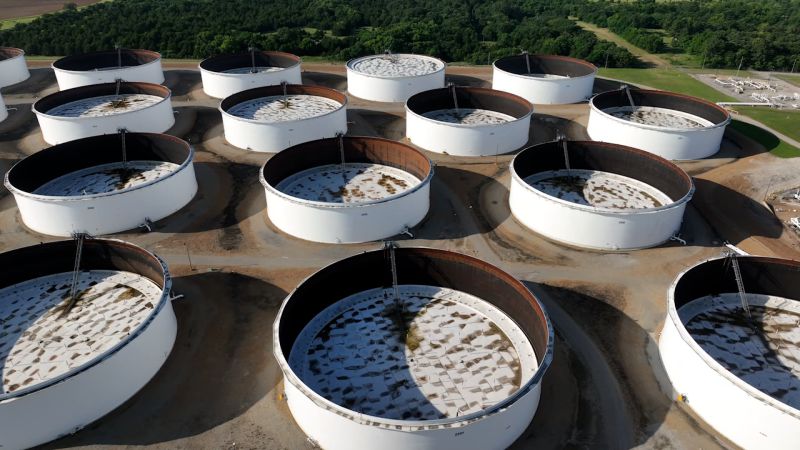
The Tanks in Cushing, Oklahoma, Are Approaching a Critical Threshold
A Hub of Energy, Now in Crisis
The tanks in Cushing Oklahoma are hitting – Oklahoma’s Cushing is often called the global hub for oil transportation. The phrase appears on a large roadside sign constructed from pipes at the intersection of Main Street and South Stiles Road, complete with a valve for dramatic effect. But this isn’t just a catchy slogan. In 1912, Tom Slick, a real-life figure, stumbled upon oil while traveling through Drumright, Oklahoma. He acquired the land for $1 per acre and began drilling, uncovering what would become Oklahoma’s most significant oil well. Today, Cushing serves as the central point for America’s energy infrastructure. It functions as the country’s oil distribution artery, where the West Texas Intermediate (WTI) benchmark is determined and stored before being sent to refineries nationwide.
A Shrinking Reserve
In recent weeks, Cushing’s oil reserves have dwindled to 21.6 million barrels, a figure that has raised alarms. This is perilously near the operational stress limit, a point at which the region struggles to meet demand. When reserves dip below 20 million barrels, they reach a state of near-exhaustion, leaving behind mostly unusable sludge. The implications of this are profound. If Cushing empties entirely, it could trigger a chain reaction in the oil market. Unless the Strait of Hormuz reopens swiftly, the world may soon witness the effects of this vulnerability.
Global Supply Chains Under Strain
The situation is not solely a local issue. US diesel stocks have plummeted to their lowest level since 2003, while gas inventories have also declined by approximately 5% compared to the previous year. Beyond Cushing, commercial crude storage facilities across the country are similarly depleted, with a staggering 7.2 million barrels lost in a single week. Despite these challenges, US oil and gas prices remain subdued, even as the largest crude supply shock in history unfolds. This resilience is attributed to historical global oversupply, which has acted as a buffer. However, that cushion is rapidly disappearing.
What Happens When the System Stalls?
The oil market’s fragility lies in its circulation, not just its volume. “Like blood pressure in the human body, the issue is circulation,” explained Natasha Kaneva, commodities strategist at JPMorgan. “The system doesn’t fail because oil disappears—it fails because the network no longer has enough working volume.” When Cushing’s inventory drops below critical levels, pipelines can’t sustain pressure, and refineries face difficulty delivering the required fuel grades. The result could be unpredictable price swings, with minor disruptions potentially sparking widespread panic.
Historical Precedents and Fears of a Repeat
Cushing’s inventory levels have reached a point reminiscent of past crises. In 2008, 2022, and 2023, similar thresholds triggered historic fuel price spikes. David Oxley, chief climate and commodities economist at Capital Economics, noted that current global oil stockpiles are just 100 million barrels above operational stress levels. This suggests the market is on the brink of a tipping point. “We’re raising alarm bells right now,” said Mike Sommers, CEO of the American Petroleum Institute, during an interview with CNN’s Phil Mattingly on *The Lead*. “We’re getting to levels where we are starting to be concerned.”
The Role of Geopolitical Events
The current shortage is fueled by a shift in global energy dynamics. America has become the last resort for regions that traditionally relied on Middle Eastern oil and fuel. During the Iran war, demand for US crude surged to record levels, overwhelming Cushing’s capacity to replenish. This imbalance has persisted, with oil flowing out of the region faster than it can be replaced. The situation is further complicated by the interconnected nature of the energy market, where a bottleneck in Cushing could ripple across continents.
Long-Term Solutions and Uncertain Outcomes
One potential fix is an export ban, which could help stabilize Cushing’s reserves and prevent a full-scale collapse. However, this solution lacks political momentum and carries risks, including long-term price increases. The alternative is to let market forces dictate outcomes, but that path may lead to rapid and severe consequences. If the current trend continues, the world’s oil market could enter a precarious zone within a month.
Why the Crisis Matters
Cushing’s role as the heart of the US energy market makes its depletion a critical issue. The region’s capacity to store up to 75 million barrels is now under threat, with current levels hovering near 21.6 million. This scarcity could disrupt the flow of oil to refineries, leading to supply chain bottlenecks and higher costs for consumers. The last time Cushing neared this threshold, fuel prices skyrocketed, and the economic impact was felt globally.
A Fragile Balance
The oil market’s reliance on Cushing’s storage capacity highlights its fragility. While the United States has historically been a major producer, the current situation underscores how interconnected global energy systems have become. A minor disruption—such as a pipeline leak or a refinery fire—could escalate into a major crisis, with prices fluctuating wildly. This scenario is not hypothetical; it mirrors the volatility seen during past supply shocks.
Looking Ahead
As the inventory levels in Cushing continue to fall, the urgency to act grows. The Strait of Hormuz remains a key factor, as its reopening could alleviate pressure on the region. However, without immediate intervention, the oil market may face its most challenging test yet. The coming weeks will be pivotal in determining whether the system can sustain itself or if it will succumb to the forces of supply and demand.
The interplay of supply, demand, and infrastructure has never been more evident. Cushing’s near-empty tanks serve as a stark reminder of how delicate the balance is in global energy markets. While the United States has weathered previous crises, the current environment is uniquely volatile. The question now is: how long before the system buckles under the weight of its own dependencies?
“We’re raising alarm bells right now,” said Mike Sommers, CEO of the American Petroleum Institute, during an interview with CNN’s Phil Mattingly on *The Lead*. “We’re getting to levels where we are starting to be concerned.”
The potential for a price surge is real, and the timing could not be more critical. With oil stockpiles in the world’s wealthiest nations now at 2.6 billion barrels, the margin for error is shrinking. At the current rate of depletion—6.3 million barrels per day—the market could reach a breaking point faster than anticipated. This is a moment that demands both immediate action and long-term planning, as the world watches to see whether Cushing can avoid the fate of its past crises.
