
Protesters set vehicles and homes on fire as violence flares over knife attack in Northern Ireland
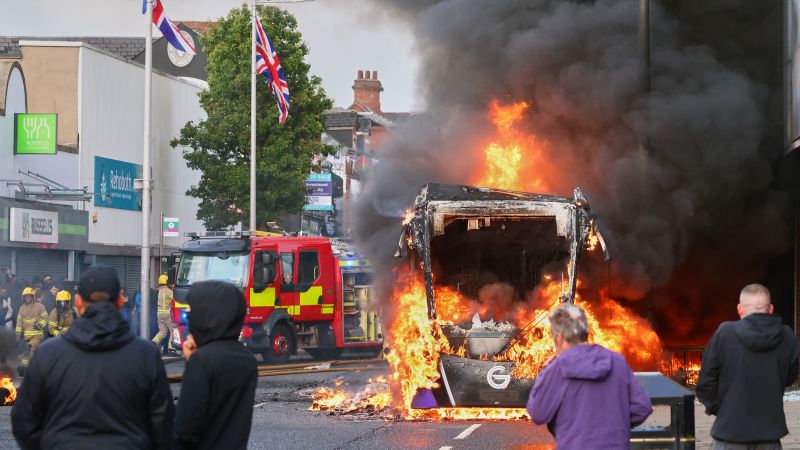
Protesters set vehicles and homes on fire as violence flares over knife attack in Northern Ireland
Protesters set vehicles and homes on fire – A knife attack in Northern Ireland has ignited widespread protests across the UK, with demonstrators in Belfast and surrounding areas taking to the streets in a display of anger and unrest. The incident, which occurred on Monday night in the northern part of the city, left a man hospitalized with severe injuries, prompting authorities to charge a 30-year-old individual with attempted murder. UK Prime Minister Keir Starmer has criticized the attack as “horrific,” emphasizing its impact on public safety and the need for calm amidst rising tensions.
On Tuesday evening, masked crowds gathered in Belfast, targeting homes, a bus, cars, and barricades with fire. The violence spread to nearby Newtown Abbey, where protesters set two vehicles ablaze, according to geolocated video from CNN. In Kilkeel, another car was ignited, underscoring the extent of the unrest. Social media footage verified by CNN shows flames consuming residential areas as emergency vehicles and firefighters rushed to the scene, responding to the chaos.
First Minister Condemns “Outright Thuggery”
Michelle O’Neill, the First Minister of Northern Ireland, described the protests as “outright thuggery,” highlighting the burning of families’ homes. “Groups of masked men are targeting innocent people who simply wish to live, work, and raise their families here,” she stated in a post on X. “Racism, intimidation, and violence are wrong wherever they occur.” Her comments reflect growing concern about the spread of anger beyond the initial attack.
The protests erupted after local police announced the charging of a Sudanese man with attempted murder following the knife attack. The victim sustained injuries to his eyes, back, and face, prompting widespread public reaction. While the attack itself was captured on video by a witness, the footage has since gone viral, showing a man pinning another to the ground before bystanders and police intervene. The incident has become a flashpoint for broader debates about community relations and the role of social media in amplifying unrest.
Broader Protests and Political Context
Smaller demonstrations also emerged in other UK cities, including Bangor, Glasgow, and London. In London, far-right protesters confronted law enforcement, chanting anti-immigration slogans. These gatherings, though less intense, added to the national conversation about the attack’s implications. Meanwhile, Northern Ireland’s Assistant Chief Constable Ryan Henderson noted that the knife attack was not yet linked to terrorism, but emphasized the ongoing investigation into its causes.
Police chief Jon Boutcher urged the public to remain composed, warning against letting social media influence perceptions of Northern Ireland’s communities. “Sporadic pockets of disorder have occurred,” he acknowledged, adding that some vehicles were set on fire during the unrest. “We ask people to protest peacefully and act responsibly,” he said, aiming to encourage calm amid the chaos.
Justice Minister Calls for Accountability
Naomi Long, Northern Ireland’s Justice Minister, condemned the violence, accusing some protesters of “wreaking destruction on the very communities they claim to protect.” “There is no place for masked thugs to threaten, intimidate, and disrupt our neighborhoods,” she stated in a Tuesday night press release. “While I understand the concerns following the attack, hate cannot be allowed to dominate the discourse.” Her remarks underscore the urgency of addressing the root causes of the unrest.
The incident has intensified political divisions, with debates about the connection between the attack and immigration. Kemi Badenoch, leader of the Conservative Party, swiftly tied the violence to “illegal immigration,” though she provided no evidence to support the claim. This linkage has fueled discussions about whether the attack is a symptom of broader societal tensions or a targeted act of extremism.
Historical Precedent and Political Climate
The current unrest echoes similar incidents from a year prior, when Ballymena experienced nights of racially motivated violence after two Romanian teenagers were accused of sexually assaulting a local girl. The charges against them were later dropped, yet the episode left a lasting impact on community relations. This history is now being revisited as the knife attack in Belfast stirs new controversy.
Adding to the political tension, the recent death of Henry Nowak, a white student fatally stabbed in December, has become a focal point for debates about mass migration and its effects on social cohesion. The release of bodycam footage of his death sparked national outrage, with police under scrutiny for their handling of the situation. Far-right leaders were accused of exploiting the tragedy to stoke racist violence for political gain.
Starmer’s response to the knife attack has aligned with his broader stance on protecting democratic institutions from external pressures. “The attack in North Belfast was heinous and wrong,” he said on Tuesday, expressing no tolerance for “abhorrent scenes of violence.” His emphasis on public safety and the role of first responders reflects a commitment to addressing both the immediate crisis and its long-term consequences.
As the investigation continues, authorities are working to determine whether the attack was an isolated incident or part of a larger pattern. The suspect, who has the legal right to reside in Northern Ireland, remains in custody. Meanwhile, the media and public continue to dissect the events, with some fearing that the violence could deepen existing divides. “There is no place for masked thugs to take to the streets and threaten our communities,” reiterated Long, urging unity in the face of discord.
The situation highlights the complex interplay between local events and national political narratives. While the knife attack itself is a tragic occurrence, its aftermath has become a battleground for ideological debates. As protests continue and the investigation unfolds, the challenge remains to balance accountability with the protection of civil liberties. The hope is that the community can come together to address the issues at hand without letting fear and anger escalate further.
