
Poised to accelerate a pivot away from Russia, Armenian prime minister claims election win
Pashinyan’s Electoral Success and Armenia’s Western Shift
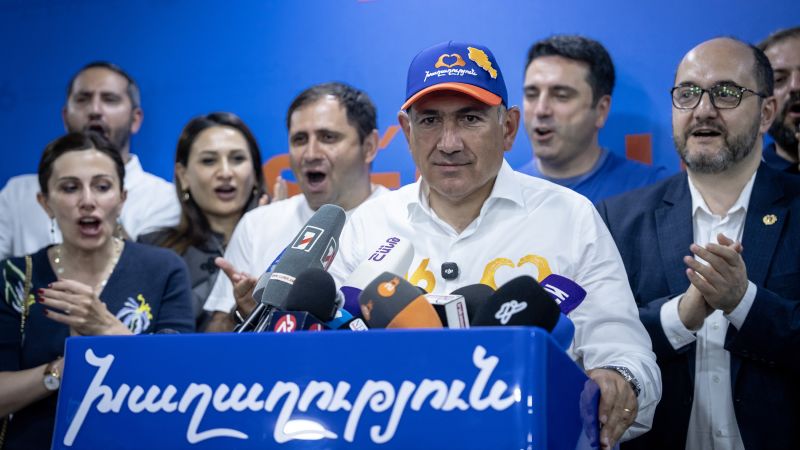
Poised to accelerate a pivot away – Armenia’s Prime Minister Nikol Pashinyan secured a decisive victory in the country’s parliamentary election on Sunday, according to results released by the Central Election Commission on Monday. With 49.81% of the vote, Pashinyan’s ruling Civil Contract party emerged as the clear leader, surpassing the opposition Strong Armenia party. However, the outcome has sparked debate over whether this win solidifies his vision of steering Armenia further from Russia’s influence toward the West. The election, widely regarded as a test of public sentiment toward the nation’s foreign policy direction, now faces scrutiny as the government navigates its next steps.
Geopolitical Shifts and Policy Ambitions
Pashinyan’s platform, which emphasized peace with Azerbaijan, improved relations with Turkey, and closer ties to the European Union, resonated with voters. His government has long sought to reduce dependence on Russia, a key security partner and economic ally, while expanding partnerships with Western institutions. This strategy has drawn criticism from Moscow, which has increasingly pressured Armenia through trade measures. The Kremlin’s import bans on Armenian goods, including fresh produce and spirits, signal a broader challenge to Yerevan’s pivot toward Europe.
Despite the strong result, Pashinyan may not have the two-thirds majority needed to fully implement his reform agenda. Smaller parties must clear a 4% threshold to gain parliamentary seats, and the final distribution of votes remains uncertain. This could limit his ability to push through sweeping changes, particularly in areas like economic restructuring and foreign policy realignment. Nonetheless, the election has been framed as a vote of confidence in his leadership and the path of Western integration.
Trump’s Endorsement and the ‘Trump Route’
US President Donald Trump has publicly supported Pashinyan’s bid for re-election, calling his leadership “a complete and total endorsement” for a new chapter in Armenian foreign policy. In a post on Truth Social, Trump highlighted Pashinyan’s role in advancing a deal that would grant the United States exclusive rights to a transportation corridor through Armenia, dubbed the Trump Route for International Peace and Prosperity (TRIPP). This initiative is part of Trump’s broader vision to position himself as a global peacemaker, leveraging Armenia’s strategic location in the South Caucasus.
“With Nikol’s help, we will bring the United States, Armenia, the South Caucasus, and Central Asia to greater heights than ever before. Make (Armenia) Great Again.”
The TRIPP corridor aims to enhance trade and transit routes between Armenia and the wider world, potentially bypassing Russian-controlled territories. While this project could bolster Armenia’s economic ties with the West, it also risks straining relations with Russia, which has long controlled key infrastructure in the region. Pashinyan’s government has already taken steps to distance itself from Moscow, such as freezing participation in the Russian-led Collective Security Treaty Organization, a move seen as symbolic of its broader strategic shift.
Russia’s Pushback and Historical Context
Russia’s response to Armenia’s growing alignment with the West has been swift and economic. In the weeks leading up to the election, Moscow imposed restrictions on Armenian imports, targeting agricultural and industrial goods. These measures, described by some as “economic coercion,” reflect the Kremlin’s desire to maintain influence over Yerevan. Russian President Vladimir Putin, in remarks prior to the vote, warned that Armenia’s aspirations for European integration could mirror Ukraine’s path to the EU.
“We are currently living through everything that is happening in respect of Ukraine. And how did it start? It started with Ukraine’s joining or attempting to join the EU.”
Putin’s comments echo the historical context of the 2014 annexation of Crimea and the subsequent conflict in Donbas, which began after Ukraine’s pro-European protests led to the ousting of President Viktor Yanukovych. Armenia, though not a direct participant in that crisis, has been steadily moving away from Russian dominance since then. The 2023 military defeat by Azerbaijan in the Nagorno-Karabakh region, which resulted in the displacement of over 100,000 ethnic Armenians, accelerated this shift. The loss exposed vulnerabilities in Moscow’s security guarantees, prompting Yerevan to reassess its reliance on Russian alliances.
EU Support and Strategic Moves
Amid these tensions, the European Union has signaled its commitment to supporting Armenia’s reform efforts. European Commission President Ursula von der Leyen described Russia’s economic restrictions as “nothing short of economic coercion” and announced a package of financial and trade assistance. The EU also plans to ease trade barriers for Armenian products, a gesture aimed at fostering closer cooperation with the country. This support has been bolstered by Pashinyan’s efforts to align Armenia with EU standards, including a recent summit that marked a significant step in their partnership.
Armenia’s outreach to the West extends beyond economic ties. Hosting Ukrainian President Volodymyr Zelensky during the election campaign further underscored Yerevan’s commitment to aligning with NATO-aligned countries. The choice of English as the primary language for their discussions, rather than Russian, has been interpreted as a deliberate effort to reduce Moscow’s cultural and political sway. These actions have not only strained relations with Russia but also positioned Armenia as a key player in the region’s evolving geopolitical landscape.
The Road Ahead
With the election results in hand, Pashinyan faces the challenge of translating public support into tangible policy outcomes. His administration will need to balance its ambitions with the realities of Armenia’s economic dependence on Russia. While the EU’s endorsement and the Trump Route offer promising avenues for diversification, the political and economic risks of this transition remain significant. The 2023 Nagorno-Karabakh conflict serves as a stark reminder of the stakes involved in Armenia’s strategic choices.
As Pashinyan’s government moves forward, the success of its Western pivot will hinge on its ability to secure international partnerships and stabilize domestic conditions. The upcoming months will be critical for testing the resilience of Armenia’s new foreign policy direction. With the geopolitical tensions between Russia and the West intensifying, the country’s decision to deepen ties with Europe could have far-reaching consequences for regional stability and global alliances.
Legacy of the Election
Regardless of the final seat distribution, the election has already redefined Armenia’s political narrative. Pashinyan’s victory underscores a growing public desire for change, even as it highlights the challenges of breaking free from Russia’s orbit. The outcome also reflects a broader trend of the South Caucasus nations seeking to assert their independence in an increasingly polarized world. For Armenia, the path ahead is one of cautious optimism and strategic recalibration, with the hope that its democratic reforms and international partnerships can pave the way for a more secure and prosperous future.
