
Sagrada Família’s 144-year journey nears its end with the Tower of Jesus Christ
Sagrada Família’s 144-Year Journey Nears Its End with the Tower of Jesus Christ
Sagrada Família s 144 year journey – Barcelona’s Sagrada Família has long captured the imagination of visitors, its spiraling towers rising like a cathedral to the heavens. For over a century, the unfinished basilica has stood as a symbol of resilience, defying time and adversity to reach its final form. The completion of the last major structural element—a cross atop the central Tower of Jesus Christ—marks a pivotal moment in the church’s 144-year construction, solidifying its place as the tallest religious structure in the world. This achievement, announced in February, brings the iconic building to its full height of 566 feet, completing a vision that began in the late 19th century and has taken generations to materialize.
A Legacy of Patience and Perseverance
The journey to complete Sagrada Família has been fraught with delays, from the devastation of World War I to shifting political landscapes and funding challenges. Yet, despite these hurdles, the basilica has remained a defining feature of Barcelona’s skyline, its unfinished silhouette a testament to the enduring power of artistic ambition. Now, after decades of effort, the final tower’s installation signals the end of an era. The inauguration, set for Wednesday, will be led by Pope Leo XIV, the 11th pontiff to oversee the project since it began. This event marks not only the culmination of the basilica’s construction but also a centennial tribute to its visionary architect, Antoni Gaudí, who passed away a century ago.
Known for his intricate designs and deep reverence for nature, Gaudí’s blueprint for Sagrada Família was as ambitious as it was unique. The basilica’s complex geometry, inspired by organic forms, required generations of architects to decipher and realize. While the central tower’s completion may seem like the final step, the project still has years of decorative work ahead. However, 2026 is already recognized as the de facto grand opening, a milestone that honors Gaudí’s legacy and the collective dedication of those who brought his dream to life.
The Tower of Jesus Christ: A Symbol of Triumph
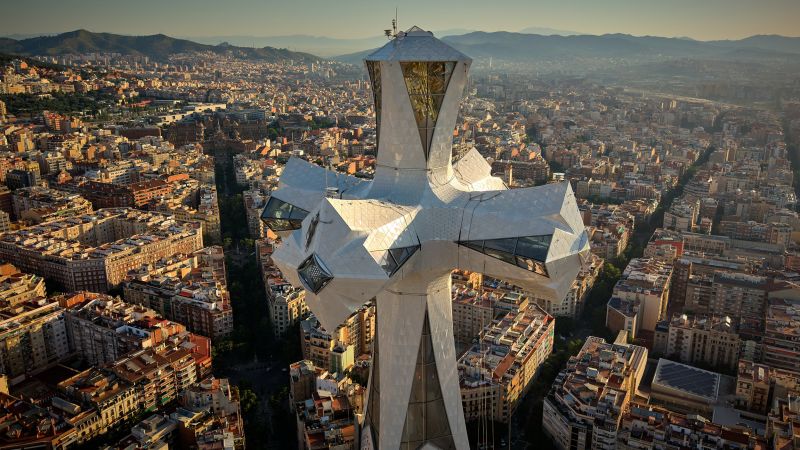
The central Tower of Jesus Christ, the last to rise, stands as the crowning achievement of Sagrada Família’s design. Its cross, a structure as tall as a five-story building and weighing over 100 tons, is a marvel of modern engineering. Crafted from concrete and stainless steel, the cross was shipped in 14 prefabricated sections from Germany, a decision that balanced Gaudí’s original intent with contemporary materials. The latter, though not used in his time, ensured the spire’s lightweight stability, a crucial innovation for its towering height.
Installation of the cross required meticulous coordination. Once in Barcelona, each section was hoisted by crane to a workshop perched 200 feet above the ground, directly atop the basilica’s central nave. There, artisans completed the pieces with stone interiors, enameled white ceramic cladding, and windows made from locally sourced glass. The final assembly and lifting into place was a months-long process, showcasing the blend of historical craftsmanship and modern precision that defines the basilica’s completion.
“Obviously, the times have changed—the technology has evolved, as have the regulations,” said Mauricio Cortés, the architect responsible for the final tower. “But we believe we’re pretty close to his plans for the exterior, for sure. With the interior, as he didn’t define it in detail, there’s more room for interpretation.”
Cortés, like many predecessors, grappled with the dual challenge of honoring Gaudí’s vision while meeting modern engineering standards. The cross, designed to reflect sunlight during the day and glow at night, is a nod to Gaudí’s belief in the interplay of light and architecture. “My client is not in a hurry,” Gaudí once remarked when questioned about completion dates. His client, he implied, was not the developer or the city’s faithful, but God himself—a philosophy that guided the basilica’s creation from its inception.
From Blueprint to Reality
When Gaudí took over the project from Francesc de Paula Villar, who had resigned over a disagreement with the developer, he knew he would never live to see it finished. The scale and intricacy of his designs made that almost inevitable. Yet, he remained steadfast, trusting that the basilica’s completion would be a divine process. The Tower of Jesus Christ, in particular, was a complex puzzle that required decades of work to solve. Its construction began in the early 1900s, and its culmination in 2026 represents the intersection of Gaudí’s original sketches and the ingenuity of modern architects.
The cross’s installation was a critical step in achieving the basilica’s full form. Its white surface, reflecting the intense Spanish sun, is both a nod to Gaudí’s aesthetic and a technical necessity. The use of stainless steel not only reinforced the structure but also allowed for the integration of intricate details, such as the enameled ceramics and stained-glass windows that adorn the building. These elements combine to create a space that is as functional as it is breathtaking, a place where faith and artistry converge.
A Monument to Faith and Innovation
Sagrada Família is more than a church—it is a monument to the enduring relationship between humanity and the divine. Its completion, though not entirely finished, marks a significant turning point. The final tower’s inauguration is a celebration of the countless individuals who contributed to its realization, from the early drafters of Gaudí’s designs to the modern engineers who ensured its structural integrity. The basilica’s soaring spires and vibrant facades tell a story of perseverance, innovation, and artistic excellence.
From the elevated workshop above the central nave, the view of the basilica is nothing short of awe-inspiring. The roof explodes with color, its gables adorned in vivid ceramic mosaics that mirror the natural world. The bell towers on the Nativity and Passion facades rise like monumental walls, each carved with biblical narratives in stone. Atop these towers are pinnacles made of Venetian glass, their shimmering surfaces capturing the light in a way that Gaudí might have envisioned. The completed cross, with its reflective properties, now stands as the basilica’s most striking feature, a beacon that promises to illuminate the skyline for generations to come.
The basilica’s design is a triumph of color and form, blending Gaudí’s organic motifs with the precision of modern construction. The central tower, dedicated to Jesus Christ, is flanked by 17 others—each representing a biblical figure or event. This arrangement reflects Gaudí’s philosophy, which saw the natural world as a source of inspiration for architecture. His use of undulating lines and geometric patterns, often likened to the growth of plants or the flow of water, has been faithfully maintained in the final tower’s structure.
As the last major element of the basilica’s framework is in place, the focus shifts to its interior. While the exterior has been meticulously restored to align with Gaudí’s original vision, the interior remains a space of creative interpretation. The workshops that once served as Gaudí’s design studios now operate under a new team, blending traditional techniques with advanced technologies. This delicate balance between honoring the past and embracing the future ensures that Sagrada Família remains a living testament to its architect’s genius.
The completion of the Tower of Jesus Christ is more than an architectural milestone—it is a cultural and spiritual event. For Barcelona, the basilica has been a symbol of identity and pride, its construction spanning the rise and fall of empires, the tumult of wars, and the evolution of artistic styles. Now, as the final spire reaches its height, the city prepares to welcome a new chapter in its history. The inauguration of the tower, though not the end of the project, signals the beginning of a new era, one where Gaudí’s dream continues to inspire and endure.
