
Ukraine targets Russian navy base near St. Petersburg on last day of ‘Putin’s Davos’
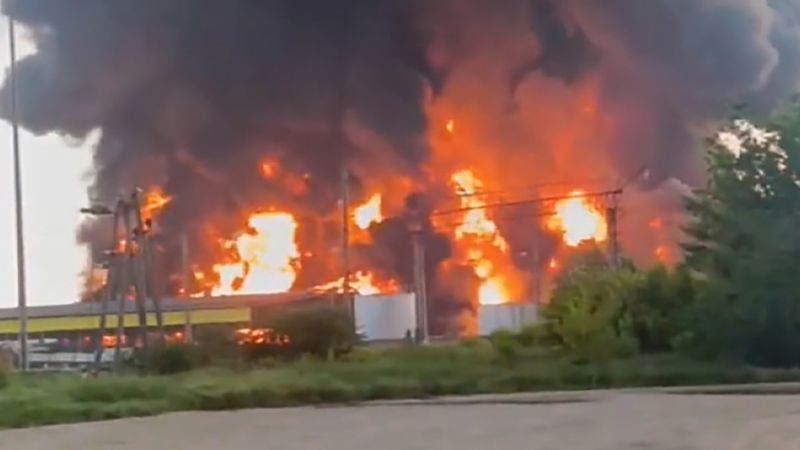
Ukraine Launches Drone Strikes Near St. Petersburg During ‘Putin’s Davos’
Ukraine targets Russian navy base near – On the concluding day of the St. Petersburg International Economic Forum (SPIEF), Ukraine executed a series of coordinated drone attacks targeting key Russian military and industrial sites in the Leningrad region. The strikes, which unfolded early Saturday, focused on naval installations, oil storage facilities, and critical infrastructure, marking a significant escalation in the conflict’s intensity. This event, dubbed by some as ‘Putin’s Davos,’ has drawn global attention as a platform for Russian leaders to engage with international business elites, but it also became the stage for a dramatic display of Ukrainian military capability.
The Kremlin-sponsored forum, held in the Russian city of St. Petersburg, drew hundreds of high-profile delegates, including influential investors and policymakers. However, the same day saw Ukraine’s drones penetrate the airspace of the region, striking multiple facilities. The Ukrainian military confirmed that the attacks targeted naval bases, oil depots, and terminals, with particular emphasis on the strategic importance of these locations. This marks the second major assault on the Leningrad area in recent days, following earlier strikes that had already tested the region’s defenses.
Zelensky’s Strategic Move
President Volodymyr Zelensky of Ukraine provided a detailed account of the attacks, highlighting the reach of his forces. “Our drones traveled over 1,000 kilometers to reach the St. Petersburg region,” he stated, pointing to the destruction of enemy naval arsenals and a base in Kronstadt. The town of Kronstadt, a crucial hub for the Russian navy in the eastern Baltic, serves as both a primary base and a training center for naval personnel. Zelensky’s announcement underscores the strategic intent behind the strikes, aiming to disrupt supply chains and weaken Russia’s military operations.
Meanwhile, the city of St. Petersburg faced immediate consequences. Governor Aleksandr Beglov issued a warning through Telegram, urging residents to remain indoors as the city endured a large-scale drone attack. “St. Petersburg came under a significant assault,” he said, noting that three individuals were injured. The city’s transportation was temporarily halted, with mobile internet services also affected. This disruption highlighted the vulnerability of the region, even as its economic significance as a global financial center remained.
Regional governor Aleksandr Drozdenko confirmed that 141 unmanned aerial vehicles (UAVs) were intercepted in the Leningrad area, with debris scattered across multiple zones. The incident in Bolshaya Izhora, a nearby village, saw over 600 people evacuated as firefighters worked to contain a blaze. CNN’s geolocation analysis of the area verified the presence of a Russian naval arsenal, further emphasizing the targets’ strategic value. The combination of drone strikes and resulting fires has intensified the pressure on Russian supply lines, particularly in the southern and eastern sectors.
Strategic Timing and Economic Impact
The timing of the attacks appears deliberate, coinciding with Putin’s participation in the forum. Zelensky’s earlier open letter to Putin, delivered two days prior, called for an end to the four-year war, positioning the letter as a diplomatic overture. However, Putin’s response was dismissive, labeling the message as “rude” and expressing doubt about its sincerity. A Kremlin spokesperson added that the Ukrainian president could “come to Moscow” if he wished to discuss peace, underscoring the political theater of the event.
Despite the forum’s focus on economic diplomacy, the drone strikes have cast a shadow over its proceedings. The Russian economy, already under strain from Western sanctions, now faces additional challenges as critical infrastructure in key regions is damaged. Zelensky’s campaign to target oil facilities and military bases aims to reduce fuel supplies and amplify economic pressure on Russian forces. This strategy has gained momentum as Ukrainian long-range drones have become more effective in hitting strategic targets, according to military reports.
Earlier in the week, Russia had also launched its own aerial assaults. The Ukrainian military reported that 272 Russian drones were detected overnight on Friday, with 249 intercepted by defense systems. These strikes, primarily targeting Ukrainian territory, indicate a back-and-forth dynamic in the conflict. However, the recent offensive by Ukraine has shifted the balance, with more precise and impactful attacks on Russian installations. The attacks on St. Petersburg and Krasnodar have served as a reminder of the war’s reach, extending beyond the front lines to affect economic centers.
One of the most notable incidents occurred in the Krasnodar region, where a Ukrainian drone strike ignited a fire at an oil depot. Russian emergency services acknowledged the blaze, noting that dozens of people had been evacuated and over 50 fire-fighting units were deployed. While the authorities ruled out a drone attack as the cause, the incident still contributed to the economic strain on Russia. The damage to the Krasnodar facility, described by Ukraine’s security service (SBU) as “at least three tanks containing petroleum products engulfed in flames,” has further complicated the country’s fuel supply chain.
Further away, in the Urals, a separate fire broke out at the Tyumen oil refinery. Officials attributed the incident to a technical malfunction, dismissing claims of a drone attack. Nonetheless, the strikes across multiple regions have demonstrated Ukraine’s growing capability to strike deep into Russian territory. The use of long-range drones has not only targeted oil infrastructure but also military bases and industrial hubs, creating a multifaceted assault on the country’s resources.
As the war enters a new phase, the attacks near St. Petersburg reflect Ukraine’s strategic approach to destabilizing Russia’s economy. The destruction of oil depots and naval facilities has not only disrupted supply chains but also drawn attention to the vulnerability of Russia’s critical infrastructure. The timing of these strikes, during a period of heightened economic discussion, suggests a calculated effort to leverage the forum’s audience and amplify the message of Ukraine’s resolve.
With the forum now behind them, Russian leaders must address the fallout from the attacks. The damage to St. Petersburg and other regions highlights the ongoing challenges in maintaining control over key areas. Meanwhile, Ukraine continues to press its advantage, using drones to target both military and economic assets. This dual approach has intensified the pressure on Russia, forcing the nation to confront the realities of its supply shortages and strategic vulnerabilities.
As the conflict progresses, the role of drones in shaping the war’s trajectory becomes increasingly evident. The ability to strike from a distance, while avoiding direct confrontation, has allowed Ukraine to maximize its impact on Russian operations. The recent attacks near St. Petersburg exemplify this strategy, combining military precision with economic disruption to challenge Russia’s dominance. The forum’s backdrop, where Putin sought to present a vision of stability and growth, now contrasts sharply with the reality of the war’s relentless advance.
