
Kim Jong Un is loving North Korean women’s soccer. What drives its remarkable success?
Kim Jong Un is Loving North Korean Women’s Soccer. What Drives Its Remarkable Success?
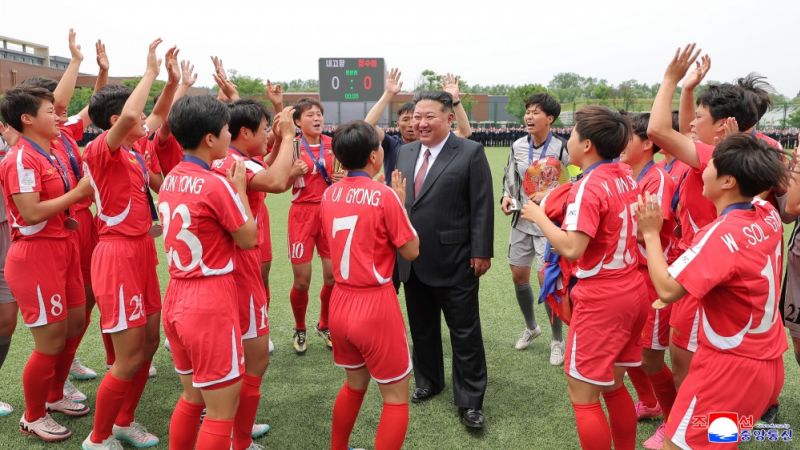
Kim Jong Un is loving North – North Korea’s women’s soccer team has captured global attention with its recent triumph in the Asian Champions League, a feat that has become a symbol of the nation’s athletic prowess. The victory, achieved on South Korean soil, was celebrated with fervor, as players and officials alike expressed pride in their achievement. Kim Jong Un, the supreme leader, was present to honor the occasion, his approval evident as the team members wept with emotion and raised their trophies. This success builds on North Korea’s reputation as a dominant force in youth women’s football, having secured world titles in the under-17 and under-20 categories. The nation’s commitment to developing soccer talent, even amid its isolation, has created a unique pathway for athletes to rise to international prominence.
A Continental Triumph and a Nation’s Pride
Naegohyang Women’s FC, based in Pyongyang, secured the Asian Champions League trophy last month, marking a significant milestone in the country’s sporting history. The victory, which took place in a South Korean stadium, underscored the team’s ability to compete on a continental stage. The achievement is not just a testament to their skill but also to the systematic approach that has fueled their rise. North Korea’s women’s teams are often referred to as “trustworthy women” and “proud daughters of the motherland,” a title that reflects their role in promoting national pride through sport.
“Although our players still lack experience in senior-level international competitions, they have grown significantly as a team,” Kim said after scooping the Most Valuable Player award in this year’s Champions League.
Kim Jong Un’s influence on the team’s success is well documented. According to the state news agency KCNA, the players attribute their achievements to the leader’s “loving care and benevolence,” which they claim has inspired a culture of relentless ambition. The supreme leader’s support extends beyond symbolic gestures; it includes tangible investments in infrastructure and training programs. This dedication has allowed North Korean athletes to compete against some of the world’s best teams, even as the nation remains secretive about its internal processes.
From Youth Academies to Global Stages
At the heart of North Korea’s soccer success is the Pyongyang International Football School, established in 2013 to align with Kim Jong Un’s vision for athletic excellence. The academy trains hundreds of young athletes, aged seven to 17, in a highly controlled environment designed to cultivate talent from an early age. Many of these students have gone on to represent their country at international competitions, with some even transitioning to professional careers. One notable example is Han Kwang Song, a forward for the men’s national team who previously played in Italy. His journey highlights the potential of the system, though it also reveals the challenges of balancing elite training with the demands of international play.
Kim Kyong Yong, the captain of Naegohyang Women’s FC, exemplifies the academy’s effectiveness. Her career, which began over a decade ago, has seen her progress through various age groups, eventually leading her to the senior team. The disciplined structure of the program ensures that players like Kim are exposed to rigorous training, with a focus on both physical development and tactical awareness. Coaches emphasize the importance of teamwork and sacrifice, traits that are drilled into players from their early years.
“When you look at the North Korean teams, the thing that impresses you the most is (that they are) very, very aggressive and very, very hard-working,” Constantine, now manager of the Rwanda men’s national team, told CNN.
Stephen Constantine, a British coach invited to North Korea in 2018 by FIFA, noted the players’ physical toughness. He described an intense training method where athletes would piggyback each other during drills, sprinting from the goal line to the 18-yard line with a teammate on their back. This practice, he said, was “insane” but highlighted the team’s commitment to endurance and speed. While physicality is a key strength, coaches acknowledge the need for technical refinement. Recent efforts to incorporate global sports science data and analyze international matches have aimed to bridge this gap, though the process remains steeped in the country’s unique ideology.
Discipline, Simplicity, and Unmatched Focus
Colin Bell, a former South Korean women’s national team manager, observed that North Korea’s youth teams, particularly the U20 squad, operate with remarkable discipline. “It’s not rocket science, but it’s very well executed,” he remarked, noting the team’s ability to master simple sequences with precision. Bell also praised the players’ “high football IQ,” a trait he believes is cultivated through consistent training and a culture of accountability. The same discipline that serves the youth teams is evident in the senior ranks, where players are expected to adhere to strict routines and perform with unwavering dedication.
Despite the nation’s isolation, North Korea’s women’s soccer program has managed to adapt and thrive. The state-controlled system ensures that athletes are selected and trained with a clear objective: to represent the country on the global stage. This approach has produced results, with teams consistently outperforming their rivals through sheer determination and tactical execution. The success of Naegohyang Women’s FC in the Asian Champions League is a prime example, as it demonstrates the ability of the program to translate training into real-world performance.
As the team prepares for the Women’s World Cup in Brazil, the question of how North Korea can maintain its dominance remains on the minds of analysts. While some attribute the success to the leader’s direct involvement and the nation’s emphasis on collective effort, others point to the systematic training and cultural support that underpin the program. The combination of these factors has created a model that, despite its secrecy, continues to produce exceptional athletes.
North Korea’s women’s soccer story is one of resilience and innovation. In a world where the nation’s isolation often limits its access to global resources, the program has carved out a niche through its rigorous training methods and ideological focus. As players like Kim Kyong Yong prepare for international competitions, their journey serves as a reminder of the power of commitment and the potential for even the most reclusive nations to make their mark on the global sports stage.
