
Book finds its way home 120 years after a library burned down
A Forgotten Book Returns to San Francisco After a Century of Silence
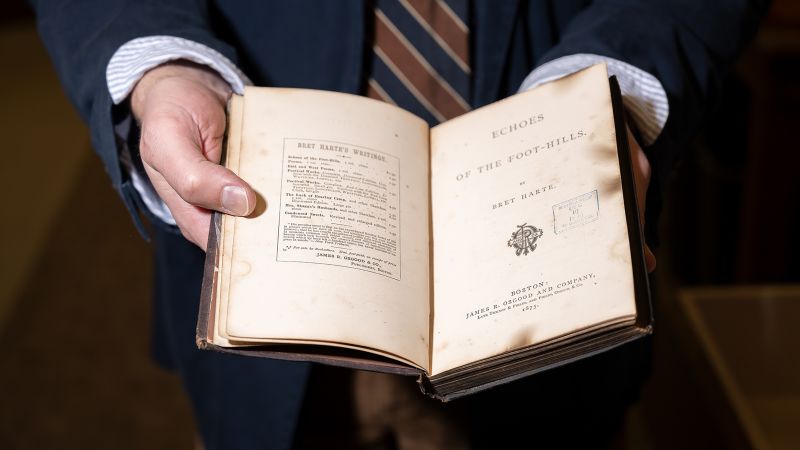
Book finds its way home 120 years – Inside the brittle pages of a charred volume, soot-stained remnants whisper tales of San Francisco’s rise as a golden-era hub. This particular book, once housed in the Mechanics’ Institute, should have been reduced to ash during the 1906 catastrophe. Yet, it endured, and after more than a century, its journey home was recently completed by Randall Schwed, a collector who stumbled upon it during an online auction. The book’s survival remains a puzzle, one that has intrigued library staff and historians alike.
The Fire That Almost Took Everything
The 1906 earthquake and subsequent fires devastated much of San Francisco, including the Mechanics’ Institute. While nearly 200,000 volumes were lost in the blaze, this book somehow escaped. Its presence today is a testament to the city’s resilience, though the exact circumstances of its survival remain unclear. Myles Cooper, the library’s manager, has been grappling with the mystery, noting that the book’s reappearance is as much a symbol of history as it is a curiosity.
“There’s something magical about how this book ended up back where it belongs,” Cooper said. “It’s like a library fantasy, a story that defies the odds.” Schwed, who purchased the book for $35, shared his perspective: “I needed to send it home. What’s interesting about this book is that it’s a survivor.” The question now is: how did it survive the flames that consumed its predecessors?
The Enigma of Agnes Quigley
One clue lies in the name Agnes Quigley, inscribed on the book’s first page. Schwed, who initially sought the owner’s identity, discovered the book’s connection to Quigley through a 1898 advertisement in the San Francisco Call and Post newspaper. The ad, which sought a young woman for domestic work, hints at the book’s possible history. While no evidence confirms whether Quigley was the same person who owned it in the past, the name’s presence suggests a deeper narrative.
Cooper proposed two theories about Quigley’s role. One possibility is that she checked the book out before the fire, carrying it to safety. Another is that she uncovered it in the wreckage, adding her name as a gesture of ownership. “Both theories are plausible,” Cooper acknowledged. “It’s a matter of speculation, but the book’s story is a reminder of how personal items can outlast disasters.” The third theory, however, adds another layer: looters may have salvaged the book during the chaos, preserving it for later discovery.
Other volumes, such as “Marriages, Rights, Customs and Ceremonies,” also survived the fire. That book was in circulation until 2001, offering a glimpse into the institute’s archival efforts. Now, “Echoes of the Foot-Hills” is locked in a display case, alongside an 1854 map of San Francisco that also withstood the earthquake. Nearby, an oversized atlas features illustrations of seismic activity created by pendulums, further enriching the institute’s historical collection.
A Legacy of Education and Rebuilding
The Mechanics’ Institute, located in the Financial District, was founded in the 1850s to provide education for gold miners. Over time, it evolved into a hub for knowledge, eventually merging with the Mercantile Library in January 1906 to become the city’s largest repository of books. Yet, just three months later, the institute lost that title, a casualty of the earthquake that left its structure in ruins.
“Our library was destroyed in ways that many other buildings were not,” Cooper said. “It completely fell down, leaving only a single wall and one brick story standing.” The devastation forced the institute to rethink its future. Rebuilding efforts began almost immediately, with donations pouring in to restore the collection. The surviving books, like the charred one now on display, were vital to San Francisco’s recovery, offering insights into its past and guiding its future.
Cooper highlighted the city’s enduring spirit, noting that the institute’s mission to save history is as relevant today as it was in the 19th century. “It’s part of San Francisco’s DNA to rebuild and rethink,” he explained. “We’ve always believed that people’s stories won’t be lost, and that’s why this book matters.” The institute’s role as a cultural anchor continues to shape the community, preserving narratives that might otherwise fade into obscurity.
The Book’s Journey Through Time
“Echoes of the Foot-Hills” has had three documented owners in its over 150-year lifespan. The first is Agnes Quigley, whose name appears on the book’s first page. The second is Schwed, who rescued it from an online marketplace. The final owner is the Mechanics’ Institute, which now safeguards its legacy. This lineage of ownership adds to the book’s significance, making it a link between different eras of the city’s history.
Cooper believes the book’s journey reflects the city’s broader story of renewal. “Even when everything burns down, there’s a place for history to live on,” he said. “That’s what this book represents—resilience, memory, and the idea that some things just refuse to be forgotten.” The institute’s collection, including the book, now serves as a living archive, bridging the past with the present.
While the exact details of the book’s survival remain elusive, its return to the library is a celebration of perseverance. Schwed’s discovery, though accidental, reignited a conversation about how objects can carry the weight of history. “It’s really kind of like a library fantasy,” Cooper added. “It’s really magical.” The book’s presence in the institute’s display case is a powerful reminder that even in the face of destruction, stories can endure and find their way home.
