
Louisiana lawmakers pass new congressional map to give GOP additional House seat
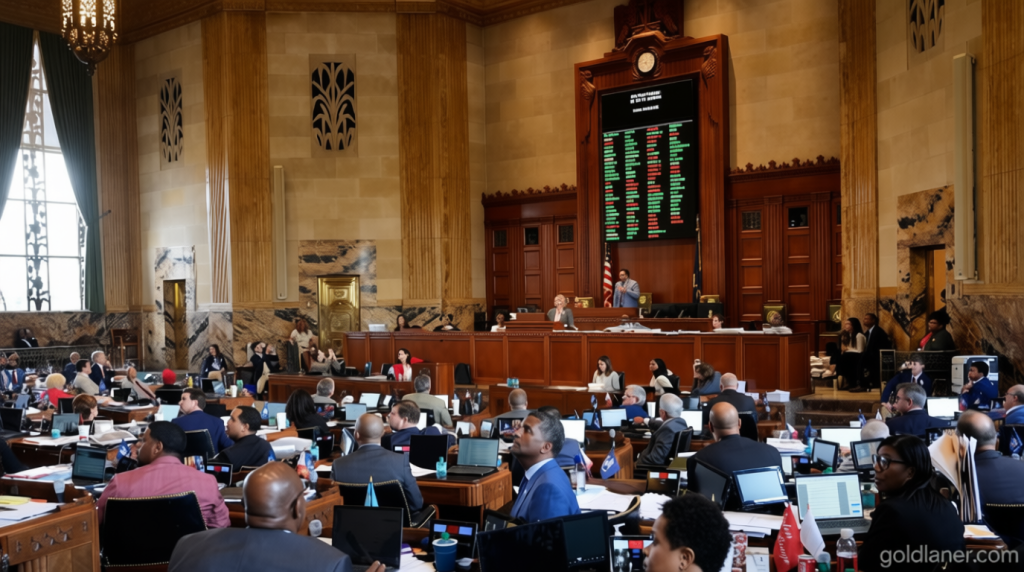
Louisiana legislators approve revised congressional map to bolster GOP majority
Louisiana lawmakers pass new congressional map – In a decisive move, Louisiana lawmakers have finalized a new congressional district configuration on Friday, aimed at securing an additional seat for the Republican Party while removing one of the state’s two historically majority-Black districts. The map, which was signed into law by Republican Governor Jeff Landry shortly after its passage by the state’s Republican-dominated legislature, represents a strategic shift in the ongoing battle over electoral boundaries. With the approval of the updated plan, the GOP now holds four of Louisiana’s six House seats, a position that will be tested in the upcoming November elections.
The impetus for the new map traces back to a landmark ruling by the U.S. Supreme Court on April 30, 2024, which invalidated Louisiana’s existing congressional boundaries as an unconstitutional racial gerrymander. This decision dealt a blow to the landmark 1965 Voting Rights Act, which had previously mandated the protection of minority-majority districts to prevent discriminatory voting practices. The court’s action has reignited a national debate over redistricting, with Republicans leveraging the weakened act to reshape electoral maps in their favor. Louisiana is among several Southern states adopting similar tactics, seeking to maximize their chances of retaining control of the U.S. House of Representatives in the midterms.
The new map, which was approved by the state Senate with a 28-10 vote along party lines, aligns with Republican arguments that a 5-1 distribution of districts is more advantageous for the party. This approach is designed to shield key figures, such as U.S. House Speaker Mike Johnson, from competitive re-election campaigns. However, Democrats have raised concerns, accusing the map of concentrating Black voters—many of whom are registered Democrats—into a single district, effectively diluting their influence. This accusation underscores the tension between partisan gains and racial equity in the redistricting process.
Supreme Court ruling sparks redistricting strategy
The Supreme Court’s decision to strike down Louisiana’s previous map has intensified the redistricting race, particularly as President Donald Trump’s administration worked to secure the GOP’s narrow majority in the House. By weakening the Voting Rights Act, the ruling opened the door for states to redraw boundaries with less oversight, enabling Republicans to pursue maps that favor their candidates. Louisiana’s action follows a pattern seen in other Southern states, where lawmakers have used this legal opening to adjust districts in ways that could shift the balance of power.
While Louisiana’s initial plan had envisioned a 6-0 GOP majority in the House, that goal required incorporating more Democratic voters into Republican-controlled districts. This strategy, however, risked alienating Black communities and potentially undermining the party’s support base. The compromise map approved Friday reflects a more measured approach, prioritizing safety for GOP representatives over a bold six-seat target. This adjustment has been praised by Republicans as a practical solution that avoids overextending their advantage.
Democrats’ accusations and Republican defenses
Democrats have criticized the new map as a racial gerrymander, arguing that it forces Black voters into a single district, leaving them vulnerable to underrepresentation. State Senator Royce Duplessis, a Democrat, highlighted this during the Senate debate, noting that other Southern states like South Carolina had resisted similar changes mid-election year. He called Louisiana’s effort a “vicious race to the bottom,” implying a prioritization of partisan interests over minority representation.
Republican state Senator Jay Morris, the bill’s sponsor, defended the map by emphasizing that party affiliation, not race, should dictate district lines. “I intentionally concentrated more Democrats into District 2 to strengthen the remaining districts for Republicans,” Morris stated during the discussion. He also instructed map demographers to exclude race data from the planning process and to avoid sharing racial statistics with lawmakers before the vote. Morris dismissed Democratic concerns, telling state Senator Sam Jenkins, “I think it’s a racially gerrymandered district that’s going to get us into a lot of trouble here.” Jenkins countered with a sharp remark: “Agree to disagree.”
Under the current map, Louisiana’s congressional districts were structured to ensure two majority-Black districts, a requirement mandated by a lower court in 2024. However, this configuration was challenged in court, and the Supreme Court’s ruling marked its demise. The state is now using a new map that replaces the old one, with the goal of aligning district lines to better reflect partisan trends. Governor Jeff Landry played a pivotal role in this shift, postponing the May 16 closed primary and converting it to an open primary on November 3, giving Republicans ample time to finalize and pass their revised map.
The new map has significant implications for key representatives. Democratic U.S. Rep. Cleo Fields’ district, which spans Baton Rouge and surrounding areas, has been reconfigured to include more white-majority communities. Meanwhile, Democratic Rep. Troy Carter’s district, centered in New Orleans, now incorporates part of Baton Rouge, creating a more racially diverse constituency. These changes are expected to draw legal challenges, with Democrats asserting that the map’s structure disproportionately disadvantages Black voters.
The ACLU of Louisiana has also signaled its intent to file a lawsuit, labeling the map as a “racial gerrymander hiding behind the thin veneer of partisanship.” The organization warned that the fight over the map is far from over, stating, “this battle is just beginning.” The plaintiffs who won the Supreme Court case have similarly criticized the legislature’s decision, pointing out that the new map retains a majority-Black district, which they argue could still be subject to legal scrutiny.
As the November elections approach, the redistricting efforts of Southern states have raised questions about their long-term impact. While Republicans have already secured gains in several states, the outcome of the House race remains uncertain. Democrats, on the other hand, are optimistic about potential shifts in California and Utah, where new district configurations could bolster their numbers. The nationwide redistricting strategy highlights the precarious balance between partisan control and minority representation, as states race to finalize their maps before the voting period concludes.
With the new map now in place, Louisiana’s political landscape has shifted, creating a focal point for debates over fairness and representation. The state’s decision to prioritize Republican interests in the House while altering the structure of majority-Black districts has set a precedent for other Southern states. As the primary election looms, the open ballot format will test the effectiveness of the new map, with voters determining whether the GOP’s redistricting efforts succeed in their goal of securing a majority. The ongoing legal challenges and political discourse surrounding this map signal that the fight for equitable representation is far from over, even as the election calendar moves forward.
