
Rescuers race to reach 7 villagers trapped for a week in flooded Laos cave
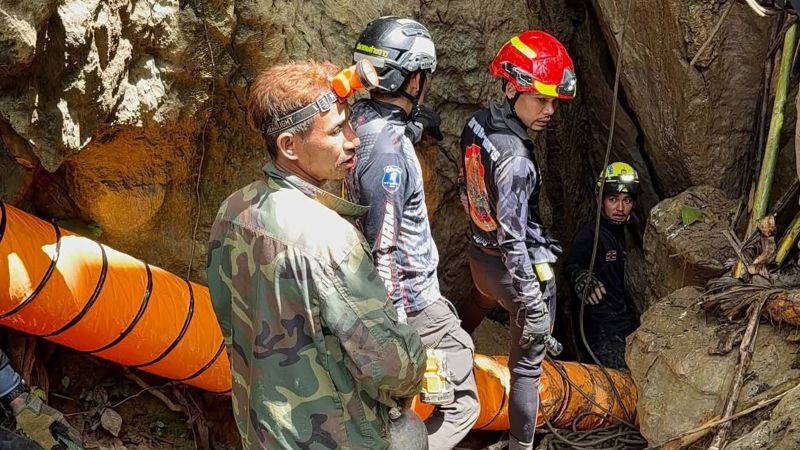
Rescuers Race to Save Seven Villagers Trapped in Flooded Laos Cave
Rescuers race to reach 7 villagers – In a high-stakes mission unfolding deep within the rugged terrain of Laos, a team of cave divers is navigating treacherous, submerged passages to locate seven villagers stranded for nearly a week inside a flooded cave system. The operation, coordinated by multiple international groups, has become a focal point of urgency as authorities and experts work to ensure the survival of those trapped. The challenge lies not only in the cave’s treacherous geography but also in the delicate balance of time and resources required to complete the rescue.
Trapped by Nature’s Fury
Last Wednesday, the villagers embarked on an expedition into the cave located in the central province of Xaisomboun, seeking gold deposits hidden within the mountainous landscape. However, a sudden deluge triggered flash flooding, swiftly transforming the narrow corridors into a labyrinth of water. The exit path was swallowed by rising waters, cutting off the group from the surface. The Associated Press reported that the situation was brought to light by one of the villagers who managed to escape before the floodwaters completely sealed the cave entrance.
According to the state-run Lao News Agency, the trapped individuals are believed to be positioned on an elevated ledge within the cave, which is said to offer a critical advantage—continuous airflow. This detail has given rescuers some hope, as it suggests the environment inside may be survivable despite the challenges. Yet, the journey to reach them remains perilous, requiring divers to traverse a 340-meter tunnel that is partially no wider than 60 centimeters. The narrow dimensions mean that movement is limited to crawling on hands and knees, or even flat on the stomach, in some sections.
Risky Operation with Expert Involvement
The rescue effort has drawn in seasoned professionals, including two Thai divers and a Finnish expert. The latter was instrumental in the 2018 Thai cave rescue of 12 boys and their coach, a mission that remains a benchmark for international cave diving teams. This time, the operation is equally complex, with the divers relying on a combination of advanced techniques and local knowledge. Bongkawong, one of the Thai divers, emphasized the significance of the cave’s specific location: “The ledge they are on is the safest spot,” he said, highlighting the strategic advantage it provides.
The team has also deployed specialized equipment to monitor conditions inside the cave. Helmets equipped with breathing masks and gas detectors are being used to track oxygen levels and detect toxic gases. Additionally, an “airline” system is being employed to channel fresh air into the submerged tunnels, ensuring the trapped villagers have a steady supply of breathable air. Video footage shared on the Facebook page of a Thai rescuer captures the claustrophobic conditions, with divers navigating pitch-black caverns almost entirely submerged.
Challenges and Coordination
The complexity of the rescue is compounded by the cave’s physical constraints. Rescuers must coordinate every movement meticulously, as the tunnel offers no space for crossing. This necessitates a synchronized approach to avoid bottlenecks and ensure safety. The MTK Command and Control Center, one of the groups overseeing the operation, has documented the progress, noting the use of cables laid between rock formations to guide divers toward the lower sections of the cave.
Bongkawong described the entry point as a steep descent, angled at 45 degrees, which requires divers to tilt sideways, duck their heads, and move in a prone position. “It’s so narrow that even the most experienced divers have to navigate with extreme caution,” he explained. The rescue team has also identified four potential shafts above the cave that could serve as access points, prompting the deployment of a rope team to rappel down and explore these routes. However, the success of this plan depends on the coordination of efforts both inside and outside the cave.
Historical Context and Local Insights
While the current rescue bears similarities to the 2018 Tham Luang cave disaster, it is distinct in its challenges. Bongkawong, reflecting on the two operations, noted: “Tham Luang was difficult to search; this cave is difficult to access.” The 2018 mission involved a multi-national team that worked tirelessly to save the boys and their coach, a feat that captured global attention. Now, the focus is on the survival of the villagers, whose actions were driven by the lure of gold.
The escaped villager, who provided crucial information about the cave’s layout, is a local who understands the terrain intimately. He managed to wade through the water and force his way out, an action that Bongkawong described using a unique term from the local dialect—“boo out.” This phrase, which translates to a specific method of exiting, underscores the importance of regional expertise in such operations. Despite repeated warnings from authorities, villagers continue to venture into the cave, drawn by the promise of mineral wealth.
Coordinated Efforts and Hope for Survival
Efforts to pump water out of the tunnels are ongoing, aiming to create clearer paths for the rescue teams. The operation has involved not only divers but also a network of local and international volunteers working in unison. The Lao News Agency reported that the accurate map of the cave, created by Bongkawong, has been a lifeline for the team. “Given the geography and the conditions of the victims, if they are in that specific area, their chances of survival are very high,” he stated in a quote shared with CNN.
The situation has also sparked attention from the global community, with CNN reaching out to Laos’ Ministry of Foreign Affairs for further details. As a one-party communist state, Laos maintains tight control over information dissemination, adding an element of anticipation for updates. The villagers’ ordeal has brought to light the risks of exploring caves in pursuit of gold, a practice that, while rewarding, can lead to life-threatening circumstances.
A Test of Resilience and Precision
The rescue operation in Xaisomboun province is taking place near the village of Long Tieng, a region known for its expansive valleys and mineral-rich landscapes. The mountainous environment adds to the difficulty, with its unpredictable weather and remote access points. Despite these obstacles, the team remains optimistic, leveraging both technology and human ingenuity to navigate the submerged corridors.
As the divers prepare to descend further into the cave, the stakes are high. The survival of the seven villagers hinges on the success of this mission, which has become a blend of science, strategy, and sheer determination. With every step taken through the waterlogged tunnels, the rescuers are not only seeking to save lives but also to reinforce the resilience of communities that continue to brave nature’s challenges in search of opportunity.
The operation is a reminder of the delicate interplay between human ambition and natural forces. While the villagers sought gold, their journey has become a race against time, with the international team working tirelessly to ensure they emerge from the cave unharmed. As the search continues, the world watches closely, inspired by the same spirit that saved the Thai soccer team in 2018.
