
Why did T. rex have tiny arms? A new study may finally have the answer
Why did T. rex have tiny arms? A new study may finally have the answer
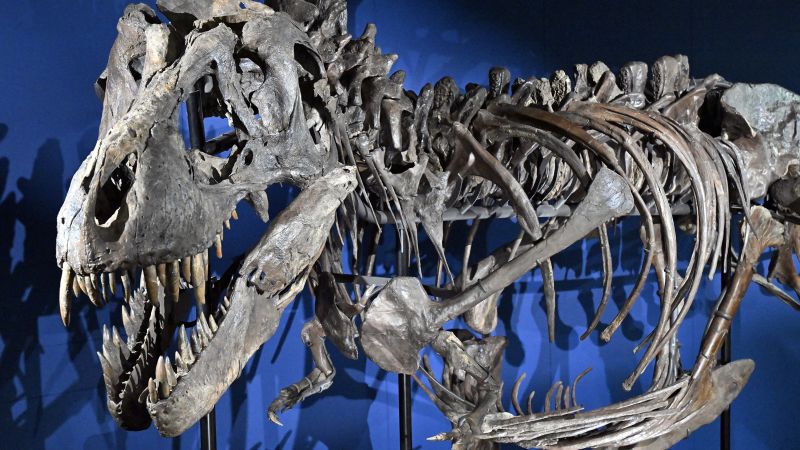
Why did T rex have tiny – Tyrannosaurus rex, the apex predator of its era, has long puzzled scientists with its disproportionately small forelimbs. These slender limbs, measuring roughly 3 feet in length, seem incongruous with the dinosaur’s massive body, which could exceed 40 feet in size for adult specimens. For decades, researchers have debated the purpose of these arms, often drawing comparisons to their more formidable relatives and suggesting they were either evolutionary leftovers or functional tools. A breakthrough study, published May 20 in the journal Proceedings of the Royal Society B, claims to resolve this enigma by proposing a unified explanation rooted in the dinosaur’s anatomy and hunting strategy.
The evolutionary trade-off of strength and size
According to the findings, T. rex’s arms were not a vestigial trait but a result of an evolutionary trade-off. The study, led by Charlie Roger Scherer, a doctoral student in Earth sciences at University College London, analyzed 85 dinosaur species to uncover patterns in body structure. The key insight emerged from a correlation between the development of massive, robust skulls and the reduction in forelimb size. “When a dinosaur invests heavily in a powerful skull, it often sacrifices arm length,” Scherer explained. This dynamic, he noted, reflects how natural selection directs resources toward traits that offer survival advantages.
“If you’re a dinosaur with a very strongly constructed skull, chances are you’re going to have very small forelimbs,” said Scherer. “It doesn’t really matter how big you are—whether you weigh 1 ton or 10 tons. A strong skull takes precedence over longer arms.”
The researchers argue that evolution doesn’t allocate energy evenly across all body parts. Instead, it prioritizes features that enhance survival. For T. rex, the skull became the primary weapon in subduing large prey. This adaptation, they claim, allowed the dinosaur to focus its biological resources on strengthening its bite force and skull structure, which in turn rendered the arms less critical. “Everything was approached headfirst,” Scherer added. “The head became the point of contact with prey, and that was the most efficient way to evolve.”
Historical theories and the new evidence
Before this study, several hypotheses had attempted to explain T. rex’s diminutive arms. Early theories suggested they might have been used to grasp prey, assist in mating rituals, or even as a means of balance. More recent models proposed that the arms shrank to minimize the risk of injury during feeding, as larger limbs could be more vulnerable to bites from struggling prey. However, these ideas lacked statistical backing, leaving the question unresolved.
The new research, by contrast, identifies a consistent trend across multiple dinosaur groups. By examining skull strength, limb proportions, and prey dynamics, the team found that large, strong skulls often coincided with reduced arm size. This pattern, they argue, was not limited to tyrannosaurids but extended to other carnivorous dinosaurs, including ceratosaurids, megalosaurids, abelisaurids, and carcharodontosaurids. These groups, which spanned diverse environments from the Triassic to the end of the Cretaceous, shared a similar evolutionary strategy: allocating resources to skull development at the expense of forelimbs.
Methodology and global scope
To validate their hypothesis, the study combined fossil data with existing scientific literature, measuring both skull bones and forelimb structures across 85 species. Researchers developed a novel approach to quantify skull strength, analyzing factors like bone density, skeletal architecture, and bite force. This allowed them to rank species on a scale of skull development, with T. rex emerging as a top performer. The second-highest scorer was Tyrannotitan, another formidable carnivore that thrived in Argentina during the Early Cretaceous, some 30 million years before T. rex’s heyday.
The study’s global perspective reveals that this trend was widespread. The species analyzed lived in regions as varied as South America, Africa, and Asia, spanning the entire Mesozoic era. “This wasn’t an isolated case,” Scherer emphasized. “It’s a pattern that occurs in different, unrelated groups over millions of years, suggesting a broader evolutionary mechanism.” The findings challenge the notion that T. rex’s arms were merely an afterthought, instead framing them as a deliberate adaptation in response to prey size and environmental pressures.
Evolutionary pressures and prey adaptation
The research highlights how predators evolved to counter increasingly powerful prey. As dinosaurs like T. rex targeted larger animals, their skulls grew stronger to deliver crushing bites, while their arms became smaller to conserve energy. “The arms were no longer essential for hunting,” Scherer explained. “Once the skull could handle the job, the arms were left to shrink.” This process, however, varied among species. Some dinosaurs reduced their fingers first, while others shortened their forearms entirely, indicating different paths to the same evolutionary outcome.
The study also underscores the role of competition in shaping these traits. For example, during feeding frenzies, larger skulls provided a distinct advantage in subduing prey, reducing the need for long arms. “It’s an arms race,” Scherer said. “As prey grew bigger, predators had to adapt by making their primary weapon—skulls—more effective.” The result was a gradual shift in body proportions, with skulls dominating the evolutionary narrative while arms became secondary features.
This pattern aligns with previous observations about the relationship between skull size and limb reduction in carnivorous dinosaurs. However, the current study is the first to establish this correlation across five distinct groups, offering robust statistical support. The researchers found that species with the largest skulls consistently had the smallest arms, regardless of their overall size. This suggests that the trade-off was a universal strategy, not a random occurrence.
Implications for dinosaur evolution
The study’s implications extend beyond T. rex, shedding light on how dinosaurs adapted to ecological challenges. By focusing on skull development, these creatures optimized their hunting efficiency, a trend that persisted for over 180 million years. “It’s a testament to how evolution can prioritize certain traits,” Scherer noted. “Even if the arms were small, they served a purpose in the context of the whole body.”
While the arms may not have been the primary weapon, their presence likely played a role in other aspects of T. rex’s biology. For instance, they could have been used to manipulate prey or stabilize the dinosaur’s massive body during movement. The study does not rule out these secondary functions, but it positions the arms as a byproduct of skull evolution rather than an independent adaptation. This distinction is critical for understanding the broader patterns of dinosaur morphology and the trade-offs inherent in survival strategies.
With the new evidence, the debate over T. rex’s arms may finally reach a resolution. The study suggests that the dinosaur’s tiny limbs were not a flaw but a calculated response to the demands of its hunting lifestyle. As Scherer put it, “The arms were an evolutionary compromise—strong enough to do the job but not so large as to divert resources from the skull.” This insight could reshape how scientists view the anatomy of other ancient predators, revealing a shared evolutionary path driven by the need for powerful, efficient hunting tools.
